
Most corporate events produce a mountain of footage and a trickle of impact. The real problem is not the camera quality or the crew size. It is the absence of a deliberate narrative. When organizations invest in corporate event coverage Malaysia without a story framework, they end up with highlight reels nobody watches and panel recordings that collect dust on a shared drive. HubSpot reports that 54% of consumers want to see more video content from brands they support, yet the majority of event footage fails to meet that demand because it captures activity instead of meaning. This article shows you exactly how to fix that.
Table of Contents
- Quick Takeaways
- Why Most Corporate Event Coverage Fails
- Defining the Narrative Arc Before the Event Starts
- Brand Video Strategy Building Blocks
- Event Video Production Decisions That Shape the Story
- Turning a Single Conference Into Multiple Content Assets
- Measuring Whether Your Story Actually Worked
- Frequently Asked Questions
- References
Quick Takeaways
| Key Insight | Explanation |
|---|---|
| Narrative must be planned before filming begins | Without a defined story arc, editors are left guessing what the event was supposed to mean, producing generic footage rather than a compelling brand story. |
| One event should produce at least five distinct content pieces | A single corporate conference can yield a keynote cut, an attendee sentiment reel, a social teaser, a leadership interview, and a post-event recap if planned correctly from the start. |
| Interview subjects are your story anchors | Executives and attendees speaking on camera provide the emotional texture that b-roll alone cannot deliver. Pre-brief them with two or three specific talking points tied to the event theme. |
| Multi-camera setups are non-negotiable for live conferences | A single camera cannot capture the energy, scale, and audience reaction simultaneously. At minimum, use a wide master shot, a tight speaker shot, and a roving camera for crowd and atmosphere. |
| Brand video strategy must define the intended emotion, not just the information | Viewers remember how a video made them feel. Define the target emotional response before scripting or shooting begins. |
| Distribution context changes how you cut the story | A 90-second LinkedIn cut and a 12-minute internal training version of the same event serve different audiences and require different editorial choices from the outset. |
| Post-event coverage has a 48-hour window | Audience engagement with event content drops sharply after 48 hours. Having a same-day or next-day turnaround edit plan is a production requirement, not a luxury. |
Why Most Corporate Event Coverage Fails
The failure mode is predictable. A company books a venue, invites a crew, and the brief to the production team is some version of “just capture everything.” The result is hours of unstructured footage where nothing is prioritized and nothing serves a clear communication goal.
In practice, corporate event coverage without a pre-defined narrative brief produces what industry crews call “wallpaper footage.” It looks professional enough on the day but becomes unusable because there is no editorial logic connecting the shots. A common mistake is treating the event itself as the content, when the event is actually just the raw material for content.
The data consistently shows the cost of this approach. According to Wyzowl’s State of Video Marketing report, 73% of marketers say video has directly impacted their sales, yet organizations continue to underinvest in the editorial planning phase that makes event video usable. The shooting day is not where good event stories are won or lost. They are won or lost in the brief written three weeks before the crew arrives.

Pro tip: Before any corporate event, write a one-page narrative brief that answers three questions: What is the single story this event should tell? Who is the primary audience for the resulting video? What action should that audience take after watching? Hand this brief to your production partner before the shoot date, not on the day.
Defining the Narrative Arc Before the Event Starts
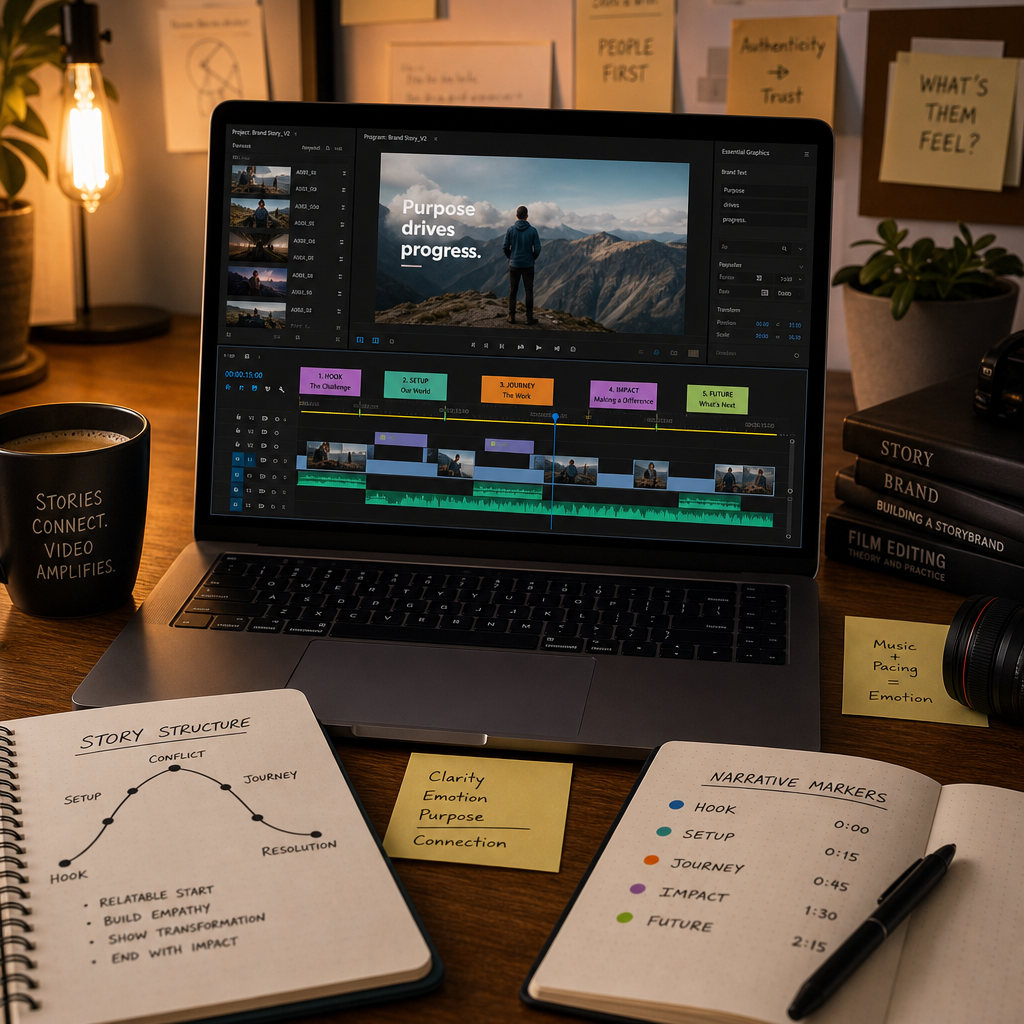
Every compelling event narrative follows a recognizable structure. There is a world before the event, a transformation or revelation during the event, and a world changed by the event afterward. This is not creative theory. It is the structure that makes audiences care about what they are watching.
The Three-Act Structure Applied to Corporate Conferences
Act one is the context. Why does this event exist? What problem or opportunity is the organization addressing? This is captured through pre-event interviews with leadership, establishing shots of the venue coming together, and the energy of registration morning.
Act two is the content and conflict. What ideas are being debated, decided, or launched at this event? This is where your keynote coverage, panel excerpts, and audience reaction shots live. The editorial goal here is not to document every session but to surface the two or three moments that define the event’s intellectual and emotional core.
Act three is the resolution. What has changed? What are attendees taking away? Post-session interviews and closing remarks are your primary sources here. This is also where your brand’s role in driving that change becomes visible without being forced.
Choosing the Central Conflict That Drives the Story
Every story needs tension. For a product launch conference, the tension is the problem your product solves. For an annual leadership summit, the tension might be the gap between where the organization is and where it needs to go. Identifying this central conflict before filming begins gives the editor a thread to pull throughout the footage.
Without that thread, editors default to chronology, which is the least interesting way to tell any story. Chronology describes what happened. Narrative explains why it mattered.
Brand Video Strategy Building Blocks
A brand video strategy for corporate events is not a single video. It is a content architecture that serves different audiences at different stages of their relationship with your organization. Getting this architecture right before production begins determines whether your event generates sustained content value or a one-time social post.
Matching Video Format to Audience Intent
Prospective clients watching a conference highlight reel need to understand your organization’s positioning and values within the first 30 seconds. Employees watching a recap of the same event need context, familiar faces, and a sense of shared experience. Investors watching a leadership presentation excerpt need credibility signals and strategic clarity. These are three different cuts of the same event, and they require three different editorial briefs.
In practice, the most effective organizations treat their event production brief the same way they treat a content calendar: with defined audience segments, distribution channels, and performance metrics for each output.
“Stories are how we think. They are how we make meaning of life. Call them truth or not, stories are what we are.” – Muriel Rukeyser, poet and social activist. The same principle applies to organizational storytelling: audiences do not remember your slide decks, they remember the story your event told about who you are.
The Role of Brand Voice in Event Video
Brand voice is not just a writing concept. It manifests in editorial pacing, music selection, color grading, and the type of interview questions your production team asks on camera. A brand that positions itself as bold and innovative should have an event video that moves fast, uses dynamic cuts, and surfaces unconventional perspectives from attendees. A brand that leads with trust and stability should have deliberate pacing, strong interview segments, and visuals that emphasize scale and organization.
A common mistake among Malaysian corporate clients is briefing their video team on logistics (what will happen, in what order) rather than on brand character (how the footage should feel to the viewer). These are fundamentally different briefs and they produce fundamentally different results.
Event Video Production Decisions That Shape the Story
Production decisions are editorial decisions. Every choice made on the day, from camera placement to microphone selection, either expands or limits what the editor can do with the story afterward. This is why experienced production teams insist on being part of the narrative planning conversation, not just the execution phase.
Camera Configuration for Narrative Flexibility
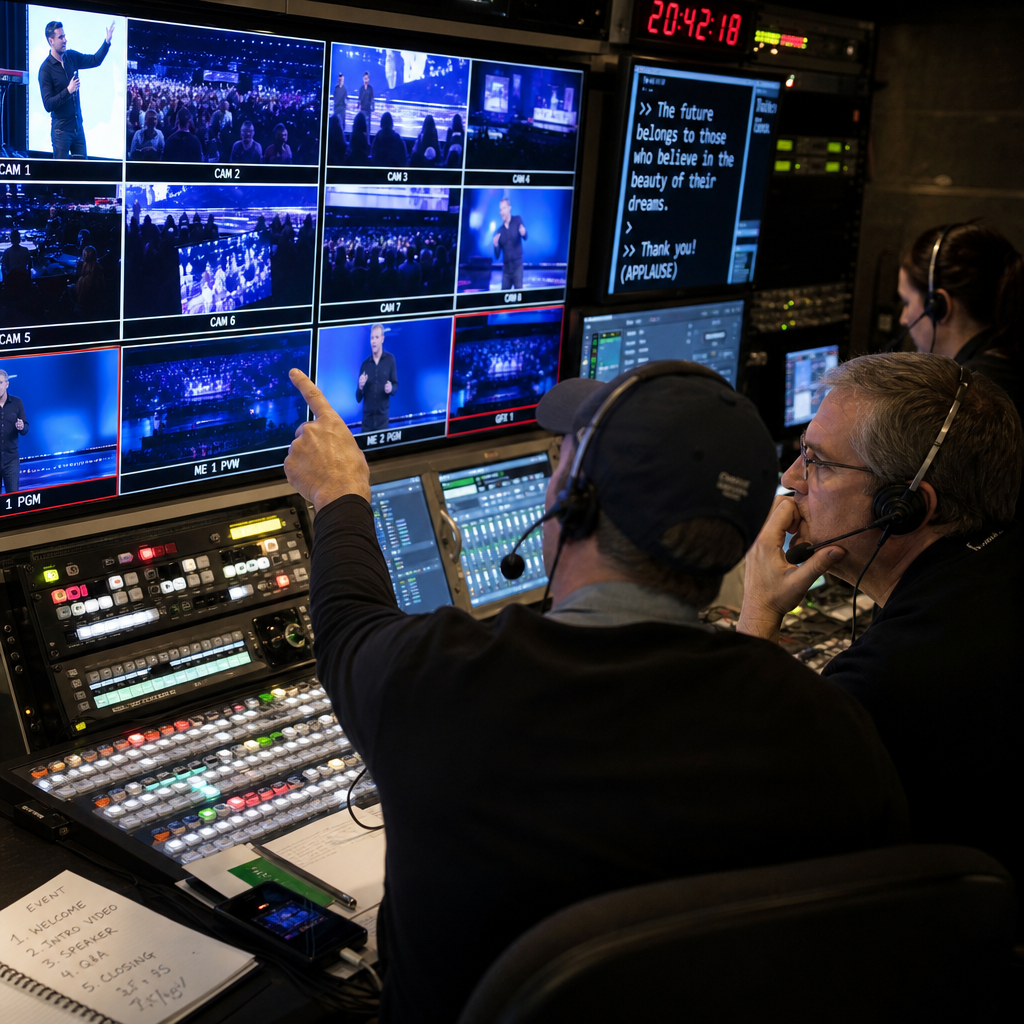
A three-camera minimum is standard for any conference that intends to produce usable narrative content. Camera A covers the wide establishing shot and gives the editor context. Camera B covers tight speaker shots that carry the verbal story. Camera C is the roving camera that captures the human moments: audience reactions, side conversations, the moment a delegate reads a key slide and nods in recognition. These human moments are what separate forgettable event footage from content people share.
For event video production in Malaysia, particularly for events held across multi-hall venues or with simultaneous breakout sessions, a dedicated camera operator for each major session is not a premium option. It is the minimum required to capture a complete story.
Audio as the Story’s Backbone
Poor audio ends careers for event video, more reliably than poor visuals. Audiences will tolerate slightly underexposed b-roll. They will not tolerate a keynote speaker they cannot hear clearly. Lavalier microphones on all primary speakers, a backup feed from the venue’s house sound system, and a dedicated audio engineer are the production requirements for any event where the spoken word is central to the narrative.
Pro tip: Always record a clean house feed directly from the event’s audio desk as a backup. On-camera microphones and lavaliers can fail. A clean house feed has saved more event videos than any other single contingency measure in production.
Comparing Event Coverage Approaches
| Approach | Best For | Key Limitation |
|---|---|---|
| Single-Camera Documentary Style | Intimate CEO town halls, small leadership retreats where authenticity is more important than production scale | Limited editorial flexibility. Cannot cut between angles, making talking-head segments feel static in longer edits. |
| Multi-Camera Studio Production | Large-scale conferences, product launches, and award ceremonies where brand prestige and production value must be visible | Requires significantly more crew and pre-production planning. Not suitable for same-day turnaround without dedicated switching and editing resources. |
| Hybrid Live-Streaming and Post-Production | Events with both in-person and virtual audiences, particularly relevant post-2020 for organizations with distributed stakeholders | Requires separate technical infrastructure for the live stream and the post-production edit. Budget and briefing must account for both outputs from the start. |
Turning a Single Conference Into Multiple Content Assets
The measure of good event production planning is not the quality of the main highlight reel. It is how many distinct, usable content pieces the production brief yields. A well-planned corporate conference should produce content that serves your audience for weeks, not just the 24 hours after the event ends.
The Content Atomization Approach
Content atomization means breaking a single event into its component stories and treating each component as a standalone piece of content. A full-day conference might yield: a 90-second social teaser cut before the event for awareness, a 3-5 minute highlight reel released within 48 hours, individual speaker soundbite clips for LinkedIn distribution across two weeks, a longer form documentary-style cut for your website and investor relations use, and a photo-essay paired with written key takeaways for blog and email distribution.
Each of these outputs serves a different audience at a different stage of engagement. None of them require additional filming. They all come from the same day of production, provided the brief was designed to capture all the necessary raw material from the start.
The 48-Hour Turnaround Standard
Audience relevance for event content has a short window. The data consistently shows engagement with post-event content drops sharply after 48 hours as the news cycle and social feeds move on. Organizations that brief their production partners to deliver a first-cut social asset within 48 hours of the event closing consistently outperform those that wait for the polished long-form edit before releasing anything.
This requires production teams to have a same-day edit capability built into the project plan, not added as an afterthought. It means on-site editing resources, pre-cleared music licenses, approved brand templates, and a client approval process that can operate in hours rather than days.
Measuring Whether Your Story Actually Worked
Brand storytelling without measurement is an opinion. The goal is not to produce content that feels good in the edit suite. It is to produce content that achieves a specific communication objective, and that objective must be measurable before production begins.
Metrics That Actually Reflect Narrative Effectiveness
View count is the least useful metric for event video content. It tells you how many people pressed play. It tells you nothing about whether they understood your message or took the intended action. The metrics that matter are: completion rate (what percentage of viewers watched to the end), engagement rate on social platforms (comments and shares indicate emotional response, not just passive viewing), and conversion actions tied to the video such as form submissions, event registrations for future events, or direct inquiries.
For internal communications content, qualitative metrics matter just as much. Post-event survey responses that reference specific moments from the video indicate narrative resonance in a way that view count never will.
Feedback Loops Between Events
Organizations that run recurring events, annual conferences, and quarterly leadership meetings have an advantage that single-event organizations do not: they can test and improve their storytelling approach across iterations. Tracking which content formats generated the most stakeholder engagement from one event and applying those findings to the next is how event video strategy matures from good to genuinely effective.
A common mistake is treating each event as a standalone production with no institutional memory of what worked previously. The brief for your next event should always include a section reviewing the performance data from your last one.
Frequently Asked Questions
How early should we involve the video production team in event planning?
At minimum, four weeks before the event. Ideally, the production team should be part of the event planning conversation from the point where the agenda and key speakers are being confirmed. This allows the narrative brief to be built around the actual content of the event rather than retrofitted to whatever happens on the day.
What is the most common reason corporate event videos fail to generate business results?
The most common reason is that the video was produced without a defined audience and without a defined call to action. A highlight reel that exists to document the event rather than to move a specific audience toward a specific next step will always underperform. Every event video should answer the question: after watching this, what should the viewer do or believe that they did not before?
How many cameras are genuinely necessary for a corporate conference in Malaysia?
For any conference with more than 100 attendees and at least one keynote speaker, three cameras is the functional minimum. Below three cameras, editorial flexibility is severely limited and the final output will show it. For large-scale events with multiple stages or simultaneous sessions, five to seven cameras plus a dedicated live-switching crew become necessary for professional-grade narrative coverage.
Can a live stream and a post-produced highlight reel be captured from the same event simultaneously?
Yes, but they require separate technical infrastructure and separate planning. The live stream requires a dedicated switching setup and broadcast-grade encoding equipment. The post-production edit requires a clean multi-camera recording with isolated audio tracks. Treating these as the same technical workflow is a production error that compromises both outputs. Brief your production partner to resource them independently from the outset.
What should a narrative brief for a corporate event video include?
A narrative brief should include: the single central story the event will tell, the primary audience for each video output, the intended emotional response, the key messages to be communicated, the interview subjects and their assigned talking points, the distribution platforms for each output, and the deadline for each deliverable. It should be no longer than two pages. If it is longer than two pages, the brief has not yet identified what truly matters.
How do we decide between a documentary-style event video and a structured highlight reel format?
The decision should be driven by audience and distribution, not by aesthetic preference. A documentary style works when the audience has the time and investment to follow a longer narrative, typically for internal communications, investor relations content, or flagship annual event coverage. A highlight reel works when the audience is external, time-poor, and needs to grasp the event’s significance within 90 to 120 seconds. Most organizations need both formats from the same event, which is why planning for content atomization from the start is the correct approach.
If you have run a corporate event and wrestled with making the video footage actually useful afterward, share what worked or what you would do differently. Your experience directly shapes how this conversation evolves.
References
- HubSpot marketing and video statistics resource covering consumer content preferences and engagement data
- Forbes business and leadership coverage including brand communications strategy and corporate event ROI analysis
- Statista data platform with video marketing adoption rates and corporate event industry benchmarks
- McKinsey and Company research on organizational communications, brand strategy, and stakeholder engagement effectiveness
- Ahrefs content marketing blog covering content distribution strategy and audience engagement measurement for brand content