
Most corporate events in Malaysia fail not because the content is weak, but because the production timeline was never properly planned. A late brief means rushed pre-production, which means missed shots, poor audio, and footage that cannot be salvaged in post. According to HubSpot, 54% of marketers say video is the content type with the highest return on investment, yet most organizations treat event video as an afterthought rather than a planned deliverable. If you are managing corporate event coverage Malaysia, this timeline removes the guesswork and puts every stakeholder on the same page before a single camera rolls.
Table of Contents
- Quick Takeaways
- Why the Production Timeline Is the Most Underrated Planning Tool
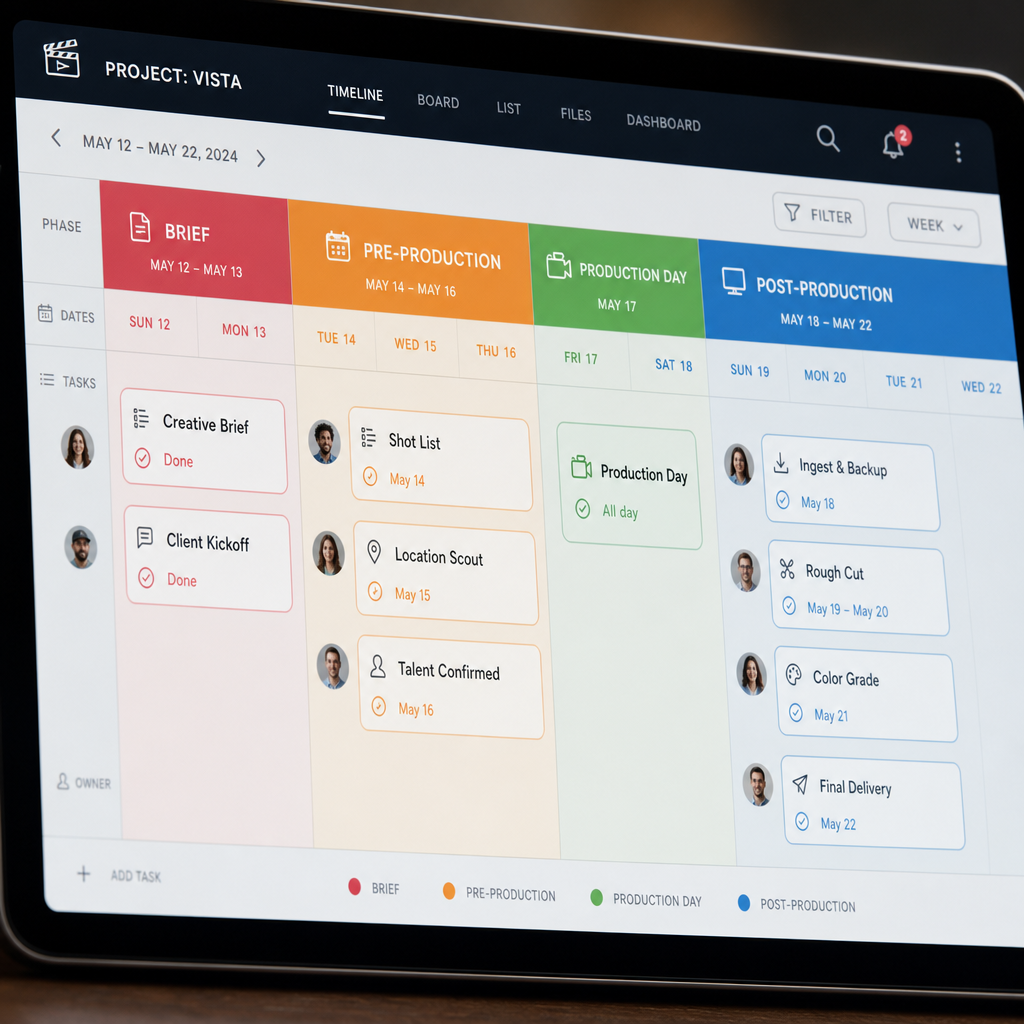
- Phase One: The Brief (6 to 8 Weeks Before the Event)
- Phase Two: Pre-Production (3 to 5 Weeks Before the Event)
- Phase Three: Production Day
- Phase Four: Post-Production and Delivery
- Comparing Corporate Event Video Production Approaches
- Common Mistakes That Derail Event Video Production in Malaysia
- Frequently Asked Questions
- References
Quick Takeaways
| Key Insight | Explanation |
|---|---|
| Brief at least 6 weeks out | Anything shorter compresses crew scheduling, location recces, and equipment booking to a point where quality suffers consistently. |
| Shot list approval is non-negotiable | A confirmed shot list shared with the client before event day eliminates disputes about missed footage after delivery. |
| Venue recce changes everything | Power source locations, ambient light conditions, and acoustic problems in Malaysian convention centres or hotel ballrooms are only visible on-site. |
| Multi-camera adds insurance, not just coverage | With two or more cameras, a cutaway or angle is always available if a speaker moves unexpectedly or a technical fault occurs on one unit. |
| Post-production timelines must be written into the contract | Verbal agreements on edit turnarounds are the single biggest source of client-vendor conflict in event video production Malaysia. |
| Highlight reel and full recording serve different purposes | A 90-second highlight reel feeds social media reach, while the full recording serves internal archival, training, and compliance purposes. |
| Live streaming requires a parallel technical brief | If the event includes live streaming, internet bandwidth, encoder setup, and platform credentials must be confirmed separately from the standard production brief. |
Why the Production Timeline Is the Most Underrated Planning Tool
Event planners in Malaysia typically build detailed rundowns for catering, AV hire, and guest registration, but the video production brief often arrives as a one-paragraph email sent four days before showtime. That gap between event planning and video production planning is where quality gets destroyed. The production timeline is not a bureaucratic formality. It is a risk management document.
In practice, a well-structured video production timeline Malaysia defines responsibilities, prevents scope creep, and gives both the production team and the client a shared reference point when decisions need to be made under pressure on event day. Without it, every stakeholder operates on different assumptions.
“Production is 90 percent preparation. The shoot itself is just the execution of decisions already made.” – a production principle consistently observed across high-volume corporate event coverage teams in Southeast Asia.
The timeline also protects the client. When a marketing manager can see exactly what deliverables are due at each stage, approval bottlenecks get resolved faster because nobody wants to be the person who stalled the process.
Phase One: The Brief (6 to 8 Weeks Before the Event)
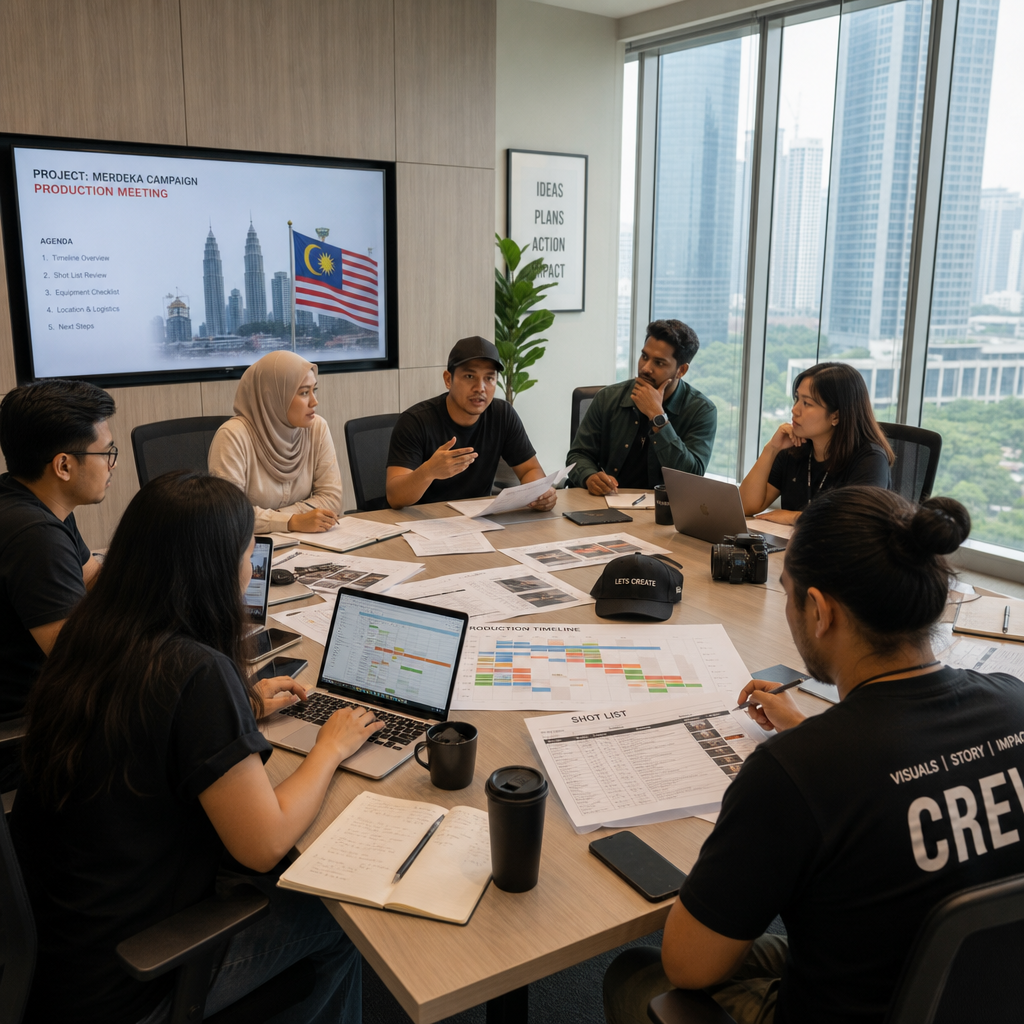
The brief is where every production decision originates. A weak brief produces weak footage. At this stage, the production company and the client need to agree on four things: the purpose of the video, the intended audience, the deliverable formats, and the distribution channels.
What a Proper Corporate Video Brief Must Include
A brief for corporate event coverage should specify the event name, date, and venue, the number of speakers or segments to be filmed, the expected deliverables (highlight reel, full recording, social media cuts), and any branding guidelines that must be followed in the edit. It should also state who the internal approver is, because approval chains that are unclear at briefing stage cause delays at delivery.
Brand managers should include reference clips or competitor event videos they admire. This is not about copying. It is about aligning visual language before production begins, which saves hours of revision later.
Setting the Right Budget Expectation at Brief Stage
A common mistake is treating budget as a detail to confirm after the scope is agreed. In reality, scope and budget need to be discussed simultaneously. Multi-camera production, live streaming integration, animated lower thirds, and drone footage all carry separate cost implications. If a client briefs for all of these on a single-camera budget, the production team either cuts corners or the relationship starts with a difficult renegotiation.
Pro tip: Ask your production partner to provide a breakdown of costs by service line during the briefing stage. If they cannot separate multi-camera costs from basic single-camera rates, that is a sign their quoting process is not transparent enough to manage scope changes mid-project.
Phase Two: Pre-Production (3 to 5 Weeks Before the Event)
Pre-production is where the production team converts the brief into a concrete operational plan. This phase has three parallel workstreams running simultaneously: crew logistics, technical preparation, and client-facing planning documents.
Venue Recce for Malaysian Event Spaces
Malaysian convention centres and hotel ballrooms present specific challenges. KLCC Convention Centre, Putrajaya International Convention Centre, and mid-size hotel ballrooms in the Klang Valley all have different ceiling heights, lighting rigs, and floor plan constraints that affect camera placement. A recce visit confirms where cameras can be safely positioned without obstructing guests, where power drops are available, and whether the ambient light requires supplementary lighting equipment.
In practice, skipping the recce is the fastest way to arrive on event day and discover that the stage is backlit by a floor-to-ceiling window that makes every speaker look like a silhouette.
Shot List and Run-of-Show Alignment
The shot list should be built from the event rundown. For each segment in the program, the production team needs to know the expected duration, the number of speakers or performers, and any specific visual moments that must be captured (awards presentations, product reveals, audience reactions).
This document should be shared with the client for sign-off at least two weeks before the event. Any changes to the program after that point must trigger a conversation about whether the original shot list is still achievable.
Technical Preparation for Multi-Camera and Live Streaming
If the event includes live streaming for virtual attendees, the technical brief for streaming runs parallel to the main production brief. Bandwidth testing, encoder configuration, platform selection, and graphics overlay design all need to be resolved in pre-production, not on the day. A bandwidth failure during a live-streamed AGM or product launch is a reputational problem that no amount of post-production can fix.
Pro tip: For live streaming events in Malaysia, always confirm the venue’s dedicated upload speed with the event organizer and run an independent speed test during the recce visit. Hotel Wi-Fi shared with hundreds of guests during a conference is not a reliable streaming backbone regardless of what the venue’s spec sheet says.
Phase Three: Production Day
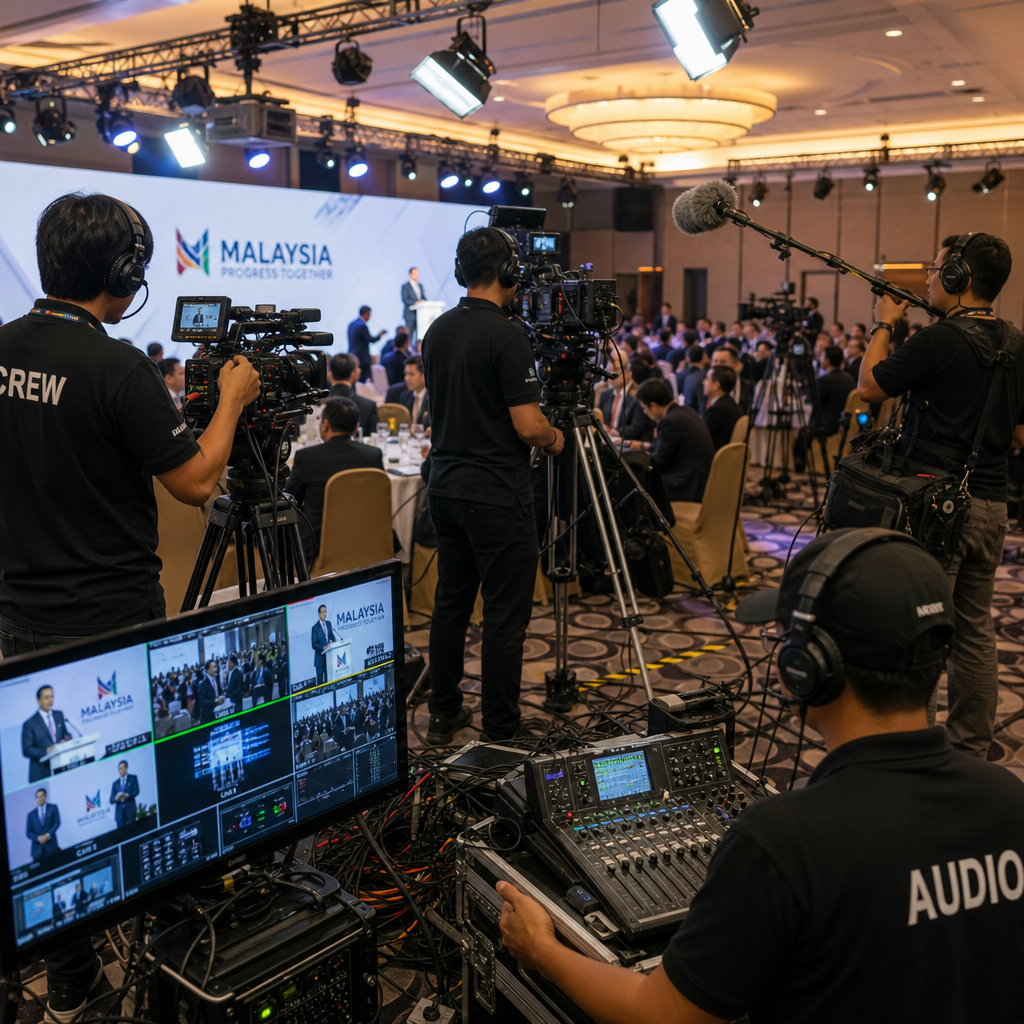
Production day is where preparation either pays off or exposes its gaps. The production team should arrive at least two hours before the first guests to complete camera placement, audio line checks, and lighting adjustments. For larger events with multiple rooms or outdoor segments, three hours is the minimum safe buffer.
Crew Roles and On-Site Communication
Each crew member needs a defined role and a communication channel. On a multi-camera corporate shoot, the director needs to be able to call cuts and angles without shouting across a ballroom. Radio earpieces or a group messaging channel on phones are both viable options depending on venue size. What does not work is an ad-hoc arrangement where the director is also operating a camera and managing client requests simultaneously.
The client-facing point of contact should be a separate person from the director. Marketing managers often have last-minute requests on event day. Routing those through a dedicated producer rather than interrupting the director mid-shoot protects the quality of coverage.
Audio Capture Is the Highest-Risk Element
Audio problems are the number one reason corporate event footage becomes unusable. A speaker who forgot to clip their lapel mic, a handheld mic with a dying battery, or a panel session where three speakers share one mic on a table all create audio that cannot be recovered in post-production. The standard professional practice is to run a redundant audio feed from the venue’s mixing desk directly into the production recorder alongside the on-camera microphones.
If the venue’s AV team is managing the mixing desk and they are not briefed to provide a line-out feed to the production crew, that redundancy disappears. This is a pre-production conversation, not a production day negotiation.
Phase Four: Post-Production and Delivery
Post-production is where the footage is turned into the deliverables specified in the brief. The timeline for this phase depends on the complexity of the edit, the number of deliverables, and how quickly the client can provide approvals. Statista data on content marketing shows that video assets take an average of three times longer to approve than static assets, which makes approval timelines critical to plan explicitly.
Edit Hierarchy: What Gets Cut First
The standard delivery order for corporate event coverage is: highlight reel first, full recording second, social media cuts third. The highlight reel is edited first because it requires the most creative judgment and the most revision cycles. Getting it approved early means the editor can reuse approved segments for social cuts without reopening creative discussions.
Full recordings are typically a straight assembly edit with clean in and out points, lower thirds for speaker names, and title cards for session breaks. These take less time per deliverable but require careful organization of multi-camera footage.
Revision Rounds and Approval Protocol
Two rounds of revisions are the industry standard for corporate event video production projects. The first round addresses structural feedback (pacing, content sequencing, missing segments). The second round addresses polish (colour grade, music levels, graphics corrections). Requests that arrive after the second round should be treated as additional scope with associated costs. This boundary should be written into the contract, not communicated verbally after the fact.
Clients who involve multiple internal stakeholders in the approval process without a single nominated decision-maker will almost always exceed two rounds. Establish who has final sign-off authority at the brief stage and document it.
Comparing Corporate Event Video Production Approaches
| Approach | Best For | Key Limitation |
|---|---|---|
| Single-Camera Run-and-Gun | Small internal events, departmental briefings, low-budget executive messages | No coverage redundancy. If one segment is missed, it cannot be recovered. Edit options are severely limited. |
| Multi-Camera Fixed Production | Conferences, AGMs, award ceremonies, product launches with a defined stage area | Requires more crew and equipment. Pre-production must be thorough because repositioning cameras during the event is disruptive. |
| Multi-Camera with Live Streaming Integration | Hybrid events, virtual AGMs, industry conferences with remote attendees | Technical complexity doubles. Bandwidth, encoder setup, and platform management require dedicated personnel separate from the recording crew. |
Common Mistakes That Derail Event Video Production in Malaysia
The same production problems appear repeatedly across corporate event coverage in Malaysia, and most of them are avoidable with process discipline rather than additional budget.
The first is treating the production company as a supplier rather than a collaborator. Organizations that share the event brief, rundown, and speaker lineup in advance consistently get better footage than those who provide the crew with minimal context on event day. A director who understands that the closing keynote is the most important segment of the event will position cameras and manage attention accordingly.
The second is approving the final cut without a structured review process. When a video is shared in a group chat and everyone comments independently, contradictory feedback accumulates and the editor has no clear mandate. Designate one person to consolidate feedback before it goes to the production team.
The third is forgetting about music licensing. Background music in a corporate highlight reel that is uploaded to YouTube without proper licensing will trigger a content ID claim, which either mutes the audio or redirects monetization. Production companies that include properly licensed music in their deliverables are providing a service with real legal value, not just aesthetic preference.
The fourth is underestimating post-production time for events with simultaneous breakout sessions. When four rooms are filmed simultaneously by separate crews, the editing workload multiplies significantly. Organizations that want comprehensive coverage of a multi-track conference need to plan edit timelines accordingly, not assume a highlight reel can be turned around in 48 hours.
Frequently Asked Questions
How far in advance should I contact a video production company for corporate event coverage in Malaysia?
Six to eight weeks is the minimum for any event that requires multi-camera production, live streaming, or more than two deliverable formats. For large-scale conferences or annual dinners with 500 or more attendees, eight to twelve weeks gives the production team adequate time for recce visits, equipment booking, and crew scheduling without paying rush premiums.
What is included in a standard corporate event video production package?
A standard package typically covers a pre-event recce, production day coverage with a defined crew size and camera count, basic colour grading and audio cleanup, lower thirds for speaker identification, a highlight reel of 60 to 120 seconds, and a full event recording. Extras such as animated graphics, drone footage, additional social media cuts, and live streaming are usually priced separately. Always confirm what is included in writing before the brief is signed off.
Can the highlight reel be ready the same day as the event?
A same-day edit is possible but it requires a dedicated editor on-site with a high-performance laptop, a structured selection of priority clips agreed in advance, and a client representative available for immediate approval. It is a viable option for events where social media momentum matters, such as product launches or award nights, but it produces a rough cut rather than a polished deliverable. The full highlight reel with colour grading and proper music should still follow within three to five business days.
What is the difference between event video production and a corporate promotional video?
Event video production captures what happened at a specific, time-bound event. The footage is primarily documentary. A corporate promotional video is scripted, planned, and shot to communicate a specific brand message, often with controlled environments and multiple takes. The two are different production categories with different budgets, timelines, and skill sets. Some production companies deliver both; others specialize in one. Confirm which type of content your brief requires before comparing quotes.
How do I evaluate whether a video production company in Malaysia has the right capability for my event?
Ask to see examples of coverage from events of similar size and format to yours. A company that has only produced small internal briefings may not have the crew structure or equipment inventory to handle a 1,000-person conference. Ask specifically about their process for audio redundancy, their camera count for an event of your scale, and who serves as the on-site director. A confident and specific answer to each of those questions is a stronger signal than a polished showreel alone.
Is live streaming more complex to produce than a standard event recording?
Yes, consistently. Live streaming introduces a parallel technical workflow that runs simultaneously with the main recording. The encoder must be configured correctly, the internet connection must be tested and dedicated, the streaming platform must be set up with the correct stream keys, and someone must monitor the live feed throughout the event to catch dropout or audio sync issues. A production team that treats live streaming as an add-on to a standard recording setup without additional personnel is taking on risk that will eventually result in a broadcast failure.
If you have produced a corporate event in Malaysia and navigated a production timeline that worked or failed spectacularly, share what you learned in the comments below.
References
- HubSpot marketing statistics resource covering video content ROI and content marketing benchmarks
- Statista global data platform with statistics on video content production timelines and digital marketing adoption
- Forbes business and marketing insights covering corporate communications and event production trends
- Ahrefs blog covering content marketing strategy and digital distribution for video assets