
Roughly 73% of B2B marketers say live video produces stronger audience engagement than any other content format, yet most corporate event planners in Malaysia still select a live streaming partner the same way they choose a caterer: on price and availability alone. That approach fails badly when the stream drops mid-keynote or the audio cuts out during a CEO announcement. Choosing the right live streaming services Malaysia partner is a technical and strategic decision, and this guide gives you a clear, no-filler framework for making it correctly.
Table of Contents
- Quick Takeaways
- Why Partner Selection Matters More Than Platform
- Technical Infrastructure You Must Verify Before Signing
- Multi-Camera Production Capability and Directing Experience
- Platform and Streaming Strategy Alignment
- Comparing Live Streaming Service Tiers
- Pre-Event Rehearsal and Run-of-Show Planning
- Post-Event Content Deliverables and Repurposing
- Red Flags That Signal an Underqualified Partner
- Frequently Asked Questions
- References
Quick Takeaways
| Key Insight | Explanation |
|---|---|
| Redundancy is non-negotiable | A credible partner runs dual internet connections and backup encoding hardware. One single point of failure can collapse your entire virtual event in front of thousands of viewers. |
| Multi-camera direction matters as much as bandwidth | Technical uptime means nothing if the director cuts to the wrong angle during a product reveal. Ask for a live directing reel before committing. |
| Platform strategy must match your audience | Streaming on YouTube works for public consumer events. For internal corporate townhalls or AGMs, a password-protected platform like StreamYard Pro or Vimeo Livestream is far more appropriate. |
| Rehearsal time is a deliverable, not a favour | Any partner who does not include a full technical rehearsal in their quote is cutting a corner that will cost you on event day. Get the rehearsal written into the contract. |
| Post-event footage is a marketing asset | The raw recording from your virtual event can become highlight reels, social clips, and internal training content. Confirm ownership rights and file formats upfront. |
| On-site crew size reflects production seriousness | A one-person team handling cameras, encoding, and directing simultaneously cannot give each role adequate attention. Corporate-grade production requires role specialisation. |
| Local market knowledge reduces logistical risk | Partners with experience in Malaysian venues know which KL convention centres have fibre limitations and which require bonded 4G solutions well in advance. |
Why Partner Selection Matters More Than Platform
A common mistake is treating live streaming as a technology purchase. Event planners often spend hours comparing platform dashboards while barely questioning the production company’s actual crew credentials. The platform is a delivery pipe. The partner is the engineering team managing the water pressure.
For virtual event production Malaysia, the stakes are particularly high. Corporate audiences in Malaysia increasingly attend hybrid and fully virtual events as primary formats, not fallback options. A poorly executed stream is not just a technical inconvenience; it signals to stakeholders that your organisation does not invest seriously in communication.
In practice, the production partner shapes every aspect of viewer experience: audio clarity, visual composition, switching pace, lower-third graphics, and real-time problem solving when something goes wrong. Choose wrong, and no platform upgrade will save you.
Technical Infrastructure You Must Verify Before Signing
Ask every prospective partner to describe their redundancy setup. A serious answer includes a primary fibre connection, a bonded 4G or 5G backup, a hardware encoder running in parallel with a software fallback, and an uninterruptible power supply for critical encoding gear. If the answer is “we use our laptop and the venue WiFi”, end the conversation.
Encoding Hardware and Bitrate Capability
Dedicated hardware encoders from brands like Teradek or LiveU deliver far more stable streams than software-only solutions under real venue conditions. Ask whether the partner owns their own encoding hardware or rents it per job. Rental equipment introduces unfamiliarity and inconsistency.
For a corporate event streamed to a regional audience across Malaysia and Southeast Asia, you need a partner capable of outputting at least 6 to 8 Mbps upstream for 1080p quality. Partners who cap at 3 to 4 Mbps are acceptable only for internal low-stakes calls, not brand-critical events.
Audio Chain Independence
Audio failure is the number one reason corporate audiences abandon a live stream. Verify that the partner runs an independent audio chain: dedicated mixing board, XLR connections from the venue sound system, and a separate monitoring feed so the operator can catch problems in real time. Do not accept a partner who relies solely on camera-mounted microphones for corporate keynote sessions.
Pro tip: Request a technical specification sheet before the site visit. Any professional live streaming services Malaysia partner should be able to produce a one-page document listing their encoder model, bitrate range, audio setup, and redundancy protocols. If they cannot produce this, their process is not mature enough for your event.
Multi-Camera Production Capability and Directing Experience
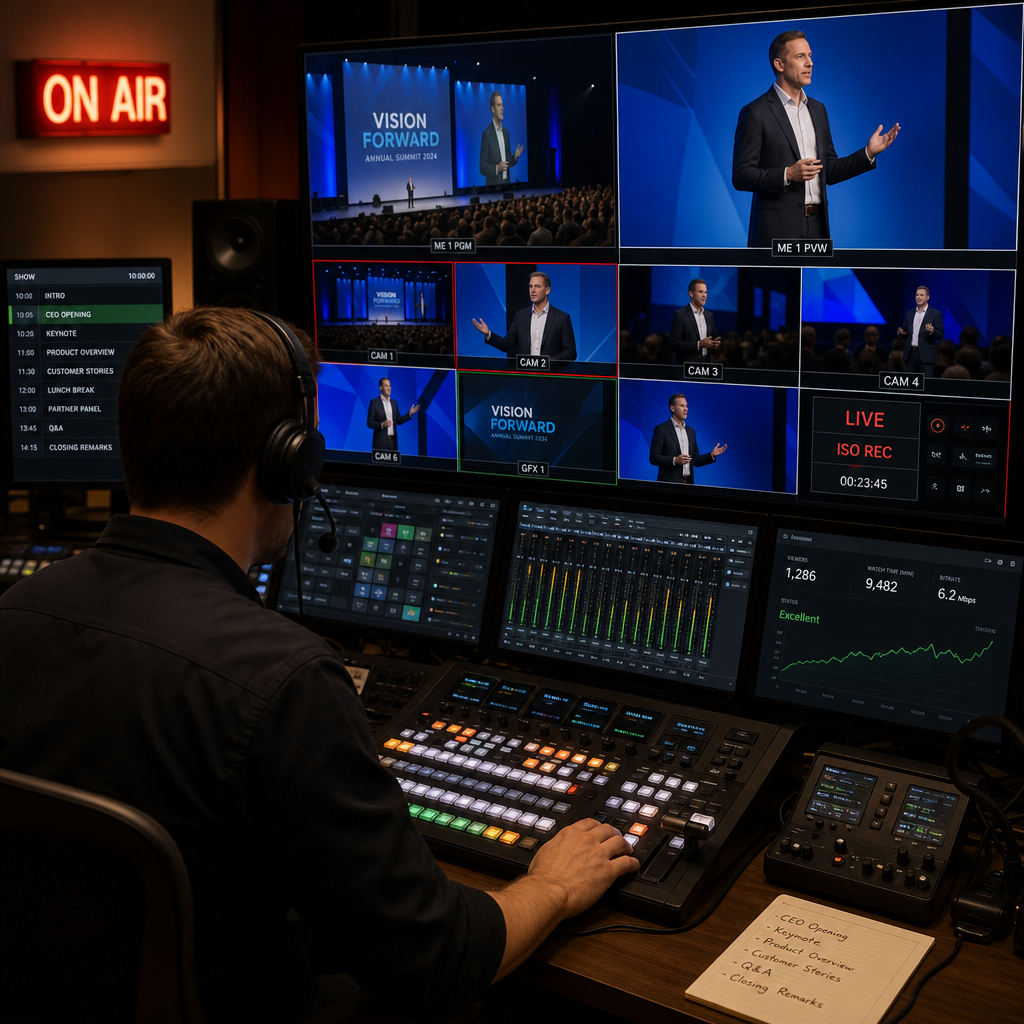
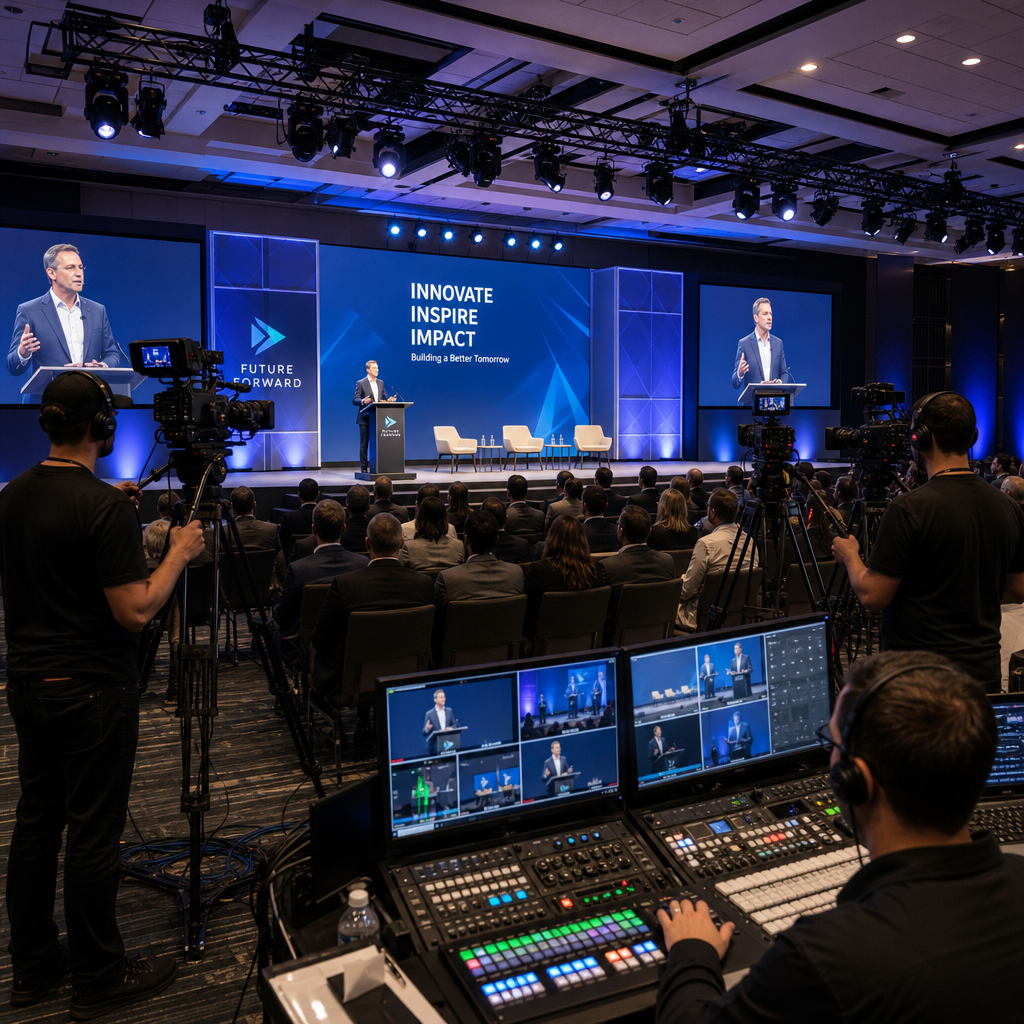
Single-camera live streams feel like CCTV footage. For corporate events where your brand image is on the line, you need at minimum three cameras: a wide establishing shot, a mid-shot presenter angle, and a roaming or reaction camera. Partners offering integrated multi-camera production bring a live director into the equation, someone who calls cuts, manages pacing, and keeps the visual narrative coherent.
What a Live Director Actually Does
The live director monitors all camera feeds simultaneously and issues cut commands to the vision mixer operator in real time. They manage lower-third graphics timing, coordinate with the event MC through an intercom system, and make split-second decisions when a speaker moves unexpectedly or a panel discussion shifts. This role requires both technical knowledge and editorial instinct.
When evaluating partners, ask specifically whether they have a dedicated director role or whether the camera operator doubles as the vision mixer. These are two fundamentally different skill sets, and combining them at a corporate event creates dangerous bottlenecks.
Graphics and Branded Overlays
Lower-thirds, animated titles, sponsor logos, and live polling integrations are not add-ons. They are core production elements that signal production quality to your audience. Ask to see examples of branded live overlays from previous corporate events, not just raw footage. A partner without a motion graphics workflow is underequipped for brand-serious organisations.
Platform and Streaming Strategy Alignment
The platform choice should be driven by your audience profile, privacy requirements, and post-event content strategy, not by whatever the partner happens to be most comfortable with. A production partner worth hiring will ask you these questions before recommending a platform, not after they have already set up their kit.
Public Events vs. Gated Corporate Events
Public product launches, brand activations, and industry conferences can stream openly on YouTube or Facebook Live, where built-in discovery helps grow your audience. Internal townhalls, AGMs, investor briefings, and client-exclusive events require gated streaming through platforms like Vimeo Livestream, Hopin, or StreamYard Pro with password protection and access controls.
Mixing these up is a serious governance risk. Several Malaysian corporations have accidentally broadcast internal HR announcements publicly because their streaming partner used the wrong platform configuration. Confirm your partner has a checklist for privacy settings before every event, not just familiarity with one platform.
Simultaneous Multi-Platform Streaming
For maximum reach, multistreaming to several platforms simultaneously through a service like Restream or Castr is worth considering for public-facing events. However, this increases encoding load and requires more upstream bandwidth. Confirm your partner has tested multistreaming under load conditions before committing this approach to a high-stakes event.
Pro tip: Always run a pre-event stream test to the exact platform you will use on event day, from the exact venue, at least 48 hours in advance. Partners who resist this or call it unnecessary are protecting their own schedule at the expense of your event reliability.
Comparing Live Streaming Service Tiers
| Service Tier | What It Typically Includes | Best Suited For |
|---|---|---|
| Basic Single-Camera Streaming | One camera operator, software encoding, single internet connection, no graphics, minimal pre-event testing | Internal team meetings, small webinar-style sessions with under 100 viewers and no brand visibility requirements |
| Professional Multi-Camera Production | Three or more cameras, dedicated live director, hardware encoding, redundant internet, branded graphics, full technical rehearsal, platform management | Corporate conferences, product launches, AGMs, press events, and any event where brand image and viewer experience are priorities |
| Integrated Hybrid Event Production | Everything in professional tier plus on-site audience management, interactive elements such as live polling and Q&A moderation, multi-platform streaming, and post-event content editing | Large-scale hybrid events combining physical and virtual audiences, industry summits, government-linked corporate events, and events with international viewership |
Pre-Event Rehearsal and Run-of-Show Planning
The run-of-show document is the single most important planning tool in live event production. It maps every moment of the event with timestamps, speaker cues, graphic triggers, and camera directions. A production partner who does not build and share a run-of-show document with your team at least one week before the event is working without a plan.
“Live production without a run-of-show is like flying without a checklist. Experienced pilots use checklists precisely because they know how fast things can go wrong.” – EventMB (now Skift Meetings), on professional event production standards.
The full technical rehearsal should simulate the event exactly: same cameras, same encoding setup, same platform, same internet connection, and the actual speakers walking through their segments. This is where you catch incompatible slide aspect ratios, microphone gain issues, and speaker positioning problems before they become live incidents.
In practice, partners who skip detailed rehearsals almost always blame technical issues on unforeseeable circumstances when things go wrong. The reality is that most live stream failures are foreseeable and preventable with proper rehearsal.
Post-Event Content Deliverables and Repurposing
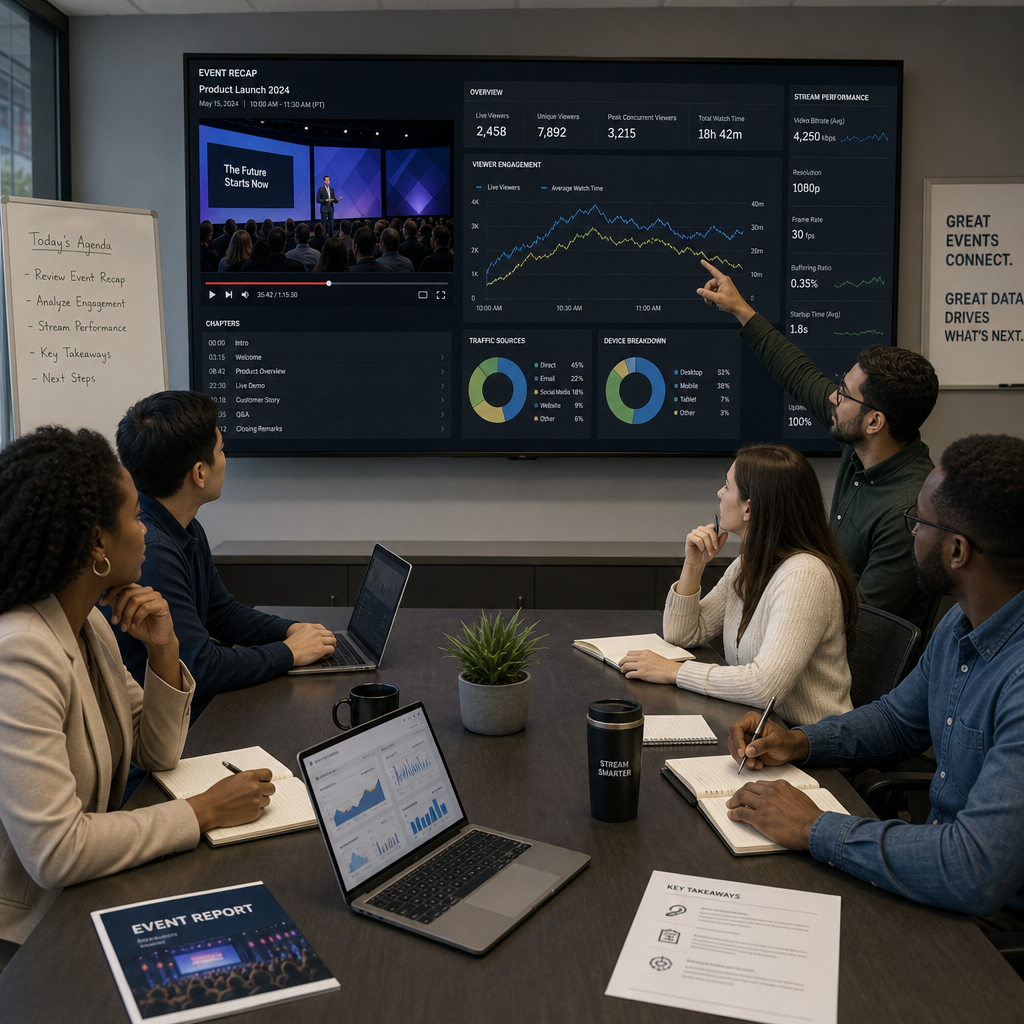
Your live stream recording is not just an archive. For corporate marketing teams, it is the raw material for a content engine that can run for months after the event. Confirm with your partner what file formats they deliver, at what resolution, and within what turnaround time after the event.
The data consistently shows that companies that repurpose event recordings into shorter social content see significantly higher content ROI. According to HubSpot’s marketing research, short-form video content drives the highest return on investment across marketing formats, which means a well-executed event recording, cut into 60 to 90 second highlight clips, can generate sustained organic reach long after the event day.
Clarify content ownership explicitly in the contract. Some production companies retain rights to footage or include licensing clauses that restrict how you can use the recordings commercially. This is a clause worth having your legal team review before signing.
Red Flags That Signal an Underqualified Partner
Price is the most obvious red flag signal, but not in the direction most event planners assume. Suspiciously low quotes for multi-camera corporate events almost always mean the partner is planning to understaff, use consumer-grade equipment, or skip redundancy entirely. You will pay for it on event day.
Other red flags to watch for include: no written contract specifying equipment list and crew roles, inability to name the specific encoding hardware they plan to use, no example of branded live graphics from a previous corporate client, and a quote that does not include any line item for pre-event testing or rehearsal.
A partner who cannot provide two or three references from comparable corporate events in Malaysia should also raise questions. Local experience matters because Malaysian venues, from KLCC to Putrajaya International Convention Centre, have specific connectivity and logistics characteristics that a purely international or inexperienced team will not anticipate.
Frequently Asked Questions
How much should a professional live streaming service cost for a corporate event in Malaysia?
A credible multi-camera live streaming production for a full-day corporate event in Malaysia typically ranges from RM 5,000 to RM 25,000 or more, depending on crew size, equipment tier, platform requirements, and whether post-production deliverables are included. Quotes below RM 3,000 for multi-camera setups almost always reflect significant equipment or crew compromises that are not worth the saving.
What is the difference between a live streaming service and a virtual event production company?
A live streaming service focuses narrowly on encoding, transmission, and platform delivery. A virtual event production company handles the full production layer: camera work, directing, graphics, audio engineering, platform management, and post-event content. For corporate events where brand experience matters, you need the full production capability, not just a transmission service.
How many cameras do I actually need for a corporate conference live stream?
Three cameras is the practical minimum for a professional corporate conference: one wide shot, one mid-shot presenter camera, and one flexible roaming camera for audience reactions or panel coverage. Single-camera streams are acceptable only for internal low-visibility events. For keynotes, product launches, or any event with external stakeholder audiences, three cameras is the baseline, not a luxury.
Can the same company handle both on-site filming and live streaming simultaneously?
Yes, and this is actually the preferred approach for efficiency and consistency. Integrated production companies manage both the physical capture and the live transmission from a unified technical setup, which means the director can coordinate camera work and stream quality from a single control position. Using two separate vendors for filming and streaming creates communication gaps and technical handoff risks.
What questions should I ask a live streaming partner before hiring them?
Ask them to describe their redundancy setup for internet and encoding, name the specific encoder hardware they plan to use, show you examples of branded graphics overlays from past corporate events, confirm whether a dedicated live director is included in the crew, explain their rehearsal process, and clarify content ownership terms in their standard contract. Any hesitation or vague answers on these points is a meaningful signal about their professionalism.
Is live streaming suitable for sensitive corporate events like AGMs or investor briefings?
Yes, but only with the right platform configuration. Annual General Meetings and investor briefings require password-protected streams with access logging, restricted sharing, and often regulatory compliance around recording and distribution. A production partner experienced in Malaysian corporate governance events will know how to configure these controls correctly. Do not assume these settings are applied by default.
If you have evaluated live streaming partners for a corporate event in Malaysia, what was the deciding factor that made you choose one over another? Share your experience below.
References
- HubSpot Marketing Statistics: data on video content ROI and audience engagement benchmarks for marketers
- Statista: global and regional statistics on live streaming audience growth and virtual event industry trends
- Forbes: business insights on corporate event strategy, virtual event production investment, and brand communication
- McKinsey and Company: research on digital event formats, hybrid workplace communication, and corporate engagement strategies
- Ahrefs Blog: content marketing and digital visibility data relevant to event-driven content repurposing strategies