
Most corporate video projects go over budget, miss the mark creatively, or require expensive reshoots for one reason: nobody wrote a proper creative brief before production started. If you are working with a corporate video production Malaysia team, the brief is not a formality. It is the document that decides whether your final video does the job you hired it to do. This guide walks you through exactly what to include, what to skip, and how to write a brief that a professional production house can actually execute without guessing at your intentions.
Table of Contents
- Quick Takeaways
- Why the Creative Brief Matters More Than You Think
- What to Include in a Corporate Video Creative Brief
- Defining Your Video Objective with Precision
- Audience Specification That Production Teams Can Use
- Budget and Timeline Communication
- Tone, Style, and Brand Alignment
- Comparison of Brief Formats
- Common Mistakes That Derail Video Briefs
- Frequently Asked Questions
- References
Quick Takeaways
| Key Insight | Explanation |
|---|---|
| One brief, one objective | A brief that lists three or four video goals produces a video that achieves none of them. Pick one primary objective per production. |
| Describe the audience behaviorally | Saying “senior managers” is not enough. Describe how they consume content, what they distrust, and what gets them to act. |
| Specify the distribution channel before scripting | A video for LinkedIn behaves differently from a video shown at a live corporate event. Channel determines format, length, and pacing. |
| Include a “what success looks like” statement | Define a measurable outcome: a specific click-through rate, number of registrations, or internal adoption rate. Vague briefs produce vague videos. |
| Reference videos you like and explain why | Pointing to a reference video and noting what specifically works (pacing, voiceover tone, graphic style) cuts revision rounds significantly. |
| State what the video must NOT do | Constraints are as valuable as requirements. Naming off-limits topics, visuals, or claims prevents costly post-production corrections. |
| Loop in legal and compliance before shooting | For regulated Malaysian industries such as finance or healthcare, compliance constraints must appear in the brief, not surface during review. |
Why the Creative Brief Matters More Than You Think
HubSpot reports that 70 percent of project failures trace back to poor communication at the scoping stage, not to execution errors. In corporate video production, that statistic is conservative. The brief is the only document where both the client’s business logic and the production team’s creative logic have to occupy the same page.
A production house in Malaysia, whether you are briefing a multi-camera event crew or a post-production team handling your explainer video, needs clarity on your intent before a single camera rolls. Without a brief, assumptions multiply. Each assumption adds a revision cycle, and revision cycles in video are expensive in both time and money.
In practice, the best briefs are never the longest ones. They are the most specific ones. A two-page brief with sharp answers outperforms a ten-page document full of hedged corporate language every time.


What to Include in a Corporate Video Creative Brief
There are eight non-negotiable components in any corporate video brief. Miss even two of them and you are asking your production team to make creative decisions that belong to you, not to them.
The Eight Core Components
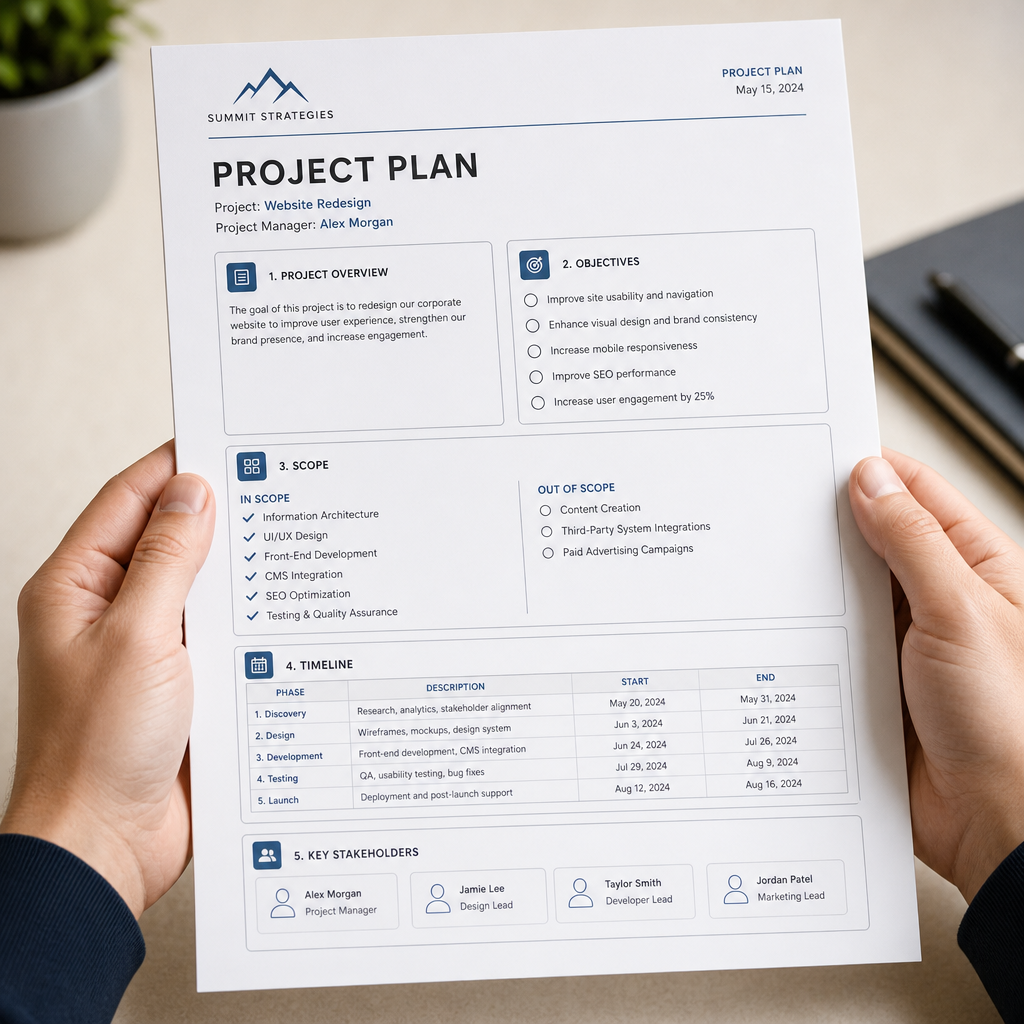
1. Project overview. One paragraph. What is the video, why does it exist right now, and what event or business moment is driving it? For example: “We are producing a three-minute company profile video to support our pitch to regional distributors at the Malaysia International Trade Exhibition in Q3.”
2. Objective. A single, measurable goal. Not “increase brand awareness.” Instead: “Drive 200 registrations for our product launch webinar from this video placed on our homepage.”
3. Target audience. Demographic plus behavioral description. This is covered in detail in the next section.
4. Key message. The one thing viewers must remember after watching. If you cannot write it in one sentence, you do not know it yet.
5. Distribution channels. Where exactly will this video live? Your company website homepage, a LinkedIn paid campaign, a physical event screen, or all three? Each requires different aspect ratios, pacing, and opening hooks.
6. Deliverables. Specify exact formats: a master file at 1920×1080 for broadcast, a square cut for social, a shorter 30-second version for ads. Ambiguity here creates post-production billing disputes.
7. Timeline and milestones. Include the date of any hard deadlines such as an event or a product launch, not just the final delivery date.
8. Budget range. A confirmed budget range is not optional. Without it, a production house cannot make responsible recommendations about crew size, locations, animation complexity, or music licensing.
Pro tip: Structure your brief as a fillable document with section prompts, not a blank page. When internal stakeholders have to fill in specific fields, they surface disagreements about the video’s purpose before production begins rather than during the review stage.
Defining Your Video Objective with Precision
The objective section is where most corporate briefs fail. Marketing teams write objectives that sound measurable but are not: “strengthen our brand positioning” or “communicate our values to stakeholders.” These are directions, not objectives. An objective has a number and a deadline attached to it.
Types of Corporate Video Objectives
For a video production house Malaysia to design the right creative approach, they need to understand which of these objective types applies to your project.
Conversion objectives apply when the video needs to move a viewer toward a specific action: booking a demo, downloading a report, registering for an event, or purchasing a product. These videos need a clear call to action and typically perform better when they are shorter and more direct.
Awareness objectives apply to brand films, company profiles, and event highlight reels where the goal is reach and recall rather than immediate action. These allow for more storytelling depth but require a distribution strategy to define what “success” actually means in audience numbers.
Internal communication objectives cover training videos, CEO messages, and change management content aimed at employees. These rarely need cinematic production values. They need clarity, credibility, and brevity.
A common mistake is assigning an awareness objective to a video that is actually being placed in a conversion context, such as a long brand story video used as a LinkedIn ad. The creative approach for each objective type is fundamentally different, and the brief is where that distinction has to be made.
“The most expensive word in marketing is ‘and.’ A video that tells your brand story AND explains your product AND drives sign-ups will do none of those things effectively.” – Ann Handley, Chief Content Officer, MarketingProfs
Audience Specification That Production Teams Can Use
“Our audience is C-suite executives and procurement managers in the manufacturing sector” is a start, but it is not enough for a production team to make creative decisions. Useful audience specification goes further and answers three questions that directly affect how the video is written, shot, and edited.
The Three Questions Your Brief Must Answer About Your Audience
What does your audience already believe about you or your category? If your viewers are already warm, familiar with your brand, and evaluating competitors, your video can skip the context-setting and move faster toward differentiation. If they are cold audiences seeing you for the first time, the video needs to establish credibility early.
What does your audience distrust? In the Malaysian B2B market, overly polished, advertisement-style videos often create skepticism among procurement professionals who respond better to case studies and demonstrations of operational competence. Knowing this changes the visual language and scripting approach entirely.
Where and when will they watch? An audience watching a video on a trade show floor is distracted and sound-compromised. They need strong visuals and text overlays. An audience watching a video on a desktop during a deliberate research session can handle narration and complex information. Your brief must specify the viewing context, not just the platform.
Pro tip: Include one or two verbatim quotes from actual customer conversations or sales calls in your brief. A line like “our clients always ask why compliance documentation takes so long” gives a scriptwriter more usable material than three paragraphs of marketing persona description.
Budget and Timeline Communication
Malaysian corporate clients frequently withhold their budget from production houses in the belief that it gives them negotiating power. In practice, it produces the opposite outcome. A production team that does not know your budget will either under-propose (giving you a quote that does not cover what you actually need) or over-propose (quoting for capabilities you do not require).
How to Frame Budget in Your Brief
State a range, not an exact number. “We are working with a budget between RM 15,000 and RM 25,000” gives a production company the information needed to design the right scope: whether to include aerial footage, how many shooting days are feasible, whether motion graphics are practical, and what music licensing tier applies.
Timeline communication must include both the hard deadline and the internal review milestones. If your video needs to be approved by three departments and a legal team, that process typically adds two to three weeks to the timeline. A production house needs to know this before they build a production schedule, not after the first cut is delivered.
The data consistently shows that timeline overruns in video production are caused by internal client approval delays more often than by production team issues. Building review time into the brief and communicating it upfront is the most reliable way to protect your delivery date.
Tone, Style, and Brand Alignment
“Professional” is not a tone descriptor. Every corporate video production company in Malaysia already assumes you want something professional. Tone specification must go further and articulate the emotional register you want the audience to leave with.
Practical Tone Descriptors That Production Teams Can Execute
Instead of “professional and modern,” try: “Confident without being boastful. The tone should feel like a trusted senior colleague explaining something clearly, not a salesperson closing a deal.” That gives a scriptwriter and director real direction.
For style, reference three to five specific videos that represent the aesthetic you want, and annotate each one. Note whether you like the pacing, the color grading, the voiceover gender and accent, the graphic treatment, or the music style. Unannotated reference videos are ambiguous. Annotated ones are instructions.
Brand alignment in video means more than logo placement. Include your brand guidelines in the brief and flag any specific requirements: colors that must appear or must be avoided, competitor brands that must not appear in the same frame as yours, spokesperson approval requirements, and any visual claims that require legal sign-off before they can be scripted.
Comparison of Brief Formats
Not all creative brief formats are equally suited to corporate video production. Here is a direct comparison of the three formats most commonly used by marketing teams working with Malaysian production houses.
| Brief Format | Best Suited For | Key Limitation |
|---|---|---|
| One-page narrative brief | Simple, single-objective videos such as CEO messages or short product promos. Fast to write and easy to share internally. | Insufficient for multi-deliverable projects or complex productions with multiple stakeholders. Easy to omit critical technical requirements. |
| Structured form-based brief | Multi-camera event productions, explainer videos, and any project with multiple deliverables and formats. Forces completeness across all required fields. | Can feel bureaucratic and slow internal sign-off if stakeholders treat it as a low-priority admin task rather than a strategic document. |
| Collaborative brief built with the production house | High-budget brand films and annual event highlights where the production company is brought in early as a creative partner, not just a vendor. | Requires significant pre-production time investment from both sides. Not cost-effective for short-turnaround or lower-budget productions. |
Common Mistakes That Derail Video Briefs
After reviewing dozens of corporate video briefs, the same patterns appear repeatedly in projects that end up over budget or requiring significant revision rounds. These are the mistakes worth avoiding specifically.
Writing the Brief After Internal Alignment Has Already Broken Down
The most damaging scenario in corporate video production is when the marketing team submits a brief to a production house without full internal alignment on the video’s purpose. The CFO thinks it is a cost-reduction story. The CEO thinks it is a brand elevation piece. The events team thinks it is an event promotional tool. When these views are not reconciled before the brief is submitted, they resurface during the review stage, and the production team gets caught in the middle of an internal argument they were never equipped to resolve.
The brief-writing process itself should function as an internal alignment exercise. If your team cannot agree on the answers to the eight components listed earlier, you are not ready to brief a production house.
Omitting the Distribution Strategy
A common mistake is treating distribution as a post-production decision. In reality, the distribution channel determines the creative approach from the first frame. A video designed for live event screening needs to open with high visual impact because audiences are mid-conversation and glancing up. A video designed for LinkedIn autoplay needs to hook viewers in the first three seconds with text overlays because 80 percent of LinkedIn video is watched without sound, according to LinkedIn’s own platform data.
Specify distribution in the brief, and specify it with channel-level detail, not just “social media.”
Confusing References with Instructions
Sending a link to a competitor’s video and saying “something like this” is not a creative direction. It is an invitation to misinterpretation. Annotate every reference. State what you like and what you do not like. If you love the pacing of a reference video but want a different visual style, say exactly that. Production teams are not mind readers and should not have to be.
Pro tip: Run your brief through a simple internal test before sending it to a production company. Ask a colleague who has no involvement in the project to read it and then answer: what is this video trying to do, who is it for, and what should viewers do after watching it? If they cannot answer all three correctly, your brief needs more work.
We would love to hear how your team approaches video briefs. What has worked, or has not worked, when briefing a production house in Malaysia?
Frequently Asked Questions
How long should a creative brief for a corporate video be?
The ideal length is one to three pages. A brief that runs longer than three pages is usually trying to substitute for conversations that should happen in a pre-production meeting. The goal is specificity, not comprehensiveness. Cover the eight core components concisely and let the pre-production discussion fill in the remaining detail.
Who should sign off on the creative brief before it goes to the production house?
At minimum, the brief should be approved by the person with budget authority, the person accountable for the video’s business outcome, and any stakeholder who will have final approval over the finished video. Getting these sign-offs before briefing prevents the situation where a production team receives conflicting revision instructions from different internal reviewers midway through the project.
Can I use the same creative brief template for different types of corporate videos?
A single template can work for most video types if it includes conditional sections. For example, a live streaming production for a corporate event requires additional fields covering broadcast platform, streaming resolution, and real-time monitoring requirements that a simple explainer video brief does not need. Start with a core template and add type-specific fields for event coverage, promotional videos, and internal communications separately.
Should the creative brief include a script or is that the production team’s job?
The brief should include a messaging outline, not a finished script. Provide the key message, supporting points, and any mandatory claims or legal language. The scripting process is a creative deliverable that the production house develops from your brief. Providing a finished script in the brief often constrains creative teams unnecessarily and produces videos that feel written rather than produced.
What is the difference between a creative brief and a production brief?
A creative brief defines the what and why: the objective, audience, message, tone, and intended outcome. A production brief defines the how: shooting schedule, crew requirements, equipment list, location logistics, and technical specifications. Both documents are necessary for a full corporate video project. The creative brief comes first and informs the production brief. Confusing the two, or trying to combine them into a single document, typically results in a document that does neither job effectively.
How specific should the budget range be in the brief?
Specific enough to define scope, not so specific that it eliminates negotiation. A range of RM 10,000 to RM 15,000 tells a production house whether aerial footage, professional actors, or animated sequences are realistic options for your project. Saying only “budget is flexible” or refusing to state a range forces the production company to present multiple scenarios, which delays the proposal stage and wastes both parties’ time.
References
- HubSpot marketing research and statistics hub covering content strategy, video marketing performance, and campaign planning benchmarks
- Forbes business and marketing editorial covering brand communication strategy, corporate content production, and creative project management
- Statista global data platform with corporate video marketing adoption rates, production spend trends, and digital content consumption statistics
- Ahrefs blog covering content marketing strategy, audience intent research, and how content structure affects business outcomes
- McKinsey and Company research on B2B marketing effectiveness, stakeholder communication, and the business impact of structured content strategy