
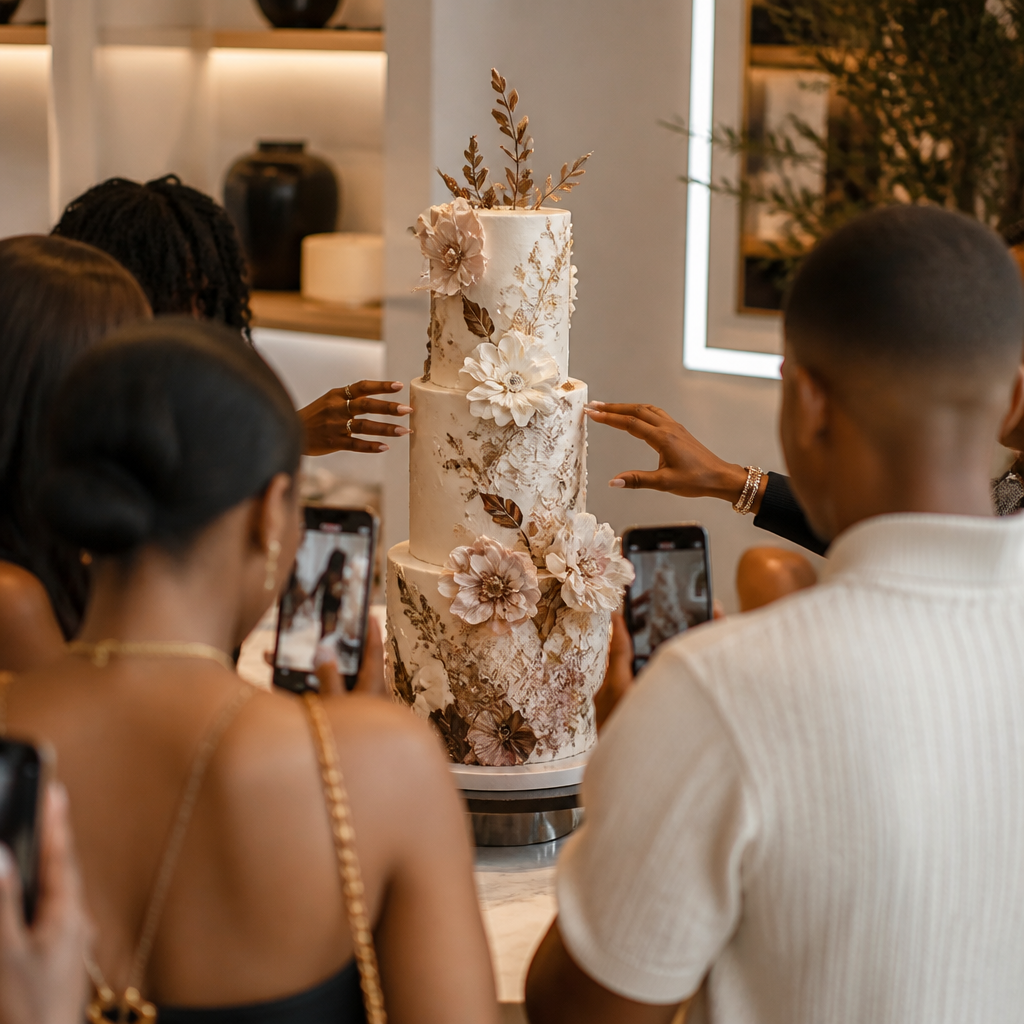
Most people have stood at a supermarket freezer section holding a RM25 box cake, felt vaguely guilty about it, and bought it anyway. But the moment a handcrafted cake Malaysia patisserie opens a box in front of guests, the room changes. Phones come out. People lean in. The conversation shifts from “let’s get this over with” to “wait, can I have that corner piece?” The price difference between a mass-produced cake and a properly made artisan one is real, but so is the gap in what you actually get: the ingredients, the skill, the taste, and the memory that outlasts the party. This article makes the case for why that investment is justified, and what to look for when you choose.
Table of Contents
- Quick Takeaways
- What “Handcrafted” Actually Means in a Cake Context
- The Ingredient Gap: Why It Matters More Than You Think
- Custom vs. Store-Bought vs. Chain Bakery: An Honest Comparison
- Taste and Texture That a Factory Cannot Replicate
- Why Premium Cakes KL and Selangor Make Sense for Celebrations
- How to Evaluate Artisan Cake Bakers Before You Order
- Frequently Asked Questions
- References
Quick Takeaways
| Key Insight | Explanation |
|---|---|
| Freshness is baked in, not added later | Artisan bakeries bake to order or in small daily batches. The cake you receive has not spent three weeks in a cold warehouse before reaching your table. |
| Premium ingredients produce a measurable taste difference | Pure French butter, Valrhona chocolate, and fresh vanilla beans create flavour depth that stabilisers and shortening simply cannot replicate. |
| Skill costs money, and that skill shows | Hand-piped decorations, layered flavour profiles, and precise bake times require training and time that mass production bypasses entirely. |
| Custom design is impossible from a shelf | A cake shaped around your occasion, flavour preference, and aesthetic cannot be produced at scale. Personalisation requires individual attention. |
| Artisan cakes carry real event memory | Guests photograph and talk about a striking handcrafted cake. A generic cake is eaten and forgotten. The difference in recall is not trivial for celebratory moments. |
| Local-inspired flavours only exist in artisan kitchens | Options like Cendol Cake or Pandan-layered creations require actual culinary development. No mass producer invests in small-batch Malaysian-inspired profiles. |
| The per-slice cost comparison is misleading | A custom cake priced at RM250 for 20 slices works out at RM12.50 per serving of freshly made, artisan dessert. That is cheaper than most restaurant desserts by a notable margin. |
What “Handcrafted” Actually Means in a Cake Context
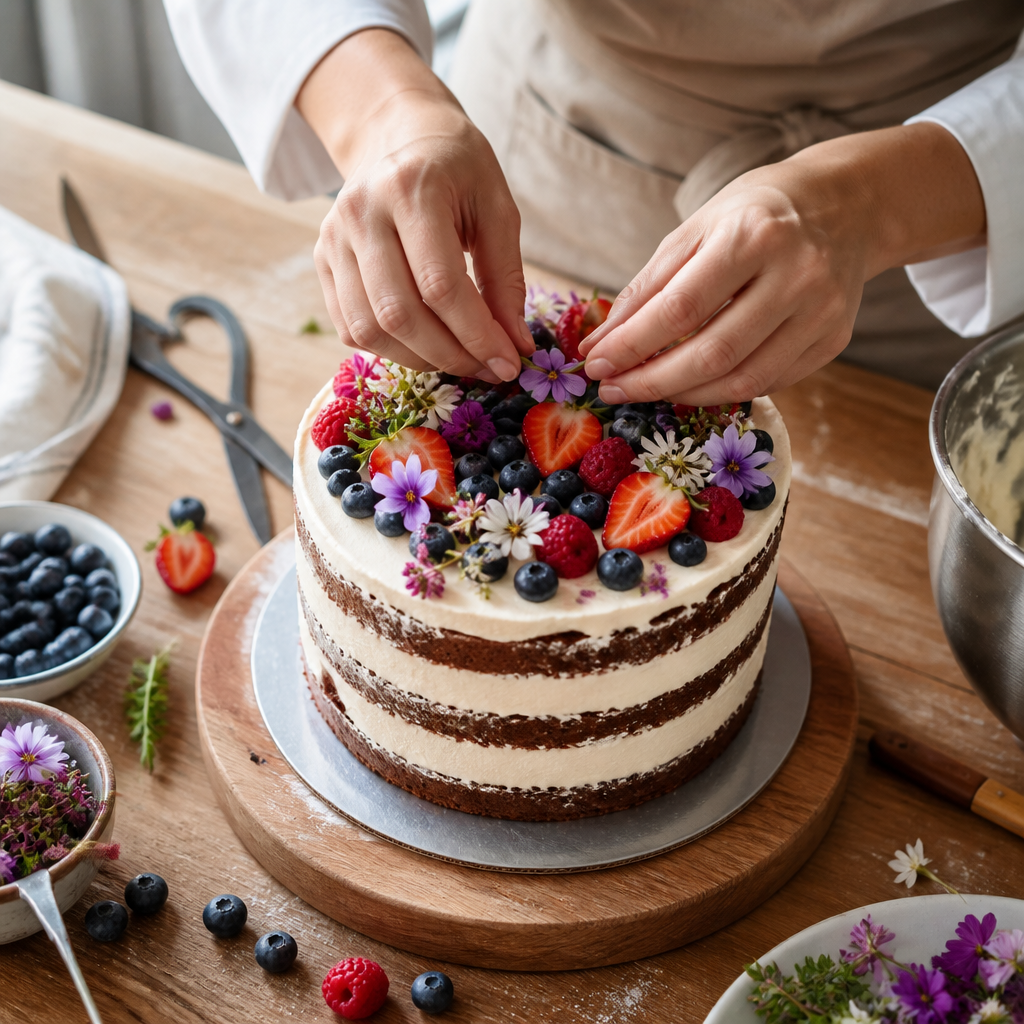
The word “handcrafted” gets thrown around loosely in food marketing. In a genuine artisan cake context, it has a specific meaning: the baker makes decisions at every stage of production that a machine or a standardised production line cannot make. The sponge is mixed to a feel, not just a timer. The layers are levelled by eye and experience. Decorations are piped, sculpted, or assembled by hand, not pressed from a mould.
This matters because baking at a craft level is a series of judgement calls. Oven temperatures vary. Humidity in a Malaysian kitchen changes how pastry behaves. A skilled pastry chef compensates for these variables in real time. A factory line cannot. The result of that constant human attention is a product that is both consistent in quality and genuinely individual in character.
At a patisserie like Petite Serie Desserts, the French patisserie tradition underpins everything from croissant lamination to entremets construction. These are techniques that take years to develop and cannot be shortcut without the finished product showing it. When you order a Black Forest Gateau or a Burnt Cheesecake from a kitchen that applies this level of craft, you are not just buying a cake: you are buying the accumulated skill of the baker who made it.
The Ingredient Gap: Why It Matters More Than You Think
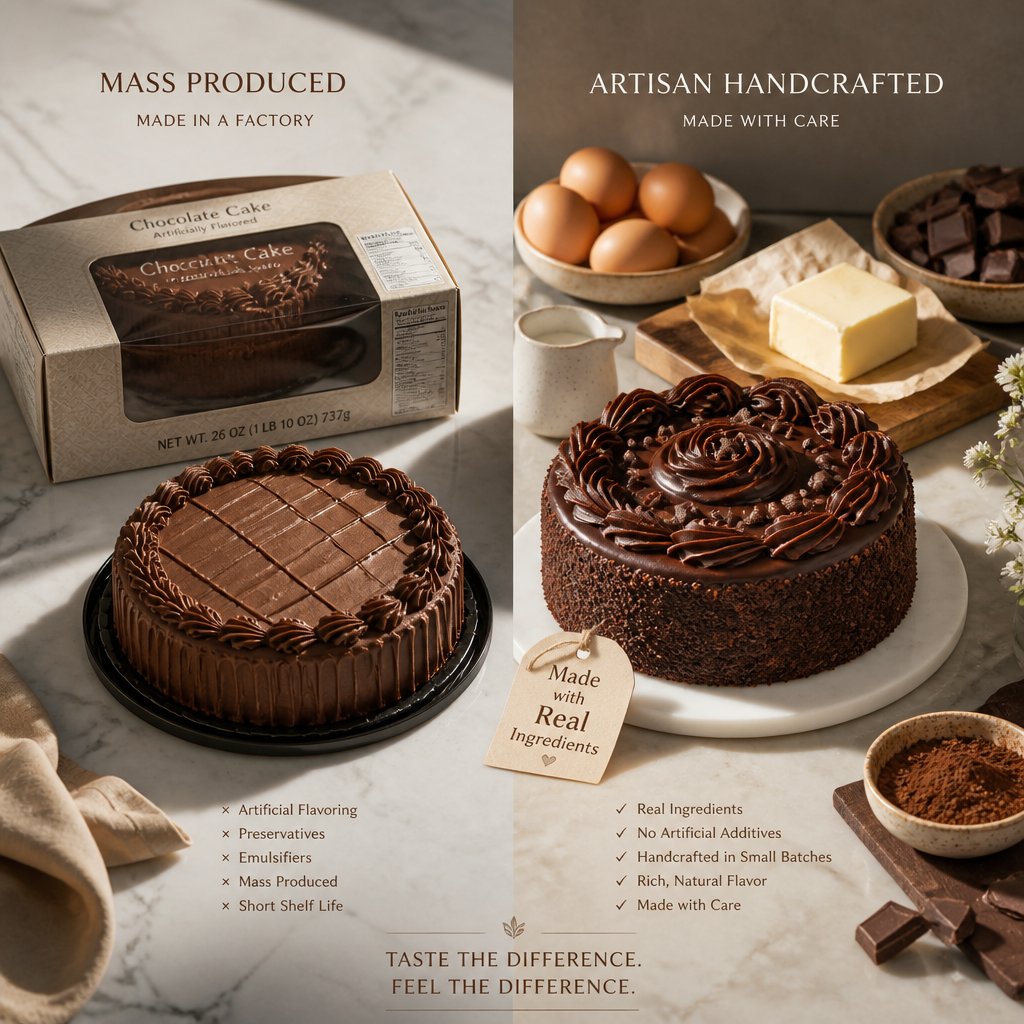
The fastest way to understand why artisan cakes cost more is to look at what goes inside them. Custom cake bakers in Malaysia routinely work with pure French butter, Valrhona chocolates, and vanilla beans fresh from the pods. These are not marketing claims. They are ingredient choices that directly produce a richer, cleaner flavour than the vegetable shortening and artificial vanilla essence found in mass-market products.
What Premium Ingredients Actually Change
Real butter creates a flavour complexity and a mouthfeel that margarine or shortening cannot replicate. High-cacao chocolate from a quality supplier produces a depth of bitterness and aroma that compound chocolate does not have. Fresh fruit purees instead of tinned fillings mean the colour and taste come from the actual fruit, not a stabiliser. These are differences you can taste immediately when you put the two side by side.
Custom cakes can also include ingredients that mass bakers would never touch: imported beetroot, fresh passionfruit, organic eggs, alcohol-infused layers, or locally sourced pandan and coconut. Each of these raises the material cost of the cake and raises the ceiling of what the flavour can achieve.
The Hidden Cost of Cheap Cakes
A common mistake is treating the sticker price of a supermarket cake as a fair comparison point. It is not. That cake was made at volume using ingredients purchased at commodity scale, often preserved to extend shelf life, and decorated with colourings that bear no relationship to real food. You pay less, but you are eating something fundamentally different. The cheaper option is not a discount version of the artisan cake: it is a different product category entirely.
“Cheap cakes prioritise scale and affordability. Bakery cakes prioritise freshness, craftsmanship and personalisation. Neither is wrong – they simply serve different celebrations.”
Pro tip: When comparing cake prices, calculate the cost per slice including what you are actually serving your guests. A RM280 artisan cake divided across 22 servings of freshly baked, premium dessert competes very differently with a RM25 supermarket slab than the headline price suggests.
Custom vs. Store-Bought vs. Chain Bakery: An Honest Comparison
Not all non-supermarket cakes are equal. There is a meaningful difference between an artisan patisserie, a chain bakery, and a supermarket option. The table below maps the real distinctions across dimensions that matter for a celebration purchase.
| Factor | Supermarket / Mass-Market Cake | Chain Bakery Cake | Artisan Handcrafted Cake (e.g., Petite Serie) |
|---|---|---|---|
| Ingredient quality | Commodity-grade, heavily preserved | Mid-range, standardised across all outlets | Premium: French butter, quality chocolate, fresh dairy |
| Freshness | Made days or weeks ahead, chilled or frozen | Made in batches, rotating display | Baked to order or in small same-day batches |
| Customisation | Pre-set designs, limited message options | Some flavour and size choices, standard decorations | Full custom: flavour, design, occasion, dietary needs |
| Flavour range | Basic chocolate, vanilla, fruit | Wider but standardised across franchise menu | Broad including French classics and local-inspired options like Cendol Cake |
| Visual impact | Generic; interchangeable with other brands | Consistent but familiar to anyone who has visited the chain | Unique to each order; distinctive enough to photograph |
| Baker expertise | Production line assembly | Trained to brand specifications | Patisserie-trained with craft knowledge in lamination, entremets, and decoration |
| Best suited for | Last-minute, low-stakes situations | Convenience purchases, office celebrations | Birthdays, milestone events, weddings, bespoke gifting |
The chain bakery sits in a middle ground that is worth examining carefully. It offers more than a supermarket option, but its core limitation is standardisation. Every outlet produces the same product using the same formula. That consistency is a feature for reliability, but it is a hard ceiling on quality. An artisan kitchen has no such ceiling because each cake is a separate creative and technical exercise.
Taste and Texture That a Factory Cannot Replicate
Taste is the argument that closes the case. You can read about ingredients and technique, but the actual proof is in a single bite of a properly laminated croissant or a well-constructed entremets with balanced sweetness, contrasting textures, and a clean finish.
Why Texture Is Half the Experience
Artisan baking produces textures that are genuinely different from their mass-market equivalents. A croissant with proper lamination, for example, has a shatteringly crisp exterior that yields to a light, layered interior. This is the result of the dough being folded with cold butter through a precise sequence of steps that cannot be rushed. A factory croissant skips or compresses these steps and produces something that is recognisably the same shape but is a different experience to eat.
The same principle applies to cakes. A well-made Black Forest Gateau has light, moist sponge layers that have been soaked at the right point in production, a cream that holds without becoming dense, and cherries that provide actual acidity against the richness of chocolate and cream. Getting all three right simultaneously is a skill. Getting any one of them wrong collapses the whole structure of the dessert.
Local Flavours Require Real Development
One area where artisan Malaysian patisseries offer something genuinely unavailable elsewhere is locally inspired flavour development. A Cendol Cake that actually captures the cold sweetness of pandan jelly against coconut cream requires a baker who has thought carefully about how to translate a beloved drink into a layered pastry format. This is recipe development work, not just ingredient substitution. Mass producers do not invest in it because the volumes do not justify the development cost. Small artisan kitchens do it because it is their point of difference and their craft.
Pro tip: If you are ordering a celebration cake for a Malaysian audience, a locally inspired flavour option like Pandan Coconut, Cendol, or Gula Melaka tends to generate more conversation and excitement than a standard chocolate or vanilla offering. It signals that the host thought specifically about the people in the room, not just the occasion.
Why Premium Cakes KL and Selangor Make Sense for Celebrations
Kuala Lumpur and Selangor have a genuine concentration of artisan patisseries producing premium cakes KL buyers can actually access with same-day or next-day delivery. This was not always the case. The growth in quality patisserie culture in the Klang Valley over recent years means that choosing a handcrafted cake over a mass-market one is a practical option for most people planning a celebration, not a luxury that requires days of lead time and complicated logistics.
The Occasion Justifies the Decision
A birthday happens once a year. An anniversary, a graduation, a baby shower, these are not repeating weekly events. They are markers that people remember and reference for years afterward. The cake sits at the centre of photographs, of the moment the candles are blown out, of the memory that the people in the room carry forward. A cake that is genuinely impressive contributes to that memory in a real way. A generic one does not add anything to it.
This is not sentimentality. It is a practical observation about what your guests will remember and what the host will feel about the decision afterward. The extra cost of a handcrafted option from a patisserie like Petite Serie’s celebration cakes range is absorbed into the event budget once. The memory of a spectacular cake at a significant celebration lasts considerably longer.
Artisan Bakeries in KL Offer More Than Just Cakes
One practical advantage of working with a specialist artisan patisserie in KL is that the event dessert experience extends beyond the main cake. A patisserie that also produces petit fours, tarts, brownies, and specialty pastries allows you to build a complete dessert table around a central showpiece cake without sourcing from multiple vendors. Consistency of quality across all items is significantly easier to guarantee when they come from a single kitchen with a unified standard.
For event planners and party organisers in the Klang Valley, this is a real operational advantage. A single point of contact for all dessert elements, same-day delivery capability, and a consistent premium standard across the range removes a meaningful logistical variable from event planning.
How to Evaluate Artisan Cake Bakers Before You Order
Not every bakery that uses the word “artisan” in its marketing delivers at an artisan standard. There are practical ways to separate genuine craft from marketing language before you commit to an order.
Ask About Ingredient Sourcing Directly
A baker who is genuinely using premium ingredients can tell you exactly what they use and why. Ask about the butter, the chocolate, the flour. A vague answer about “quality ingredients” without specifics is a signal that the answer matters less to them than the marketing. A baker using real French butter or a quality couverture chocolate will typically tell you without being asked, because it is a point of pride in their work.
Look at the Texture, Not Just the Decoration
Social media has produced a generation of visually spectacular cakes that taste mediocre because the focus went entirely into the exterior. A useful evaluation test is to look at cross-section photographs of cut cakes, not just the outside. Even layers, consistent crumb, and visible real fillings are signs of genuine baking skill. An extremely elaborate exterior sitting on a dense, uneven sponge is a warning sign.
Verify the Ordering Lead Time and Delivery Capability
A genuine artisan kitchen manages lead times carefully because quality production cannot be infinitely scaled in response to last-minute demand. Patisseries that offer same-day delivery in KL and Selangor while maintaining quality have invested in production planning that makes this possible. If a baker claims same-day capability for any custom cake regardless of complexity, that is worth questioning. Realistic lead time expectations are a mark of a professional operation, not a weakness.
In practice, ordering a custom celebration cake with three to seven days of lead time gives an artisan kitchen the space to source the right ingredients, plan the bake schedule, and deliver at their actual quality standard. Last-minute orders are possible at a good patisserie because they plan for them, not because they cut corners to accommodate them.
Frequently Asked Questions
Why do handcrafted cakes in Malaysia cost significantly more than supermarket cakes?
The cost difference reflects four real factors: premium ingredients purchased at small-batch prices rather than commodity volume, the skilled labour of a trained pastry chef who makes individual decisions throughout production, the time investment in hand decoration and custom design work, and the freshness of a product baked to order rather than weeks in advance. A supermarket cake is a different product category produced under entirely different constraints. The price comparison is not between equivalent goods.
How far in advance should I order a handcrafted celebration cake in KL or Selangor?
For a standard celebration cake with moderate customisation, three to five days is a reasonable minimum at most artisan patisseries. For elaborate multi-tier designs, sculpted decorations, or orders during peak periods like school holidays and major public holidays, one to two weeks ahead gives the kitchen appropriate time to plan. Some patisseries, including those with established same-day delivery systems, can accommodate shorter notice for certain items. Always check directly with the bakery rather than assuming availability.
What makes an artisan cake from a KL patisserie better than one from a well-known chain bakery?
The key difference is the ceiling on quality. A chain bakery produces every cake to the same standardised formula across all outlets, which guarantees consistency but fixes quality at the level the formula was written to. An artisan patisserie has no such formula ceiling. Each cake is a separate exercise in craft, allowing the baker to work with better ingredients, apply more refined technique, and produce something that is genuinely individual rather than interchangeable with thousands of identical products made the same week in other locations.
Are locally inspired flavours like Cendol Cake or Pandan Coconut actually worth trying, or are they novelty options?
When executed well by a skilled pastry kitchen, local-inspired flavours are not novelty items. They are legitimate flavour profiles developed specifically for a Malaysian palate. Pandan has a genuine floral complexity that works well in layered cake formats. Cendol profiles, when properly translated, create a contrast of coconut cream richness against the vegetal sweetness of pandan that is genuinely distinctive. The key is that the baker has thought through the translation from drink or dessert format into cake structure, rather than just adding pandan colouring to a vanilla base.
What should I look for in a why buy artisan cake Selangor search to find a genuinely skilled patisserie?
Look for bakeries that show cross-section images of their cakes alongside the exterior shots, that can specify what ingredients they use when asked, that have realistic lead time requirements for custom work, and that have a range of products showing technical breadth rather than just one signature item. A patisserie that produces both laminated pastries and layered entremets is demonstrating a wider range of genuine baking skill than one that focuses only on decorated novelty cakes. Read reviews for comments on flavour and texture specifically, not just visual presentation.
Can I order artisan pastries and petit fours alongside a celebration cake from the same patisserie?
Many specialist artisan patisseries in KL and Selangor offer a full range of dessert items beyond celebration cakes, including croissants, Danish pastries, tarts, brownies, and petit fours. Ordering all dessert elements from a single kitchen has a practical advantage: the quality standard, flavour profile, and visual aesthetic are consistent across everything served. This matters particularly for event dessert tables where visual cohesion is part of the presentation and where guests will naturally compare the different items they are eating.
Have you ordered a handcrafted cake for a celebration recently? Tell us what made the experience worth it, or what you wished you had known before choosing.
References
- Why custom cakes in Malaysia cost more than supermarket alternatives: a breakdown of ingredients and time
- An overview of custom cake bakers in Malaysia and the premium ingredients they use
- A bakery’s honest explanation of the difference between artisan and mass-produced birthday cakes
- Custom cakes versus store-bought options: what actually justifies the higher price point
- A cake maker explains why handcrafted cakes cost more and why that cost reflects real value