
Most corporate teams in Malaysia sign a contract with a video production house before asking the questions that actually matter. The result: a polished-looking proposal, a budget that balloons mid-project, and a final cut that looks nothing like the brand brief. HubSpot reports that 91% of businesses use video as a marketing tool, which means competition for good production talent is fierce and vendors know it. Before your organisation commits to any video production house Malaysia clients should treat the vetting process like a procurement exercise, not a creative chat over coffee.
Table of Contents
- Quick Takeaways
- Why These Questions Matter More Than the Showreel
- Comparing Production House Approaches at a Glance
- Frequently Asked Questions
- References
Quick Takeaways
| Key Insight | Explanation |
|---|---|
| Portfolio relevance beats portfolio size | A production house with three corporate event videos in your sector is more useful than one with fifty unrelated brand films. |
| Named team members matter | Freelancers-on-call are not the same as an in-house crew. Ask specifically who will direct, shoot, and edit your project. |
| Pre-production time is not billable padding | Briefing sessions, scripting, and storyboarding account for roughly 40% of total production quality. A house that skips this phase is cutting corners. |
| Revision rounds must be capped in writing | Unlimited revisions is a red flag, not a perk. It signals the production house does not have a clear creative process. |
| Footage ownership is a legal question, not a courtesy | Raw files, B-roll, and music licences all need clear assignment in the contract before any payment is made. |
| Live streaming and multi-camera are separate skill sets | Not every production house that films events also manages stable real-time streams. Confirm technical capability with past streaming logs or client referrals. |
| Measurement criteria should be agreed before production starts | If the production house cannot define what success looks like for your specific video, they are selling output, not outcomes. |
Why These Questions Matter More Than the Showreel
A showreel is a sales tool. It is curated to show the best work under the most favourable conditions, often with budgets and client access that your own project may never match. The ten questions below are designed to reveal what happens on an ordinary Wednesday when your brief is complex, your timeline is tight, and your budget is fixed.
Corporate video production Malaysia has grown significantly in the past five years. Brands in financial services, government-linked companies, and technology firms are all commissioning more video content than ever before. That growth has attracted a wide range of providers, from full-service studios with dedicated post-production suites to two-person operations renting equipment per project. The gap in quality, process, and reliability between those two ends of the market is enormous.
Asking the right questions is the only reliable way to tell them apart before you sign anything.

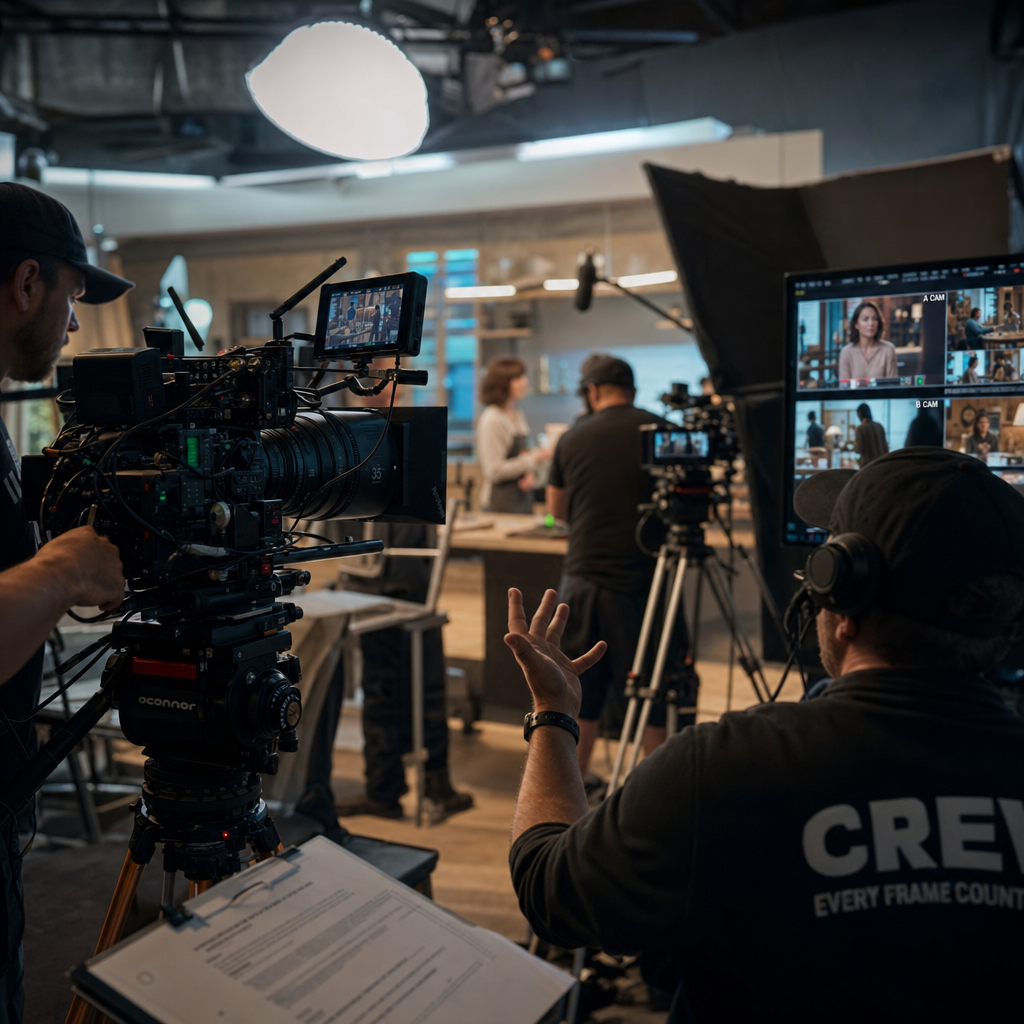
Does Your Portfolio Match Our Industry and Video Format?
This is the first and most important filter. A production house that specialises in music videos or property walkthroughs operates with a completely different visual language than one that regularly produces corporate event coverage, explainer videos, or promotional content for listed companies.
What to look for in the portfolio review
Ask to see at least three finished projects that share two of your three criteria: same industry, same video format, and similar production scale. If a vendor cannot produce three matching examples, they are asking you to fund their learning curve.
In practice, the most common mistake corporate teams make is being impressed by production value, meaning sharp visuals and good music, rather than narrative clarity. A video can look expensive and still fail to communicate a brand message effectively. Watch the portfolio pieces with the sound off first. If the story is still coherent, the production house understands visual storytelling, not just cinematography.
Pro tip: Ask the production house to name the specific director of photography and editor on each portfolio piece. If those people are no longer with the company, the work you are seeing is not a reliable indicator of what you will receive.
Who Exactly Will Be on Our Project?
This question separates established production studios from aggregators who win work and then subcontract it. Both models exist in the Malaysian market, and both can produce acceptable results, but they carry different risk profiles.
In-house crew versus freelance network
An in-house crew means consistent communication, shared institutional knowledge, and a team that has worked together before. A freelance network can be highly talented, but coordination risk increases with every additional contractor, especially on multi-camera event shoots where real-time communication between operators is critical.
Ask for the names and LinkedIn profiles of the director, director of photography, sound recordist, and lead editor who will work on your project specifically. If the production house hesitates, the answer is almost certainly that they do not know yet. That is a risk you should price into your decision.
“The crew is the product. Equipment can be rented. Experience and team chemistry cannot.” – Common principle cited across professional production associations including the International Documentary Association.
How Do You Handle Pre-Production?
Pre-production is where most corporate video projects succeed or fail, not in the edit suite. A production house that moves straight from contract signing to shoot day without a structured discovery, scripting, and storyboarding phase is cutting the process that protects your budget and your brief.
What a strong pre-production process looks like
A professional pre-production phase for a standard corporate video typically includes a detailed brief session, a written script or at minimum a structured outline, a shot list, a storyboard or mood board, a location recce if shooting on-site, and a confirmed call sheet at least five working days before the shoot. Each of those steps is a quality checkpoint.
Ask the production house to walk you through their exact pre-production checklist. If they describe it as flexible or client-led without any fixed milestones, that is a sign that the process is reactive rather than structured. Reactive production is expensive production.
Pro tip: Request a sample call sheet from a previous project, with client details redacted. A well-constructed call sheet is one of the clearest indicators that a production house runs a disciplined operation on shoot day.
Can You Manage Live Streaming and Multi-Camera Simultaneously?
For event planners and corporate communications teams running hybrid or fully virtual events, this question is non-negotiable. Live streaming and multi-camera production are technically distinct disciplines. A production house that films beautifully in post-produced formats may not have the encoding hardware, redundant internet infrastructure, or live switching operators needed to deliver a stable real-time stream.
Technical capability indicators
Ask specifically about their live streaming encoder hardware, their backup internet connection protocol, and the number of simultaneous streams they have managed at a single event. Ask whether they use a dedicated live vision mixer or whether switching is handled by the same operator managing camera one. These are not trick questions. Any production house that has genuinely delivered complex hybrid events will answer them without hesitation.
The Malaysian corporate events market has moved toward integrated productions where the in-room experience and the online audience are managed as a single production, not as two separate feeds. A production partner that treats live streaming as an add-on bolt-on rather than a core capability will create problems during the event itself, not before it.

What Is Your Revision Policy?
Revision policies reveal how a production house thinks about the creative process. A flat unlimited revisions offer sounds attractive, but in practice it means the production house has not committed to a defined creative direction and expects the client to course-correct their work indefinitely. That is not a service model. It is an absence of one.
A structured revision policy typically specifies a fixed number of rounds at each stage, usually two rounds of feedback at script stage, two at rough cut, and one at fine cut. Changes outside the agreed scope are quoted separately. This structure protects both parties and keeps the project moving forward.
Ask the production house to define what counts as a revision versus what counts as a scope change. The distinction matters. Changing a line of narration is a revision. Changing the entire angle of the video after the rough cut is a scope change that should carry a cost.
What Does the Quote Actually Cover?
Opaque pricing is one of the most common sources of conflict in corporate video production Malaysia engagements. A quote that lists only a single line item labelled Video Production Package tells you almost nothing about what is included and what will be billed additionally.
Line items to request in every quote
A transparent production quote should break out pre-production fees, crew day rates, equipment costs, location or permit fees, post-production hours, motion graphics if applicable, voiceover talent fees, music licencing, and delivery format costs. Any item not listed in the quote is a potential surprise invoice later.
Common additional charges that clients do not anticipate include overtime on shoot day, additional revision rounds, subtitle or captioning work, and format resizing for different distribution platforms. Ask explicitly whether each of those is included or billable separately before signing.
What Is a Realistic Timeline for Our Project?
A production house that promises a two-week turnaround for a fully graded, motion-graphics-heavy corporate video is either planning to cut the post-production process significantly short, or they are telling you what you want to hear. In practice, a standard three-minute corporate video with one shoot day takes three to five weeks from brief to final delivery when pre-production, editing, review cycles, and colour grading are all done properly.
Ask for a project schedule broken into phases, not just a delivery date. If the production house cannot produce a phased schedule on request, they are managing the project reactively rather than planning it proactively. For event coverage and live streaming work, also ask how quickly edited highlights or a full event cut can be delivered after the event itself.
Pro tip: Build a contractual buffer of five working days into every agreed delivery date. Unforeseen client-side delays in feedback, approval, or asset provision are the most common cause of timeline overruns, and having written buffer time prevents disputes about responsibility.
Who Owns the Footage After Delivery?
Footage ownership is a legal matter that is frequently treated as an afterthought in production agreements. The default position in many Malaysian production contracts is that the production house retains ownership of the raw footage and grants the client a licence to use the final edited deliverable. That distinction matters enormously if you want to repurpose content, extract B-roll for future campaigns, or work with a different editor in the future.
Ask for a clear statement in the contract that specifies who owns the raw files, the project files in the editing software, and any motion graphics assets created specifically for your project. Also confirm whether music licences are perpetual or time-limited, and whether those licences are for online distribution, broadcast, or both. A production house that cannot answer these questions clearly has not thought about the legal structure of what they are selling.
How Do You Measure Whether the Video Worked?
This question separates production vendors from genuine content partners. A production house focused purely on output will measure success by whether the video was delivered on time and on budget. A content partner will ask what the video is supposed to achieve before a single frame is shot, and will define success criteria accordingly.
For a promotional video, success might mean a target view-through rate or a conversion event. For an internal communications video, it might mean comprehension scores measured via a post-viewing survey. For live event streaming, it might mean peak concurrent viewers or average watch time. None of those metrics can be measured if they are not defined upfront.
According to Statista, video ad spending in Southeast Asia is projected to continue growing through 2027, which means the competitive bar for what counts as effective corporate video content is rising. A production house that cannot articulate performance benchmarks is not keeping pace with that bar.
Can You Provide Client References from Similar Projects?
Portfolio reviews show you what a production house is capable of. Client references tell you what it is actually like to work with them. These are very different data points, and both are necessary before making a hiring decision.
Ask for two to three references from clients who commissioned a project similar to yours in scope and format. When you contact those references, ask three specific questions: Was the project delivered on the agreed timeline? Were there unexpected costs? Would you commission this production house again for a high-visibility project?
A production house that is reluctant to provide references or offers only written testimonials rather than direct contact information is signalling that their client relationships may not survive direct scrutiny. In practice, confident production teams actively encourage reference calls because positive word-of-mouth is their most effective new business channel.
Comparing Production House Approaches at a Glance
| Evaluation Criterion | Full-Service Integrated Studio | Specialist Event Coverage House | Freelance Network Aggregator |
|---|---|---|---|
| Pre-production structure | Formal process with dedicated producer and scripting phase | Strong on logistics and scheduling, variable on scripting | Typically minimal, relies on client-supplied direction |
| Live streaming capability | Usually in-house with dedicated encoding hardware | Core competency, often owns redundant streaming rigs | Subcontracted, quality depends on individual contractors |
| Post-production turnaround | Three to five weeks for a standard corporate cut | Highlights within 48 hours, full edit in two to three weeks | Variable, dependent on freelancer availability |
| Pricing transparency | Detailed line-item quotes standard | Package-based with clear event day rates | Often single-line quotes with many potential add-ons |
| Footage ownership clarity | Contractually defined, usually full transfer available | Varies, raw files often retained by default | High risk of ambiguity, multiple contractors may hold files |
Frequently Asked Questions
What is a reasonable budget for corporate video production in Malaysia?
A professionally produced three-minute corporate video in Malaysia typically ranges from RM 8,000 to RM 35,000 depending on crew size, shoot days, motion graphics complexity, and post-production requirements. Live event coverage with multi-camera setups and live streaming infrastructure adds cost. Any quote below RM 5,000 for a full corporate production warrants serious scrutiny of what is being excluded.
How many cameras do you need for a corporate event shoot?
A minimum of three cameras is standard for a corporate event that includes a main stage, audience reaction shots, and speaker close-ups. High-profile launches or conferences with multiple simultaneous sessions may require five or more. A production house that proposes single-camera coverage for a multi-session event is either under-resourced or not fully briefed on your requirements.
What is the difference between an explainer video and a promotional video?
An explainer video is designed to make a complex product, service, or process easy to understand, typically using animation, narration, and a structured problem-solution format. A promotional video is designed to generate desire and brand affinity, usually with a stronger emotional or aspirational tone. They serve different objectives and require different scripting and visual approaches. A good production house will ask which one you actually need before quoting.
How do I protect my brand when working with a new production house?
Issue a formal brand brief before pre-production begins. This document should include your brand colour palette, approved typefaces, tone of voice guidelines, logo usage rules, and any restricted visuals or messaging. Ask the production house to sign off on a brand compliance checkpoint at script stage and again at rough cut. This prevents brand inconsistencies from reaching final delivery, where correction is expensive.
Is it worth paying more for a production house that includes video content strategy?
Yes, consistently. A production house that asks how the video fits into your broader content calendar, which distribution channels it will be used on, and what audience behaviour it is intended to change will produce work that performs better after delivery. Production quality and strategic alignment are both necessary. Paying a premium for strategy is cheaper than paying to reshoot a video that looks good but does not work.
What should I check in a production contract before signing?
Check for four things before signing any production contract: a clear payment schedule tied to project milestones rather than a single upfront payment, a defined revision policy with capped rounds, an explicit statement of who owns the raw footage and final files, and a late delivery clause that protects you if the production house misses agreed deadlines. If any of those four items is absent, request an amendment before signing.
If you have worked with a video production house in Malaysia and encountered questions or contract issues not covered here, share your experience in the comments. Your input helps other corporate teams make better informed decisions.
References
- HubSpot Marketing Statistics: data on video adoption rates among businesses globally
- Statista: Southeast Asia digital video advertising spend projections and market data
- Forbes: business insights on vendor vetting, contract management, and production ROI
- Malaysia Digital Corporation: official resource for the Malaysian digital content industry and production standards
- Ahrefs Blog: research and data on content marketing performance and video content strategy