
Most Malaysian businesses produce one or two corporate videos, declare the job done, and wonder why their competitors keep winning more clients. The problem is not the quality of those videos. The problem is that a single brand film cannot do the work of eight. Corporate video production Malaysia has matured significantly over the past five years, and companies that treat video as a full-stack content system, not a one-off project, are consistently outperforming those that do not. This guide breaks down exactly which eight video types belong in your marketing strategy and why each one serves a distinct function that the others cannot replace.
Table of Contents
- Quick Takeaways
- Why One Video Is Never Enough
- 1. Brand Story Videos
- 2. Explainer Videos
- 3. Event Coverage Videos
- 4. Live Streaming Productions
- 5. Testimonial and Case Study Videos
- 6. Product and Promotional Videos
- 7. Internal Training and Communications Videos
- 8. Social Media Video Content
- Comparing Video Formats by Business Objective
- Frequently Asked Questions
- References
Quick Takeaways
| Key Insight | Explanation |
|---|---|
| Brand story videos build trust before the sales conversation starts | Viewers who watch a company’s brand film are significantly more likely to contact that company versus those who only read about it. First impressions happen before the first meeting. |
| Explainer videos directly reduce sales cycle length | HubSpot reports that 96 percent of people watch explainer videos to learn about a product or service. Removing confusion early shortens the decision timeline for corporate buyers. |
| Event coverage video has a lifespan far longer than the event itself | A well-produced event video continues generating awareness, lead inquiries, and sponsor value for 12 to 18 months after the event date when distributed correctly. |
| Live streaming is now a standalone content asset, not just a broadcast | Multi-camera live streams can be edited into highlight reels, training clips, and social cuts, multiplying the content output from a single production investment. |
| Testimonial videos outperform written case studies in B2B contexts | Seeing and hearing a real client describe measurable results carries far more weight with procurement committees than a PDF case study. The emotional signal is irreplaceable. |
| Social media video content must be produced natively, not repurposed | A 90-second corporate brand film cropped to a square and posted on Instagram almost never performs. Platform-native video, shot and edited for the format, consistently outperforms repurposed content. |
| Internal videos reduce training costs and improve message consistency | Organizations using internal video for onboarding and communications report up to 50 percent reduction in time spent repeating the same information across departments and locations. |
Why One Video Is Never Enough
A corporate buyer at a Malaysian GLC or a marketing manager at a retail brand is not making decisions based on a single touchpoint. They watch your brand film, read your website, see your LinkedIn posts, and then ask a colleague if they have heard of you. Brand video content Malaysia works exactly like a sales funnel: different video types serve different stages of awareness, consideration, and decision.
In practice, the businesses getting the strongest ROI from video are not spending more on one very expensive brand film. They are producing a portfolio of video types that work together. A compelling brand story video pulls prospects in. An explainer video answers the inevitable “but how does it work?” question. A testimonial video closes the loop on credibility. None of these formats is interchangeable.
A common mistake is assuming that one polished corporate video can do all of this at once. It cannot. A video that tries to tell your story, explain your services, and present a client testimonial simultaneously ends up doing none of those things effectively. Each format has a specific job, and that specificity is what makes it perform.
1. Brand Story Videos
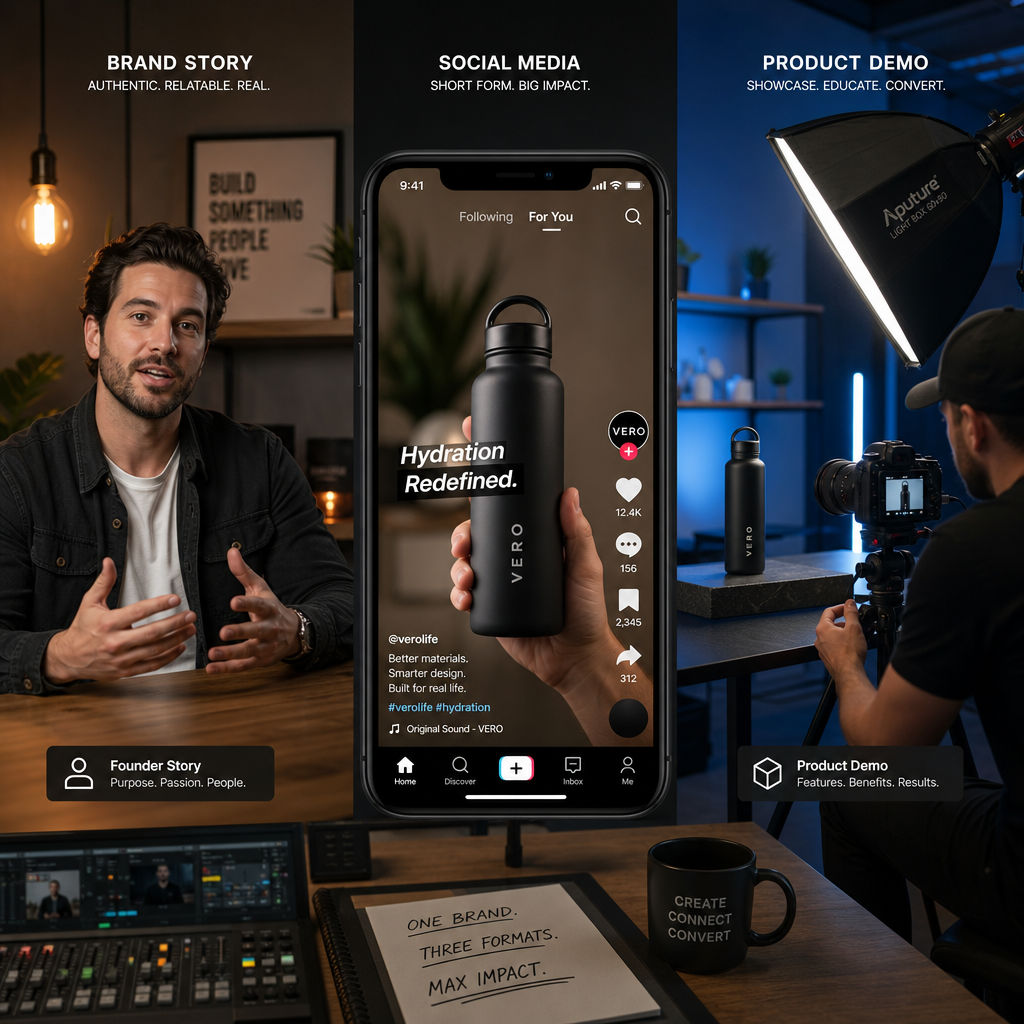
The brand story video is the foundation of any corporate video production Malaysia strategy. It answers the question every new prospect asks before they even pick up the phone: “Who are these people, and should I trust them?” A well-executed brand film communicates your company’s values, vision, and personality in two to three minutes without feeling like a sales pitch.
What separates a brand story video from a generic company profile
A company profile video lists what you do. A brand story video shows why you exist and who you are for. The difference is not cosmetic. When a procurement committee is evaluating two equally qualified vendors, the one with a compelling brand narrative wins disproportionately often, because people buy from people they feel they already know.
For Malaysian corporates, this is particularly important because many buying decisions still involve relationship-building. A brand story video gives your audience a way to start that relationship before the first meeting. It works at networking events, on your website homepage, and as a LinkedIn introduction for key stakeholders.
Pro tip: Keep your brand story video between 90 seconds and three minutes. Anything longer loses the majority of viewers before the call to action. If you have more to say, produce a series rather than extending a single video.
2. Explainer Videos
If your product or service has any complexity to it, an explainer video is not optional. It is the most efficient sales tool you can produce. According to HubSpot, 96 percent of people have watched an explainer video to learn more about a product or service, and 88 percent say they have been convinced to make a purchase or inquiry after watching one.
Animation versus live-action for Malaysian B2B explainers
The choice between animated and live-action depends on what you are explaining. For software platforms, financial products, or multi-step processes that cannot be easily filmed, animation is more effective because it can visualize abstract concepts clearly. For physical services, manufacturing processes, or anything that benefits from showing real people and real environments, live-action builds more credibility.
In practice, the most effective explainer videos for Malaysian B2B audiences combine both: a live-action introduction featuring a real person followed by animated graphics that walk through the process. This approach anchors trust through human presence while using animation to handle the complexity.
A common mistake is making explainer videos too long. The sweet spot for corporate explainers is 60 to 90 seconds. Every extra second increases drop-off rate. If your service genuinely requires more explanation, produce a series of short explainers rather than one long one.

3. Event Coverage Videos
Malaysian organizations invest heavily in corporate events, product launches, annual dinners, conferences, and industry summits. A common mistake is treating event coverage as an afterthought, assigning a single camera operator with no clear brief and expecting a polished highlight reel in return. The result is footage that captures what happened but fails to communicate why it mattered.
Multi-camera production as the baseline for credible event coverage
Professional event coverage requires at minimum three camera angles: a wide establishing shot that captures the scale and atmosphere of the event, a medium shot for speakers and presenters, and a close-up camera for audience reactions and detail moments. Single-camera event footage looks amateur regardless of post-production quality, and it limits the editor’s ability to create a dynamic, engaging final cut.
The strategic value of event coverage extends well beyond the event itself. A professionally produced highlight reel demonstrates organizational credibility to prospects who were not there, provides sponsor deliverables that justify their investment, and creates shareable content for your LinkedIn and YouTube channels. Events that attract media or government figures carry additional authority when documented professionally.
Pro tip: Brief your video production team at least two weeks before the event. Share the run-of-show, confirm which moments are non-negotiable highlights, and agree on a delivery timeline for the edited video. Last-minute briefings result in generic coverage that misses the moments that mattered most to your brand.
4. Live Streaming Productions
Live streaming for corporate events is no longer a fallback for when in-person attendance is restricted. It has become a primary content strategy for organizations that want to extend their event’s reach beyond the physical room. A product launch streamed professionally to 500 remote stakeholders has a broader immediate impact than the same event attended by 100 people in person.
The content multiplication model for live streams
The real case for investing in professional live streaming is what happens after the broadcast ends. A multi-camera live production generates hours of footage that can be segmented into shorter clips, edited into highlight reels, and repurposed as social media content, all from a single production day. Organizations that plan this repurposing strategy upfront get three to five times more content output per production day compared to those that treat the live stream as a single-use broadcast.
For Malaysian organizations hosting hybrid events, AGMs, investor briefings, or product launches, live streaming also creates a permanent record of the event that can be shared with stakeholders who could not attend, used in future onboarding materials, or repurposed as part of a thought leadership content series.
“Video has become the lingua franca of business communication. Organizations that invest in multi-camera live production are not just broadcasting events. They are creating content infrastructure.” – Wyzowl State of Video Marketing Report, 2024
5. Testimonial and Case Study Videos
Written case studies are useful. Video testimonials are persuasive. The difference is that a written case study asks the reader to imagine the credibility of your results, while a video testimonial shows a real human being describing a real outcome in their own words, with their face, their voice, and their genuine emotion on screen.
Why procurement committees respond to video testimonials differently
In B2B contexts, purchasing decisions are rarely made by a single person. They go through procurement committees, board approvals, or multi-stakeholder sign-offs. A video testimonial from a peer organization, ideally from a recognizable Malaysian brand or institution, does something written content cannot: it gives the skeptic in the room a visual, emotional answer to “but has this actually worked for someone like us?”
The data consistently shows that buyer trust increases significantly when the testimonial subject is from the same industry, market, or organization type as the buyer. This means your testimonial video portfolio should be deliberately segmented. Do not rely on a single testimonial from your most famous client. Build a library that represents the different sectors and organization sizes you serve.
Keep testimonial videos authentic. Scripted testimonials read as scripted on camera, and Malaysian audiences are particularly attuned to authenticity. Brief your clients on the topics you would like them to cover, then let them speak in their own words. Light coaching is fine. Heavy scripting destroys credibility.
6. Product and Promotional Videos
A promotional video has one job: to make the viewer want what you are offering. It is not the place for a comprehensive explanation of your services or a detailed brand narrative. It is a focused, high-energy piece of content designed to drive a specific action, whether that is registering for an event, requesting a proposal, or visiting a landing page.
Matching production style to the promotional objective
For product launches, the promotional video should generate anticipation and desire. For corporate services, it should create a clear sense of capability and differentiation. For event promotion, it should make the target audience feel that not attending would mean missing something important. Each of these requires a different production approach, pacing, and visual language.
Malaysian promotional videos for corporate audiences perform best when they lead with a specific outcome rather than a list of features. “We helped a leading Malaysian bank reduce their annual conference budget by 30 percent while tripling their stakeholder reach” is more compelling than “we offer multi-camera live streaming and post-production services.” Specificity converts. Generality does not.
7. Internal Training and Communications Videos
This is the most underutilized video format among Malaysian businesses, and it consistently delivers some of the strongest measurable ROI. Organizations with multiple offices, large headcounts, or complex compliance requirements waste enormous amounts of time and money repeating the same information through live briefings, printed manuals, and email chains.
Onboarding videos as a retention and consistency tool
A structured onboarding video series reduces the time it takes a new employee to become productive and ensures that every person in the organization receives the same foundational information regardless of who their direct manager is. This consistency is especially valuable for organizations that operate across multiple states or have high turnover in specific departments.
For corporate communications, video messages from senior leadership carry significantly more weight than email memos. A three-minute video from the CEO explaining a strategic change lands differently than a written memo. The tone, the expression, and the directness of face-to-face communication, even through a screen, builds alignment in a way that text cannot replicate.
The production standard for internal videos does not need to match your external brand content. Clean audio, consistent lighting, and clear visuals are sufficient. Authenticity matters more than production value in internal communications. The goal is clarity and trust, not impression management.
8. Social Media Video Content
Social media video is not a trimmed-down version of your corporate brand film. It is a distinct content format with its own rules, and producing it as an afterthought to your main video production schedule is one of the most common and most costly mistakes Malaysian marketing teams make.
Platform-specific production for LinkedIn, Instagram, and Facebook
LinkedIn video content for B2B audiences performs best in a 60-to-90-second vertical or square format that leads with a specific insight, problem, or result in the first three seconds. Captions are non-negotiable because the majority of LinkedIn video is watched without sound. Facebook video for Malaysian corporate audiences benefits from a slightly longer format with subtitles and a strong thumbnail. Instagram Reels rewards fast pacing, visual dynamism, and native audio.
Each of these platforms requires a different edit, different pacing, and often different footage. The most efficient way to produce platform-native social video is to plan it during the same production day as your main corporate video shoot. This requires briefing your production team to capture additional footage, interviews, and behind-the-scenes content specifically for social use. It adds minimal time to the production day and multiplies your content output significantly.
Pro tip: When briefing your video production partner, always ask for a social media cut package as part of the deliverables. At minimum, this should include three to five short clips formatted for LinkedIn, two square-format cuts for Facebook and Instagram, and a set of still frames pulled from the video for use as thumbnails and supporting graphics.
Comparing Video Formats by Business Objective
Not every video type serves the same stage of the buyer journey or the same business function. The table below maps the eight formats to their primary business objective, ideal distribution channel, and typical production investment level for Malaysian corporate contexts.
| Video Type | Primary Business Objective | Ideal Distribution Channel |
|---|---|---|
| Brand Story Video | Build awareness and establish trust with new prospects | Website homepage, LinkedIn company page, pitch decks |
| Explainer Video | Reduce confusion and shorten the sales cycle | Product pages, email campaigns, sales team presentations |
| Event Coverage Video | Extend event ROI and demonstrate organizational credibility | LinkedIn, website, sponsor reports, media kits |
| Live Streaming Production | Expand event reach and generate reusable content assets | Private links for stakeholders, YouTube, LinkedIn Live |
| Testimonial and Case Study Video | Overcome buyer skepticism and accelerate purchase decisions | Sales proposals, website case study pages, email follow-ups |
| Product and Promotional Video | Drive specific actions: registrations, inquiries, visits | Paid social, landing pages, event screens |
| Internal Training and Communications Video | Improve consistency, reduce training costs, build alignment | Internal LMS, company intranet, HR onboarding portals |
| Social Media Video Content | Build ongoing brand visibility and audience engagement | LinkedIn, Instagram, Facebook, TikTok for B2B brands |
The most important takeaway from this comparison is that no single video type covers more than two or three of these objectives well. Organizations that invest in only one or two formats are leaving significant strategic value uncaptured. A full corporate video production Malaysia strategy uses these formats in combination, not in isolation.
Frequently Asked Questions
How much does corporate video production in Malaysia typically cost?
Corporate video production costs in Malaysia vary significantly by format, scope, and production quality. A single-camera brand story video from a reputable production company typically starts around RM 8,000 to RM 15,000. Multi-camera event coverage for a full-day corporate event ranges from RM 12,000 to RM 30,000 depending on crew size, equipment, and post-production requirements. Live streaming production with professional switching and multi-camera setup starts around RM 5,000 for a half-day event. The key variable is not just the shooting day but the post-production: editing, color grading, motion graphics, and sound mixing make up between 40 and 60 percent of the total cost on most projects.
How long should a corporate brand video be?
For a brand story video intended for website and LinkedIn use, two to three minutes is the proven optimal range. Anything shorter often fails to establish sufficient emotional connection. Anything longer loses a significant proportion of viewers before the call to action. Explainer videos perform best at 60 to 90 seconds. Promotional videos for social media should be 15 to 30 seconds for paid placements. Internal communications videos can run longer, up to 10 minutes, because the audience has a specific reason to watch and is not scrolling past in a feed.
What is the difference between event coverage and live streaming production?
Event coverage refers to filming an event for post-production delivery, typically a highlight reel or full edit delivered days or weeks after the event. Live streaming refers to broadcasting the event in real-time to a remote audience. In practice, the best approach for major corporate events is to combine both: live stream the event for remote stakeholders while also capturing dedicated footage for a polished post-event highlight reel. The two productions can share crew and equipment with careful planning, which makes the combined approach more cost-efficient than running them separately.
Do Malaysian B2B companies actually use social media video effectively?
The honest answer is that most do not. The most common failure pattern is posting a polished corporate brand film on LinkedIn with no context, no caption, and no follow-up content strategy, then concluding that social media video does not work for B2B. What actually works is a consistent cadence of shorter, platform-native content: leadership commentary videos, client insight clips, behind-the-scenes production content, and event teasers. Malaysian B2B audiences on LinkedIn respond well to video content that leads with a specific, relevant insight rather than a brand message. The companies doing this consistently are building real audience relationships over time.
How do I brief a corporate video production company effectively?
A strong video production brief covers six elements: the specific objective of the video, the target audience and what matters to them, the key message you want viewers to take away, the intended distribution channel and format requirements, any mandatory inclusions such as logos, spokespeople, or product demonstrations, and the deadline and budget range. The biggest mistake organizations make is briefing only on what they want to show rather than what they want the viewer to think, feel, or do after watching. Start with the desired outcome and work backwards to the content. Production companies that ask about your audience and your objective before talking about cameras and equipment are the ones worth working with.
Is it worth investing in internal training videos for a small Malaysian company?
Yes, particularly for companies with more than 20 employees, multiple locations, or roles that have a structured onboarding requirement. The break-even point on an internal training video is typically reached after the video has replaced three to five live training sessions on the same content. For compliance training, safety procedures, and product knowledge, video also provides a documented record that everyone received the same information, which has genuine legal and operational value. Small companies can start with a modest production standard: clean audio, consistent lighting, and clear delivery are sufficient for internal use.
What type of corporate video has made the biggest difference for your organization’s marketing or internal communications? Share your experience in the comments below.
References
- HubSpot marketing and video statistics resource covering buyer behavior and video conversion data
- Statista data platform with digital video usage, corporate content marketing trends, and Southeast Asian media consumption reports
- Forbes business coverage of corporate video strategy, content marketing ROI, and B2B buyer behavior research
- Ahrefs blog covering content marketing distribution strategy and video SEO for B2B organizations
- McKinsey and Company research on B2B buyer decision-making, digital content influence, and marketing investment prioritization