
Most Malaysian corporate events reach only the people physically in the room. That is an enormous missed opportunity, especially when live streaming services Malaysia providers can now deliver broadcast-quality production at a fraction of the cost of a decade ago. Statista data from 2023 shows that live video content generates three times more engagement than pre-recorded content. Yet many event planners still treat live streaming as an afterthought, bolting it on two days before the event instead of building it into the production plan from the start. This guide fixes that.
Table of Contents
- Quick Takeaways
- Why Live Streaming Matters for Corporate Events in Malaysia
- Pre-Production Planning: The Work That Happens Before Any Camera Is On
- Technical Requirements for a Professional Corporate Live Stream
- Choosing the Right Streaming Platform for Your Corporate Event
- Virtual Event Production Malaysia: How Hybrid Events Work
- Common Mistakes That Kill Corporate Live Streams
- Measuring the Success of Your Live Stream
- Frequently Asked Questions
- References
Quick Takeaways
| Key Insight | Explanation |
|---|---|
| Internet connectivity is the single biggest failure point | A bonded 4G or dedicated fiber line with at least 10 Mbps upload speed is non-negotiable for stable HD streaming at Malaysian corporate venues. |
| Multi-camera setups increase viewer retention significantly | Switching between wide, medium, and close-up shots every 30 to 45 seconds keeps remote audiences engaged far longer than a single static camera feed. |
| Audio quality matters more than video quality | Viewers tolerate slightly soft video but will abandon a stream within 30 seconds of poor audio. Dedicated lapel and podium mics are mandatory. |
| Platform choice must match your audience, not your preference | A closed corporate AGM needs a private streaming platform. A product launch targeting a wide public audience performs better on YouTube Live or Facebook Live. |
| Live streaming doubles your event’s content lifespan | The recorded stream becomes a repurposable asset: highlight clips, social cuts, internal training material, and on-demand replays. |
| Rehearsals are not optional for hybrid events | A full technical run-through at least 48 hours before the event catches 90% of the problems that would otherwise appear live in front of your stakeholders. |
| Closed captions expand your reach in a multilingual market | Malaysia’s multilingual corporate audience benefits directly from real-time captions or on-stream text overlays, improving accessibility and comprehension. |
Why Live Streaming Matters for Corporate Events in Malaysia
The business case for live streaming a corporate event in Malaysia is straightforward: you have already spent the budget on venue, speakers, AV, and logistics. Broadcasting that event to remote stakeholders, employees across Sabah and Sarawak, or overseas partners costs a fraction of that total and multiplies the audience without multiplying the venue capacity.
For marketing teams, a live stream also generates a real-time content asset. A well-produced annual general meeting or product launch can yield two to three hours of footage that your content team repurposes for weeks afterward. Corporate event live streaming is not a technical novelty. It is now a standard expectation for professionally run organizations.
The Malaysian corporate landscape adds specific nuance. Events in Kuala Lumpur frequently need to reach audiences in Penang, Johor Bahru, Kota Kinabalu, and Kuching simultaneously. Regional offices, distributors, and partners cannot always justify the travel cost and time. A properly executed live stream removes that barrier entirely.
Pre-Production Planning: The Work That Happens Before Any Camera Is On
Every professional live streaming team will tell you the same thing: the stream is only as good as the pre-production plan behind it. In practice, 80% of live stream failures are caused by decisions that were not made in the planning phase.
Define the Audience and Access Model First
Before selecting equipment or platforms, determine exactly who will watch the stream and how they will access it. A shareholders’ AGM requires a password-protected private stream with controlled registration. A product launch might want a fully public broadcast with social sharing enabled. A training seminar for 200 internal staff needs a stable platform that handles concurrent logins without degrading video quality.
Getting this wrong means rebuilding the technical setup days before the event. Define the access model at the briefing stage, not the production stage.
Create a Run-of-Show Document
A run-of-show document maps every segment of the event against a timestamp: when speakers go live, when presentations appear on screen, when Q&A opens, when music plays during transitions. Your production team uses this to cue cameras, manage graphics overlays, and coordinate with the on-site AV team.
For a corporate event in Malaysia, this document should also note language switches. If a session moves between Bahasa Malaysia and English, the stream director needs to know in advance to prepare relevant lower-thirds or caption toggles.
Venue Site Survey
Visit the venue before the event day. Check internet infrastructure, confirm whether the venue allows external fiber lines to be brought in, assess ambient lighting at the stage, and identify camera positions that do not obstruct the physical audience. Many hotel ballrooms in Malaysia have challenging mixed lighting that requires correction before the stream looks professional.
Pro tip: Request the venue’s internet speed test results at least two weeks before your event. Many hotel and convention center connections are shared with hundreds of other users. Always bring a bonded cellular backup connection regardless of what the venue claims about its bandwidth.
Technical Requirements for a Professional Corporate Live Stream
There is a significant quality gap between a smartphone pointed at a stage and a professional multi-camera live production. For corporate events where the stream represents your organization’s brand, that gap matters enormously.
Camera and Switching Setup
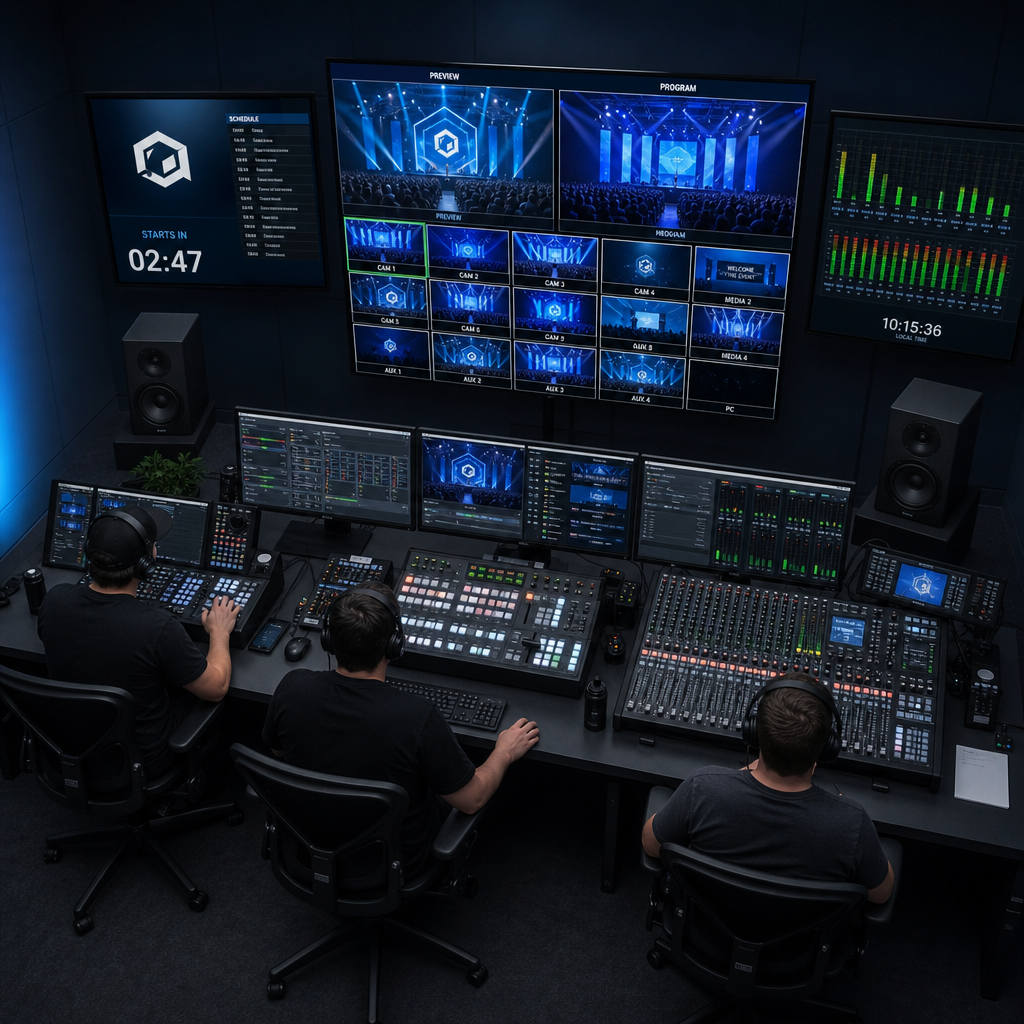
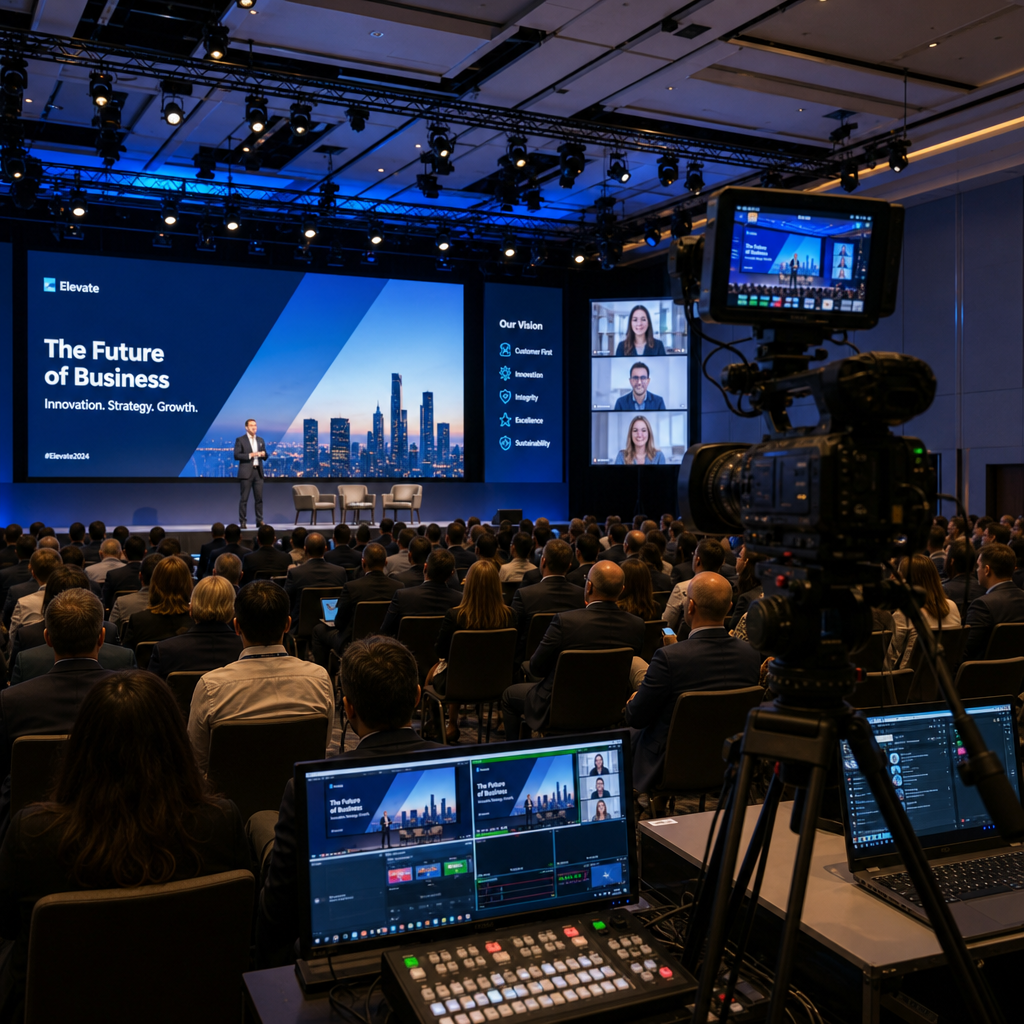
A minimum of three cameras is the professional standard for a corporate event: one wide shot covering the full stage, one medium shot on the primary speaker, and one roving camera for audience reactions and panel coverage. A live vision mixer or hardware encoder switches between these feeds in real time.
For larger events such as product launches, gala dinners, or multi-session conferences, four to six cameras with a dedicated stream director becomes standard. The goal is to give remote viewers a dynamic visual experience that approximates what the physical audience sees.
Audio Chain for Live Streaming
The audio feed for a live stream is almost never the same as the main house PA. Room acoustics, speaker distances, and reverberation make the house mix inappropriate for streaming. A separate mix sent directly from the audio console to the encoding system produces the cleanest result.
Use dedicated lapel microphones on all primary speakers, a podium mic for standalone presentations, and boundary microphones for panel tables. Never rely on camera-mounted microphones for any speaker further than two meters away.
Encoding and Bandwidth
For 1080p streaming at 30 frames per second, you need a minimum stable upload speed of 8 to 12 Mbps. For multi-bitrate adaptive streaming that serves viewers on varying connections, that rises to 15 to 20 Mbps. Bonded cellular solutions combining four or more 4G/5G connections are the professional backup of choice when venue fiber cannot be guaranteed.
“Connectivity is not a detail you handle on the day. It is the foundation of the entire production. If the pipe is not solid, nothing else matters.” – Production principle used consistently by professional live streaming teams across Southeast Asian corporate events.
Choosing the Right Streaming Platform for Your Corporate Event
Platform selection directly affects viewer experience, access control, analytics, and post-event content usability. The wrong choice creates problems that cannot be fixed mid-stream.
| Platform | Best Use Case for Malaysian Corporate Events | Key Limitation |
|---|---|---|
| YouTube Live | Public product launches, brand awareness events, large-scale conferences with open audiences. Free, highly reliable infrastructure, strong SEO value for recorded replays. | Limited access control. Not suitable for confidential AGMs or internal-only events without workaround configurations. |
| Vimeo Live / Vimeo Premium | Private corporate streams, investor briefings, internal town halls. Supports password protection, custom branding, and clean embeds on corporate intranets. | Paid subscription required. Less familiar to general Malaysian audiences who may encounter login friction. |
| Custom RTMP to Dedicated CDN | High-security regulatory events, government-linked company briefings, events requiring deep analytics and branded player experiences. | Higher cost and technical complexity. Requires professional setup. Not suitable for teams without an experienced live streaming partner. |
In practice, most Malaysian corporate events at the mid-market level use YouTube Live for public events and Vimeo or a private RTMP destination for closed sessions. Facebook Live remains popular for brand events targeting consumer audiences, but its reliability and analytics are significantly weaker than YouTube for professional corporate use.
Pro tip: Always stream to a backup destination simultaneously. Most professional hardware encoders support dual-stream output. If your primary platform experiences an outage, your audience can be redirected to the backup within minutes rather than losing the event entirely.
Virtual Event Production Malaysia: How Hybrid Events Work
Virtual event production Malaysia has matured significantly since 2020. The industry moved quickly from emergency Zoom calls to properly produced hybrid events where the physical and virtual audience receive a comparably engaging experience.
What Separates a Hybrid Event from a Live Stream
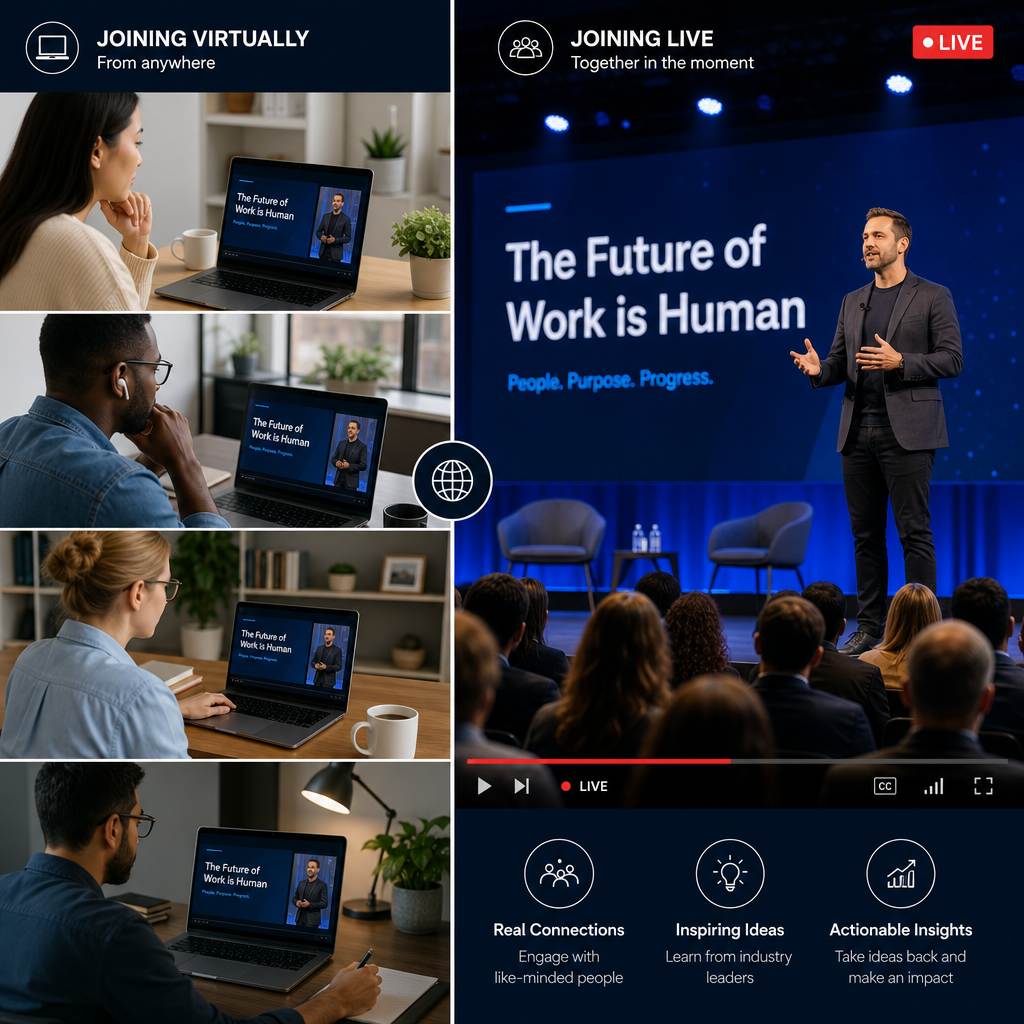
A live stream broadcasts one-way. A hybrid event creates two-way interaction between the physical audience and remote participants. This means integrating live Q&A tools, polling platforms, virtual networking, and dedicated moderation for the online audience, not just a stream link sent out by email.
The production team for a hybrid event is larger than for a standard live stream. You need a stream director, a dedicated online audience moderator, and someone managing the virtual platform separately from the on-site AV team. Trying to collapse these roles to save costs consistently produces a degraded experience for one audience or the other.
The Virtual Stage and Graphics Package
Professional hybrid events use a branded graphics package displayed in the stream: lower-thirds identifying speakers, animated transitions between sessions, live poll results visualized on screen, and a branded holding slide during breaks. This is what separates a credible corporate production from a raw feed.
For Malaysian organizations presenting to regional or international stakeholders, this visual layer is a direct signal of production quality and organizational credibility. It does not require a large budget, but it does require planning and a competent production partner who builds the package before the event day.
Latency Management for Live Q&A
Standard streaming platforms introduce 15 to 45 seconds of latency between the live event and what remote viewers see. This makes real-time Q&A technically awkward. Using low-latency streaming modes available on YouTube Live or dedicated platforms like StreamYard, Restream, or a private server reduces this to under five seconds, making live interaction practical.
Common Mistakes That Kill Corporate Live Streams
Having observed and corrected dozens of corporate live stream setups, the same errors appear repeatedly. These are not hypothetical risks. They are the actual reasons streams fail, viewers drop off, and event organizers receive complaints from stakeholders.
A common mistake is treating the stream as an add-on to the physical event. When the production budget and planning focus entirely on the room experience, the remote audience receives a narrow, poorly lit, single-camera feed with house audio that sounds like it was recorded inside a tin box. Remote viewers notice immediately and they do not stay.
Another consistent problem is insufficient testing of presenter technology. In a hybrid event, remote speakers joining via video conferencing need their audio and video integrated cleanly into the stream. Running that integration for the first time during the event is a serious risk. A 30-minute technical rehearsal with every remote presenter solves this entirely.
Ignoring time zones is a specific problem for Malaysian corporate events with international audiences. An 9:00 AM KST event in Kuala Lumpur is 2:00 AM in London. Scheduling streams without considering your primary remote audience’s working hours dramatically reduces live viewership. The on-demand replay becomes even more important in these cases, which means the recording quality must be prioritized from the start.
Finally, not having a communication plan for technical failures is a production gap that no professional team should have. If the stream drops, who sends the notification to remote attendees? What is the backup link? Who makes the call to switch platforms? These decisions must be made before the event, not during it.
Measuring the Success of Your Live Stream
Too many Malaysian corporate event teams measure live stream success by whether it technically worked. That is a floor, not a ceiling. A properly measured live stream tells you far more about your audience, your content quality, and your event’s actual reach.
Metrics That Actually Matter
Peak concurrent viewers tells you how many people cared enough to tune in at the same moment. Watch time and average view duration tells you whether your content was engaging or whether people dropped off after the opening remarks. Replay views in the 48 hours following the event tells you how much additional value the recording generated beyond the live moment.
For marketing teams, stream metrics feed directly into campaign reporting. A product launch that reached 2,400 concurrent viewers with an average watch time of 34 minutes is a quantifiable result your CMO can present alongside paid media spend. That data did not exist before live streaming was part of the production plan.
Connecting Stream Data to Business Outcomes
HubSpot’s marketing research consistently shows that video content drives higher conversion rates than text or static visual formats. For corporate events, connecting stream viewership data to downstream actions, such as sales inquiries received within 72 hours of a product launch stream or employee survey scores following a town hall, builds the business case for investing in professional live streaming services Malaysia rather than treating it as a line item to cut.
Track UTM-tagged links shared during the stream to measure click-through behavior from your viewing audience. This is basic attribution that most corporate event teams overlook entirely.
Frequently Asked Questions
How much does professional live streaming for a corporate event cost in Malaysia?
A basic single-camera live stream with professional audio and a dedicated encoder starts from approximately RM 2,500 to RM 4,000 for a half-day event. A full multi-camera production with a stream director, branded graphics package, and hybrid event management for a full-day conference typically ranges from RM 8,000 to RM 20,000 depending on complexity, crew size, and platform requirements. Requesting a detailed scope from your production partner before comparing quotes is essential, since these numbers only mean something when attached to a defined technical specification.
What internet speed does a venue need to support a professional live stream?
For a stable 1080p live stream, you need a minimum dedicated upload speed of 10 to 15 Mbps. The critical word is dedicated. Shared hotel or convention center Wi-Fi is almost never suitable for professional streaming. A professional production team will bring bonded cellular or arrange dedicated fiber specifically for the stream, independent of the venue’s general internet provision.
Can we live stream a confidential corporate event such as an AGM or board briefing?
Yes, and this is done routinely. Private streaming platforms such as Vimeo Premium, a password-protected YouTube stream set to unlisted, or a custom RTMP destination with registration-gated access all provide controlled environments. Your production partner should configure the access control settings, provide a registration or invitation workflow, and test access with a sample of attendees before the event day.
How far in advance should we book live streaming services for a major corporate event?
For a large-scale event such as an annual conference, product launch, or hybrid AGM, booking your production partner four to eight weeks in advance is the professional standard. This gives the team time for venue site surveys, pre-production planning, graphics design, platform configuration, and a proper technical rehearsal. Booking two to five days before the event is a common mistake that forces shortcuts throughout the production process.
What is the difference between live streaming and virtual event production?
Live streaming is one-directional: you broadcast what is happening at your event to a remote audience. Virtual event production creates a two-way interactive experience where remote attendees can participate in Q&A, polls, networking, and breakout sessions. Virtual event production requires more technology, more personnel, and more pre-event technical coordination. Most professional corporate events today use a hybrid model combining both, where the live stream carries the main broadcast and a separate virtual platform manages remote audience interaction.
Do we need a separate production crew for live streaming, or can the AV team handle it?
In most cases, the on-site AV team managing the room’s projectors, screens, and house audio is not equipped or contracted to simultaneously operate a professional live stream. Live streaming requires a dedicated encoder operator, a stream director managing camera cuts, and someone monitoring the remote platform for technical issues. Trying to assign these tasks to an AV crew focused on the physical room experience almost always produces a degraded stream. Dedicated live streaming crew is the correct approach for any event where the remote audience is a genuine priority.
If you have produced or attended a corporate live stream in Malaysia, share what worked and what you would do differently in the comments below.
References
- Statista: Global data and statistics on live video streaming engagement and digital event trends
- HubSpot Marketing Statistics: Research on video content performance and audience engagement rates
- Forbes: Business coverage of corporate event production, virtual events, and enterprise communication trends
- Ahrefs Blog: Data and analysis on content marketing, video SEO, and audience reach for digital content strategies
- McKinsey and Company: Research on digital transformation, enterprise communications, and the business impact of virtual events