
Introduction
Corporate event planners in Malaysia face a decision that directly affects audience reach, budget allocation, and brand perception: should you stream your event live or produce a polished on-demand recording? The answer is not interchangeable. Each format serves a different audience behavior, technical requirement, and business goal. With live streaming services Malaysia growing rapidly across sectors from finance to education, choosing the wrong format can mean paying for production value your audience never sees, or missing the real-time engagement window that drives immediate action. This guide cuts through the noise and gives you a practical framework for making the right call.
Table of Contents
- Introduction
- Quick Takeaways
- What Live Streaming Actually Delivers for Corporate Events
- Where On-Demand Recording Wins
- Cost Comparison: Live vs. On-Demand Production in Malaysia
- The Hybrid Approach: Streaming Live and Repurposing the Recording
- Technical Requirements You Cannot Ignore
- Decision Checklist: Which Format Fits Your Event
- Frequently Asked Questions
- References
Quick Takeaways
| Key Insight | Explanation |
|---|---|
| Live streaming drives immediate engagement | Real-time interaction through live Q&A, polls, and chat creates urgency that recorded content cannot replicate post-event. |
| On-demand recording extends shelf life | A well-edited recording continues generating views and leads for months, making it more cost-effective for evergreen content. |
| Technical failure risk is higher in live production | Bandwidth drops, encoder crashes, and audio sync issues have no safety net during a live broadcast. Redundancy planning is non-negotiable. |
| Audience geography determines format priority | If your attendees span multiple time zones or locations, live streaming removes the barrier of physical attendance. On-demand suits asynchronous consumption. |
| Brand-sensitive content often suits on-demand better | Product launches, legal briefings, and investor presentations benefit from the editing control that only post-production allows. |
| Hybrid production offers the best ROI for large events | Streaming live while simultaneously recording for later distribution maximizes both reach and content longevity within a single production budget. |
| Platform choice affects discoverability | Live content on LinkedIn or YouTube can surface in feeds and notifications, giving corporate brands organic exposure that a private recording does not. |
What Live Streaming Actually Delivers for Corporate Events
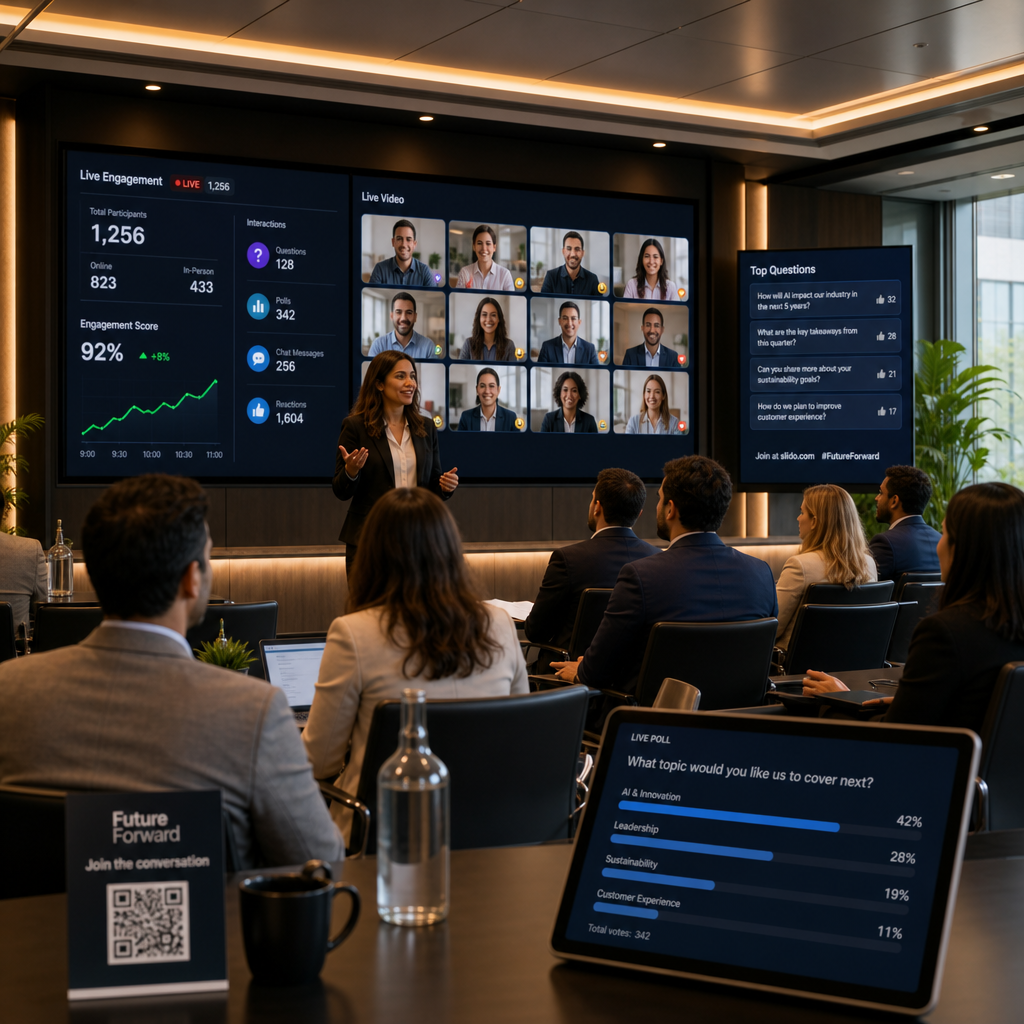
Live streaming is not just a broadcast mechanism. It is a real-time brand experience. When your CEO addresses shareholders, when your company holds its annual general meeting, or when you launch a product to a national distributor network, the live format creates a shared moment that no edited recording can replicate after the fact.
According to Statista, global live streaming revenue is projected to exceed USD 184 billion by 2027. In the Malaysian corporate context, this growth is visible in sectors like banking, government-linked corporations, and higher education, all of which have adopted live streaming for stakeholder communication since 2020 and have not reverted.
In practice, the most effective live streams in a corporate setting combine multi-camera switching, lower-third graphics for speaker names and topics, and a moderated audience interaction layer. Without these elements, a live broadcast feels like an unattended phone call. With them, it functions as a credible broadcast-quality event.
When Live Streaming Outperforms Every Other Format
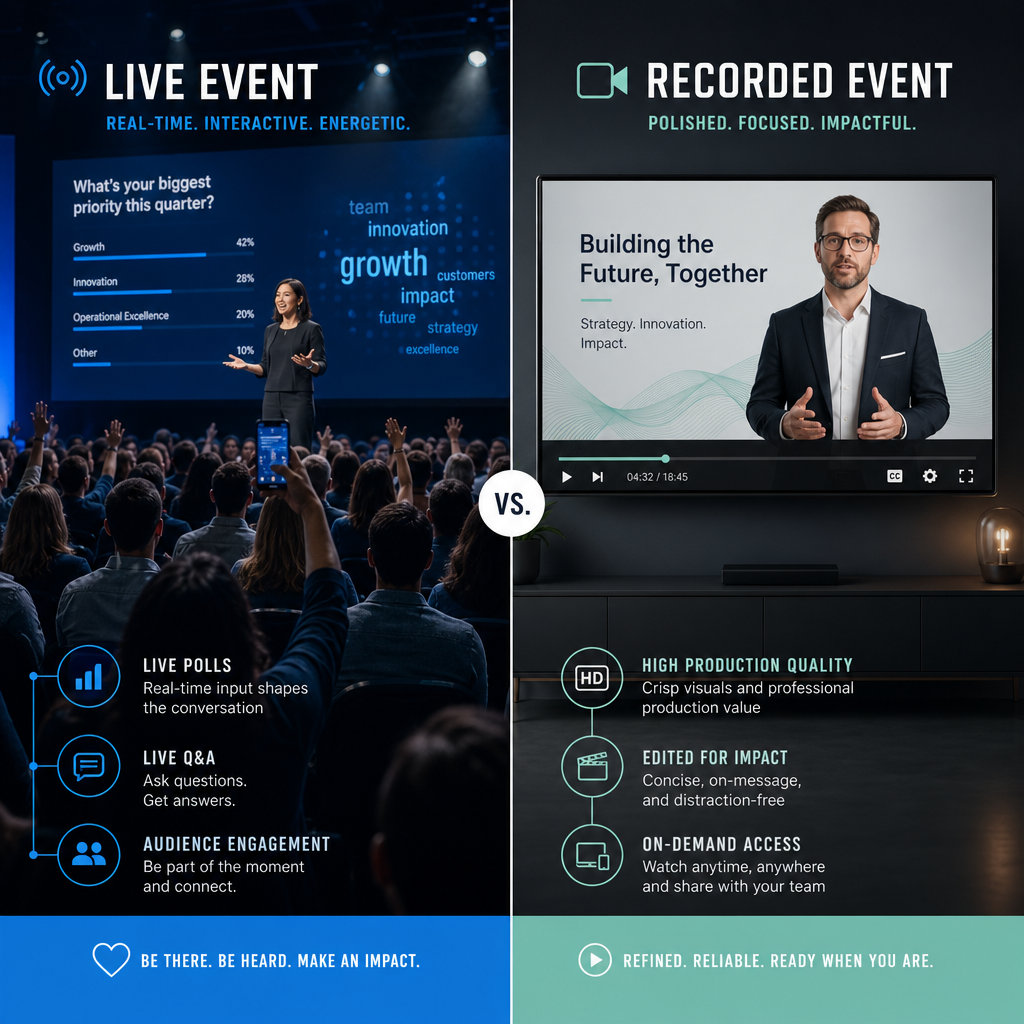
Live is the correct choice when the event has a time-sensitive element: a product launch where pre-orders open at the end of the broadcast, an AGM where shareholder votes are cast in real time, or a crisis communication session where leadership must be seen responding immediately. The perceived authenticity of live content also matters. Audiences trust unedited moments more than polished productions in contexts that require credibility over aesthetics.
A common mistake is treating live streaming as a backup plan for attendees who could not make it physically. That framing underinvests in the live production quality. If 500 people are watching remotely and only 100 are in the room, the remote audience is your primary audience and the production should reflect that.
Pro tip: For any corporate live stream expected to reach more than 200 concurrent viewers, use a dedicated hardware encoder rather than software-only solutions. Hardware encoders handle network instability more reliably, which matters when your internet connection at a hotel ballroom or convention centre is shared with hundreds of other devices.
Where On-Demand Recording Wins
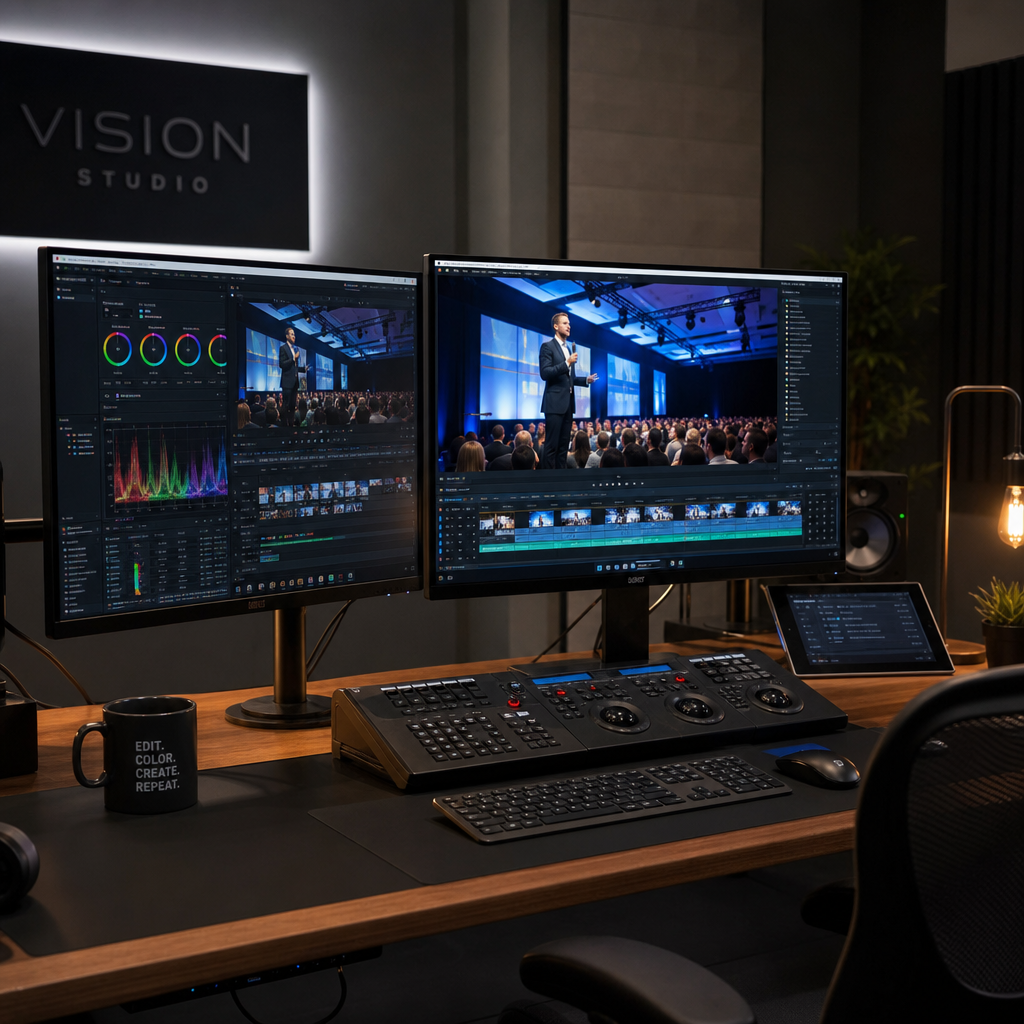
On-demand recording gives you something live streaming never can: editorial control. You can cut dead air, remove a speaker’s verbal stumble, add motion graphics, insert b-roll footage, and color-grade the final output to match your brand palette. For corporate video content that will appear on a company website, LinkedIn page, or sales deck, that level of polish is not optional.
The data consistently shows that on-demand content generates longer average watch times than live replays. HubSpot reports that branded video content with clear editing and structured storytelling retains viewers at significantly higher rates than unedited raw recordings. For a 45-minute corporate event, a 6-minute highlight cut will outperform the full replay in almost every measurable metric.
Content Types That Belong in Post-Production
Training videos, internal communications, product explainer content, and event highlight reels all perform better as on-demand pieces. These are formats where the viewer needs clarity and efficiency, not the feeling of being present at a live moment. If your marketing team plans to distribute the content across multiple channels over a three-month campaign window, on-demand recording is the only format that supports that use case.
Investor relations content deserves special mention. Financial disclosures, earnings briefings, and board presentations require precise language. A live broadcast of these sessions carries risk: a misspoken figure or an incomplete sentence could be interpreted incorrectly. Recording and editing these sessions before distribution protects the organization legally and reputationally.
Pro tip: When producing on-demand corporate video content, record a separate clean audio track using a dedicated audio interface alongside the video capture. Camera-mounted microphones and room acoustics can degrade audio quality in large venues. Clean audio in post-production is far easier to work with than noise-heavy room recordings.
Cost Comparison: Live vs. On-Demand Production in Malaysia
Budget is rarely the deciding factor for large corporates, but it shapes the decision for mid-sized organizations running multiple events per year. The cost structures for live and on-demand production differ significantly, and understanding the breakdown prevents budget surprises.
Live production costs are front-loaded. You pay for the crew, equipment, encoding hardware, streaming platform licenses, and internet infrastructure before a single viewer connects. On-demand production costs are spread across shooting and post-production phases, with the majority of the budget going into editing, motion graphics, color correction, and sound mixing after the event ends.
| Production Element | Live Streaming | On-Demand Recording |
|---|---|---|
| Pre-event technical setup time | 4-8 hours including encoder configuration and stream testing | 2-4 hours for camera and audio setup |
| Crew requirements | Camera operators, vision mixer, streaming engineer, graphics operator | Camera operators, audio engineer, director |
| Post-production costs | Minimal unless replay editing is requested | Significant: editing, color, audio, graphics |
| Platform or distribution cost | Ongoing: CDN fees, platform subscriptions, bandwidth | One-time: hosting fees or file delivery costs |
| Re-usability of content | Low without post-production intervention | High: editable for multiple formats and channels |
| Failure recovery options | Limited: technical failures are visible to live audience | Strong: issues can be corrected in editing |
For Malaysian corporate event budgets, a full multi-camera live stream with professional graphics typically requires a higher day-rate production investment than a comparable on-demand recording shoot of the same duration. However, when you factor in the content volume produced, the live stream often captures more raw footage across more sessions simultaneously, which can reduce the per-minute cost of usable content.
The Hybrid Approach: Streaming Live and Repurposing the Recording
The strongest recommendation for large-scale corporate events, conferences, and product launches is to run both simultaneously. Stream live to your remote audience while recording clean, uncompressed files for post-production use. This is not twice the cost. A competent production crew already handles both outputs as part of a standard virtual event production Malaysia workflow.
“The organizations that get the most value from event production are the ones that treat every live event as a content library, not a one-time broadcast.” – Content strategy principle widely applied in corporate video production
In practice, a hybrid workflow at a two-day conference might produce: one continuous live stream per day for remote delegates, three to five edited session highlights for LinkedIn distribution, one executive keynote cut for the company website, and one internal all-staff version with proprietary financial details included that would not be in the public stream.
Managing the Hybrid Workflow Without Overloading Your Crew
The key to a smooth hybrid production is clear role separation. The live streaming engineer focuses exclusively on the outgoing stream quality, monitoring bitrate, audio levels, and viewer count. A separate operator handles recording capture and file management. These two roles cannot be merged without increasing the risk of failure in one or both outputs.
For the post-production phase, brief the editing team during the live event rather than after. A producer on-site who takes timestamped notes during the event saves hours of review time in the edit suite. This is a small operational detail that significantly improves turnaround time for content delivery.
Technical Requirements You Cannot Ignore
The most common cause of a failed corporate live stream is not the camera or the encoder. It is the internet connection. Hotel venues, convention centres, and office buildings across Malaysia vary enormously in their available upload bandwidth. A 1080p live stream at broadcast quality requires a stable upload speed of at least 10 Mbps, with a recommended 20 Mbps to allow headroom for fluctuation.
Always request a dedicated internet line rather than sharing the venue’s general WiFi. Bonded cellular solutions using multiple 4G or 5G SIM cards from different carriers provide a reliable backup when venue internet is unstable or unavailable. This is standard practice for professional live streaming services in Malaysia and any production company that does not mention it during pre-production planning is a red flag.
Platform Selection for Corporate Live Streams
Platform choice depends on audience type. Public-facing events benefit from YouTube Live or LinkedIn Live because of their built-in discovery and notification systems. Internal events, board meetings, and confidential briefings require password-protected platforms like Microsoft Teams, Zoom Webinars, or a private stream hosted on a CDN with access controls. Mixing these up, streaming a confidential investor briefing to a public platform, is an error that has caused reputational damage for organizations that did not specify requirements clearly during production planning.
For on-demand recording, the technical priority shifts to file format and resolution. Record in the highest available resolution, minimum 1080p, and use a format that is editing-friendly such as ProRes or H.264 at high bitrate. Footage shot in a highly compressed format to save storage space creates quality problems in post-production that cannot be fixed retroactively.
Decision Checklist: Which Format Fits Your Event
Rather than presenting a generic decision tree, the following questions will give you a direct answer for your specific event. Answer each one before briefing your production company.
Choose live streaming if: your event has a fixed date and time that cannot be replicated, your audience is geographically distributed and cannot attend in person, the business objective involves real-time interaction or voting, or the content loses relevance within 48 hours of the event.
Choose on-demand recording if: the content will be used in sales or marketing campaigns over weeks or months, the speaker or content requires editing for clarity or compliance, you need multiple output versions for different audience segments, or the event involves sensitive financial or legal information that must be reviewed before distribution.
Choose a hybrid production if: your event runs longer than four hours, you have both an in-person and remote audience, your marketing team has a content distribution plan beyond the event date, or your budget allows for a full production crew with clear role separation between live and recording functions.
The organizations that consistently get the most out of their event production budget are the ones that decide format before they decide venue. Format determines crew size, equipment list, internet requirements, and post-production scope. Trying to add live streaming to an event that was planned only for recording, or vice versa, always costs more and delivers less than planning for the right format from the start.
Frequently Asked Questions
Can a live stream recording be used as the final on-demand version?
Technically yes, but it is rarely the best choice. A live stream recording is compressed for delivery, which means it has lower visual quality than a direct camera recording. It also contains all the pacing of the live event including transitions, waiting periods, and unedited moments. For professional distribution, a dedicated recording track captured simultaneously with the live stream will always produce better on-demand content than the stream replay.
How much lead time does a professional live streaming setup require in Malaysia?
A professional live streaming crew needs a minimum of two to four weeks for pre-production planning, which includes site surveys, internet testing, graphics preparation, and platform configuration. For large-scale events with multiple sessions, 30 days is a more realistic timeline. Last-minute bookings compress this planning window and increase the risk of avoidable technical failures on the day.
What is the realistic concurrent viewer limit for a corporate live stream without a CDN?
Without a content delivery network, a direct stream from a single server becomes unstable at relatively low viewer counts, often under 500 concurrent users depending on the hosting infrastructure. For events expected to draw more than 200 to 300 simultaneous viewers, a CDN is not optional. Professional live streaming services Malaysia providers include CDN infrastructure as a standard component of event packages for this reason.
Is it possible to live stream and record simultaneously without doubling the production cost?
Yes. Most professional multi-camera setups route the signal to both a streaming encoder and a recording device simultaneously from the same vision mixer output. The incremental cost is in the additional storage media and a dedicated recording operator, not a full duplication of the crew or equipment. This is why a hybrid approach is cost-effective when the crew is already sized for a live production.
Which format performs better for internal corporate communications: live or on-demand?
It depends on whether the communication requires shared timing or flexible access. All-hands meetings and town halls benefit from live streaming because the shared experience creates organizational alignment. Training content, policy briefings, and process documentation perform better as on-demand recordings because employees need to consume them at their own pace, pause for note-taking, and return to specific sections. Many Malaysian organizations now maintain both formats in their internal communications mix.
What happens if the internet connection fails during a live corporate stream?
A professional production setup uses bonded cellular failover, which automatically switches to mobile network connections if the primary venue internet drops. Without this redundancy, a connection failure ends the stream for all remote viewers with no immediate recovery option. Any live streaming services provider that does not include failover planning in their technical specification is not equipped for professional corporate event production.
If you have run a corporate event using live streaming or on-demand recording, share what worked and what you would change about the format decision in the comments below.
We would love your feedback and any insights you would share with others. What perspective would you add?
References
- Statista: Global live streaming market size data and digital video consumption statistics
- HubSpot Marketing Statistics: Video engagement rates and branded content performance benchmarks
- Forbes: Corporate video strategy and enterprise digital communication trends
- McKinsey and Company: Digital engagement and remote event effectiveness research
- Ahrefs Blog: Content distribution strategy and video SEO performance insights