
Most companies spend between RM 50,000 and RM 200,000 on their annual dinner, then walk away with a few blurry smartphone photos and zero usable content. That is not a celebration, that is a sunk cost. The real opportunity in event coverage Malaysia is not the night itself but the months of marketing content, internal communication material, and brand-building assets you can extract from one well-produced event. This guide is written for corporate teams and event planners who want to stop treating annual dinners as expenses and start treating them as content investments.
Table of Contents
- Quick Takeaways
- Why Most Annual Dinner Coverage Fails to Deliver ROI
- Pre-Event Planning: The Work That Determines ROI Before the Night Begins
- Multi-Camera Production and Why Single-Camera Coverage Wastes Your Budget
- Content Extraction Strategy: Turning One Night Into 90 Days of Assets
- Live Streaming for Hybrid Reach and Internal Broadcast
- Measuring ROI from Corporate Event Coverage
- Comparison of Coverage Approaches for Annual Dinners
- Frequently Asked Questions
- References
Quick Takeaways
| Key Insight | Explanation |
|---|---|
| Plan your content outputs before the event, not after | Defining what deliverables you need (highlight reel, testimonial clips, social cuts) before production begins ensures camera crews capture the right moments with the right framing. |
| Multi-camera setups multiply your post-production options | A single camera locks your editor into one angle. Three or more cameras allow cutaways, reaction shots, and audience coverage that make the final video far more compelling and professional. |
| A 2-3 minute highlight reel is your highest-ROI deliverable | HubSpot reports that videos under three minutes achieve the highest completion rates. A tight highlight reel can anchor your employer branding campaigns, LinkedIn posts, and internal newsletters for months. |
| Live streaming extends your audience beyond the room | Hybrid broadcasting allows remote employees, overseas stakeholders, and VIP guests who could not attend to experience the event in real time, increasing internal engagement and perceived event value. |
| Testimonial capture requires deliberate scheduling | Unplanned testimonials produce awkward, unusable footage. Schedule a dedicated 30-minute interview window during cocktail hour or post-dinner, with a brief prepared by the production team. |
| Brand consistency between the event and video output matters | Lower-thirds, color grading, and motion graphics should reflect your brand guidelines. Generic templates signal low investment to your audience and undermine the corporate image you spent the dinner building. |
| Raw footage handover without post-production is a false saving | Unedited footage has near-zero marketing value. Companies that skip professional post-production lose the majority of their potential content ROI because no internal team has the time or tools to cut it properly. |
Why Most Annual Dinner Coverage Fails to Deliver ROI
The pattern repeats across Malaysian corporations every year. The event committee books a venue, arranges catering, hires a host, and then, often as an afterthought, calls a videographer. The brief is usually some version of “just capture everything.” The result is hours of shaky footage nobody ever watches.
The fundamental problem is that event documentation and content production are treated as the same thing. They are not. Documentation is archival. Content production is intentional. ROI only comes from the second one.
A common mistake is assuming that the production company is responsible for deciding what content to create. They are responsible for capturing and producing what you brief them to create. If you walk into a shoot without defined deliverables, you will receive raw footage, maybe a generic highlights video, and nothing that plugs into your actual marketing calendar.
Pre-Event Planning: The Work That Determines ROI Before the Night Begins
In practice, the companies that extract the most value from event coverage Malaysia spend more time in pre-production briefings than they do shopping for the cheapest quote. The production brief should answer four questions before a single camera is booked.
Define Your Deliverable List First
Write down every piece of content you want to walk away with. A typical high-ROI annual dinner production brief includes a 2-3 minute highlight reel for social and employer branding, a 5-7 minute full event summary for internal use, short 30-60 second clips cut for LinkedIn or Instagram, executive speech excerpts formatted for the company intranet, and testimonial interviews from employees or leadership.
If your brief does not include a specific list like this, your production partner cannot plan camera positions, lighting rigs, or interview setups to capture those assets. You are leaving content on the table.
Align the Production Team with Your Brand Brief
Your corporate video production partner needs your brand guidelines before the event, not after. Color palettes, approved fonts for lower-thirds, logo usage rules, and any specific messaging you want embedded in the edit should be handed over during the pre-production meeting. The post-production phase is not the time to discover that the graphic templates clash with your rebrand.
Pro tip: Send your production team the event runsheet at least one week in advance. Knowing when the CEO speech, awards presentation, and entertainment segments occur lets the crew plan camera moves, wireless microphone placements, and lighting adjustments well before the night, which directly affects footage quality and therefore content usability.
Budget for Post-Production as a Non-Negotiable Line Item
A common mistake among event committees is allocating 80 percent of the video budget to the shoot day and then discovering there is nothing left for editing. Post-production typically accounts for 40 to 60 percent of the total time invested in a corporate video. Skimping here means your content sits unusable. Build the edit budget in from the start or accept that you are paying for documentation, not marketing assets.
Multi-Camera Production and Why Single-Camera Coverage Wastes Your Budget
Single-camera event coverage is appropriate for a 20-person internal meeting. For a 200 to 2,000 person annual dinner, it is the wrong tool for the job, and the data from post-production editing consistently shows why. With one camera locked on stage, you have no coverage of audience reactions, no wide establishing shots, no close-ups of award recipients, and no B-roll of the room atmosphere. Your editor has nowhere to cut, which means the final video feels static and long regardless of how good the event was.
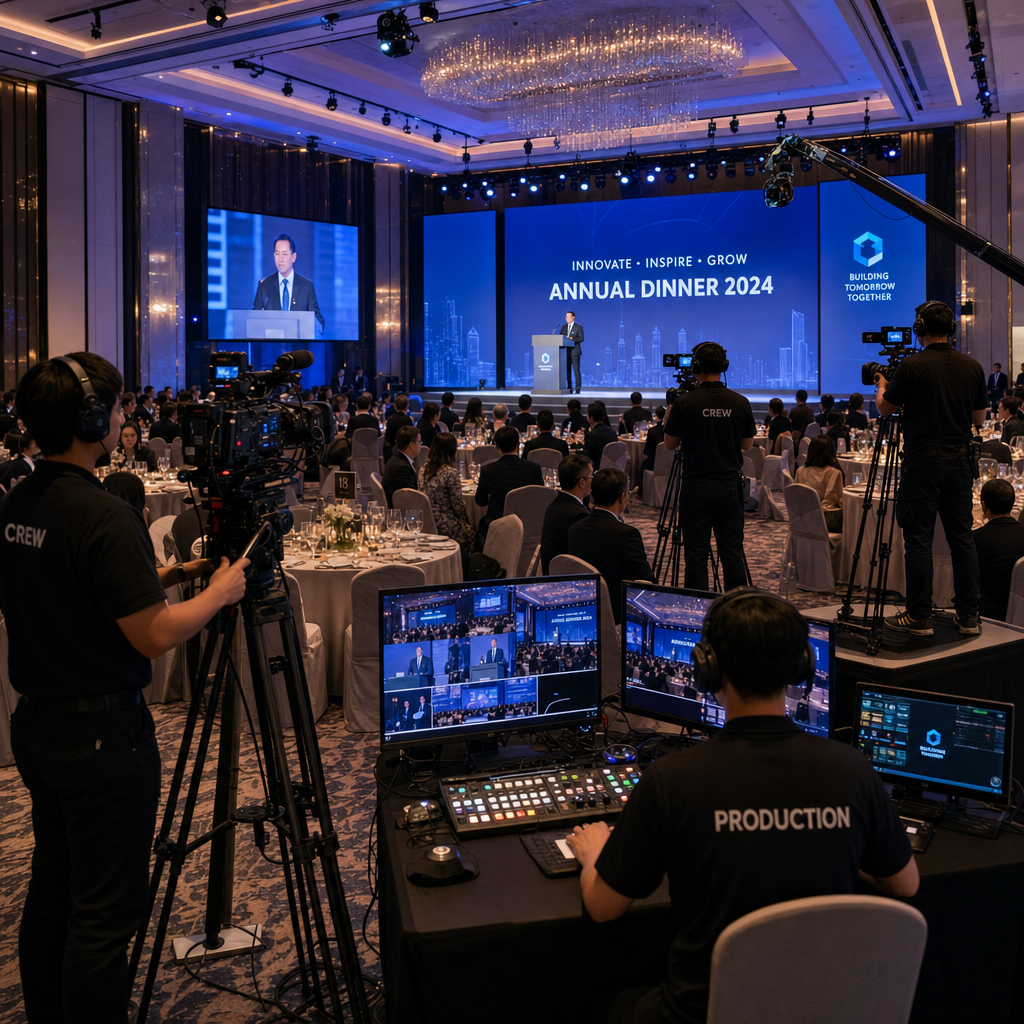
Multi-camera corporate video production in Malaysia typically involves three to five cameras in a professional setup for mid-to-large annual dinners. One camera holds a wide master shot of the stage. One covers a medium shot for speeches and presentations. At least one roams the room for audience coverage and ambient atmosphere. A fourth on a jib or slider captures cinematic B-roll that elevates the production value of the final cut.
The Specific Shots That Drive Engagement
The data consistently shows that reaction shots, specifically audience members laughing, applauding, or receiving awards, generate significantly higher emotional engagement in corporate videos than stage-only footage. These shots require a dedicated roaming camera operator and cannot be captured after the fact.
Executive speeches are another area where multi-camera setups pay off. A single tight shot of a CEO speaking for eight minutes is unwatchable as a standalone clip. Cutting between a medium shot, a wide shot showing the room, and audience reaction transforms the same speech into a three-minute asset suitable for internal communications.
Pro tip: Brief your production team to capture at least 10 to 15 individual employee reaction shots during the awards and entertainment segments. These become the emotional anchors of your highlight reel and employer branding content. They cannot be faked or recreated in post-production.
Content Extraction Strategy: Turning One Night Into 90 Days of Assets
One professionally produced annual dinner, when planned correctly, should yield enough content to sustain 90 days of corporate communications activity. This is not an exaggeration. It is a production planning exercise.
The Asset Hierarchy for Annual Dinner Content
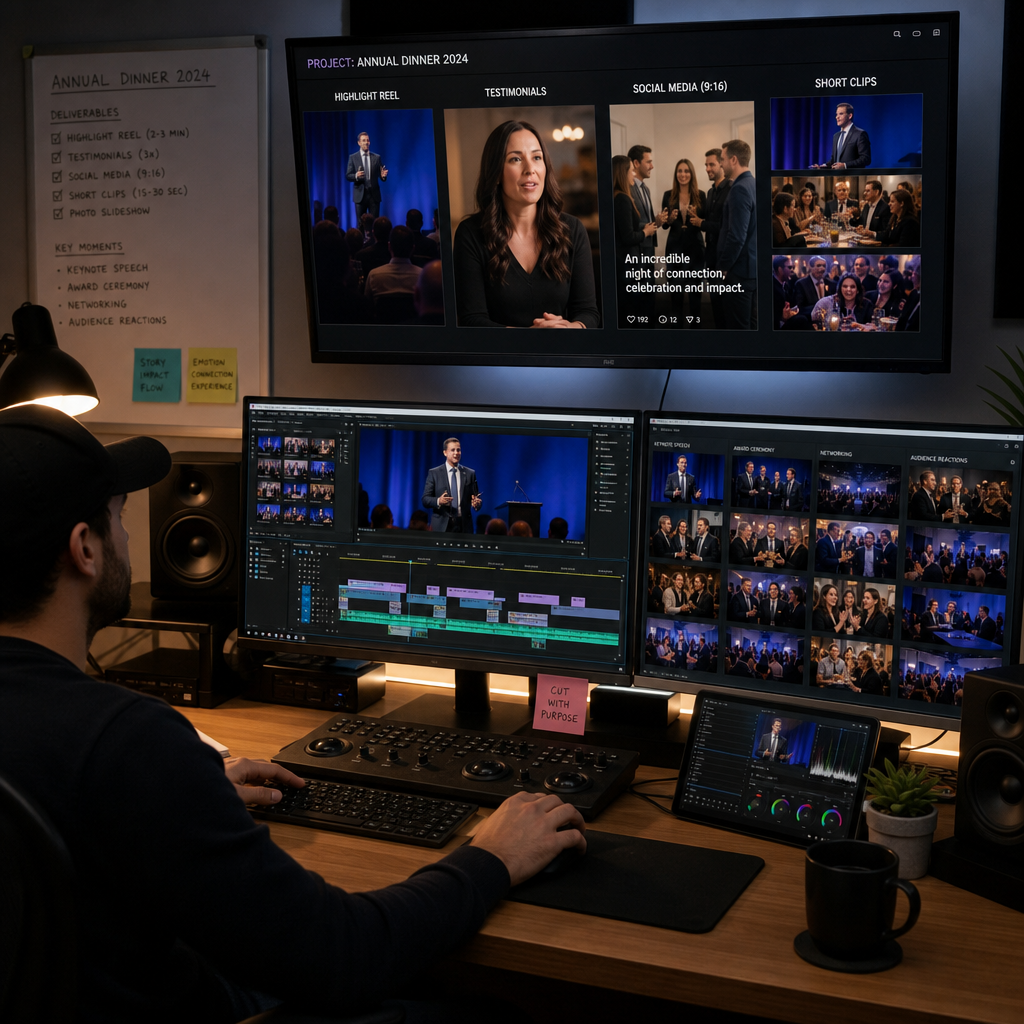
Think of your event footage as raw material organized into tiers. The primary asset is the highlight reel, typically 2 to 3 minutes, which serves as your flagship piece for LinkedIn, the company website, and email campaigns. The secondary assets are purpose-cut clips: a 60-second leadership message cut, a 90-second employee appreciation montage, and a 45-second atmosphere reel for employer branding. Tertiary assets are still frames extracted from the video for social posts, internal newsletters, and press releases.
According to Statista, video content is among the top formats used by B2B marketers globally, with over 80 percent of businesses using video as a marketing tool. A single annual dinner, properly covered, feeds this demand without requiring additional production budgets for three to four months.
Testimonial Production During the Event
Testimonials from employees, leadership, or clients captured at the annual dinner carry a specific authenticity that studio-produced testimonials lack. The energy of the event is visible in the subject’s demeanor. The challenge is logistics.
In practice, unplanned testimonials produce unusable footage because subjects are not prepared, lighting is poor, and background noise overwhelms the audio. Schedule a dedicated interview corner with proper lighting and a wireless lapel microphone. Prepare three to four prompt questions in advance and share them with interviewees during the cocktail reception so they have time to think. The production crew manages the technical side. You manage the subject preparation.
Live Streaming for Hybrid Reach and Internal Broadcast
Live streaming annual dinners is no longer a pandemic workaround. It is a deliberate audience expansion strategy. Malaysian corporations with regional offices, remote teams, or overseas stakeholders use live streaming to include audiences that cannot physically attend, which directly increases the perceived value and reach of the event.
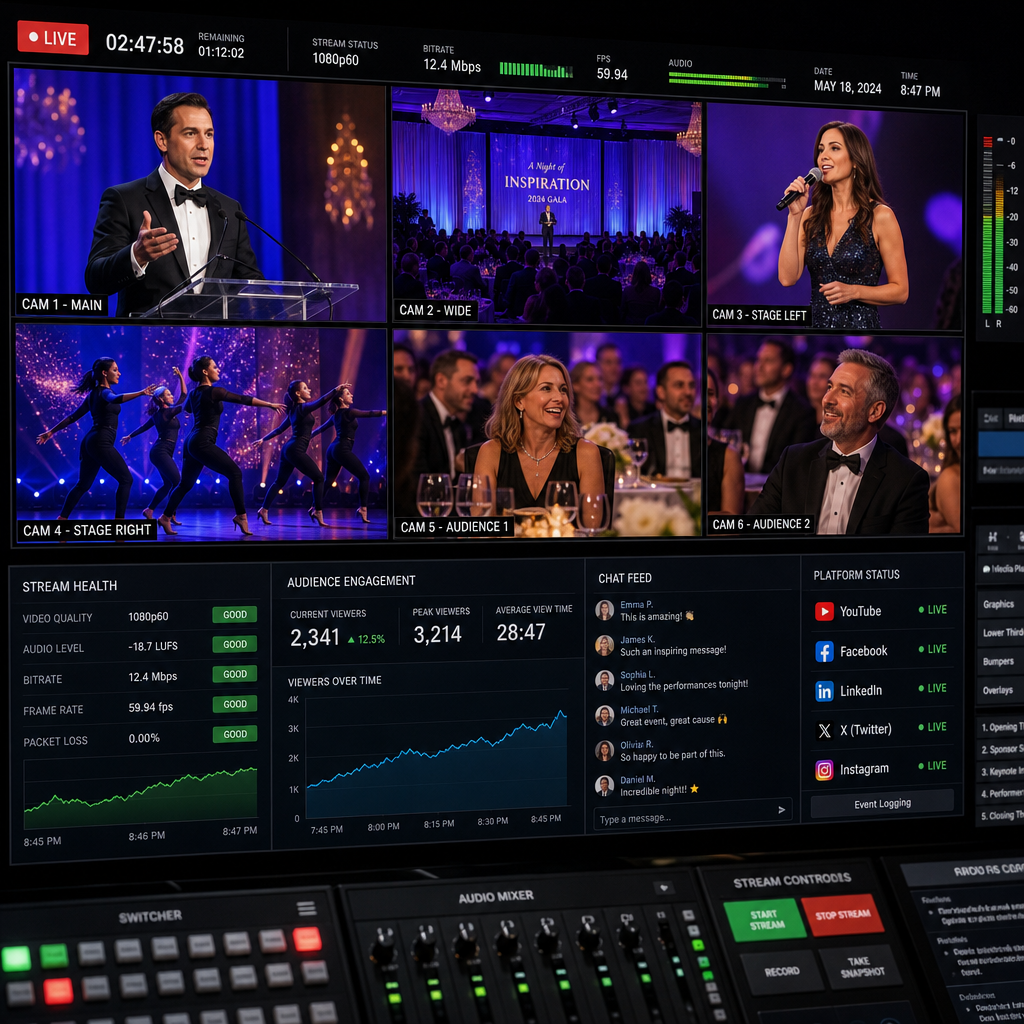
A properly executed live stream requires more than a laptop and a webcam. Reliable multi-camera switching, professional audio mixing, branded lower-thirds and overlays, a stable high-bandwidth internet connection, and a dedicated technical operator are the minimum requirements for a broadcast that does not embarrass the brand.
Internal vs. Public Streaming Decisions
The decision between a private streaming link for internal stakeholders and a public broadcast requires clarity before production begins. Private streams, hosted on platforms with password protection, are appropriate for internal town halls, awards ceremonies, and leadership addresses. Public streams on company social media channels are appropriate for brand-building events where audience size directly serves marketing objectives.
The recorded stream also becomes a content asset in its own right. An archived live stream with chapter markers can be distributed to employees who attended but want to revisit specific moments, to internal communications teams building the annual report, and to HR teams using the event for employer branding materials.
Measuring ROI from Corporate Event Coverage
ROI from event coverage is measurable when you define metrics before the event, not after. The companies that claim event coverage has unclear ROI are the ones that never set measurable objectives. Take a clear position on what success looks like before you commission the production.
Content Performance Metrics
For marketing teams, the primary metrics are video views, engagement rate on social content, click-through rates on email campaigns featuring event footage, and website session duration on pages where event videos are embedded. HubSpot’s marketing research consistently shows that pages with embedded video content have higher dwell times than text-only pages, which signals content quality to search algorithms.
For internal communications teams, track employee open rates on newsletters featuring event recap videos versus text-only newsletters. Track participation in post-event surveys. In most corporate environments, internal communications with visual content outperform text-only formats significantly in both open rates and stated comprehension.
Employer Branding Metrics
Annual dinner coverage published as employer branding content should be tracked against LinkedIn follower growth, job application volume in the weeks following publication, and candidate-stated discovery sources during the recruitment process. These are slower metrics but directly relevant to the long-term value of the content investment.
“Video is no longer a ‘nice to have’ in corporate communications. It is the primary format through which employees and external audiences form impressions of your organization’s culture and leadership.” – Forbes Human Resources Council
Comparison of Coverage Approaches for Annual Dinners
Not all event coverage engagements are structured the same way. The table below compares the three most common approaches Malaysian companies use when planning their annual dinner coverage, based on scope, cost range, and realistic content output.
| Coverage Approach | What It Includes | Realistic Content Output |
|---|---|---|
| Basic Documentation Package (1 camera, minimal edit) | Single videographer, raw footage delivery or basic edit, no multi-camera switching, no audio mixing, no branded graphics | One 10-15 minute unbranded recap video with limited reusability. No social cuts. No testimonial assets. Suitable only for archival purposes. |
| Professional Multi-Camera Production (3-5 cameras, full post-production) | Multi-camera crew, professional audio, branded lower-thirds and motion graphics, highlight reel plus secondary cuts, color grading, director supervision on-site | 2-3 minute branded highlight reel, 5-8 minute full recap, 3-6 social-ready short clips, testimonial segments, still frame extraction. 90 days of usable content. |
| Integrated Production with Live Streaming (multi-camera plus hybrid broadcast) | Everything in multi-camera production plus real-time streaming to internal or public platforms, live graphics switching, dedicated stream operator, archived broadcast | All multi-camera deliverables plus a complete archived broadcast, extended audience reach to remote stakeholders, live engagement data analytics, branded stream recording for distribution. |
The professional multi-camera production approach delivers the best ROI for most mid-to-large Malaysian corporations running annual dinners of 200 or more guests. The basic documentation package is appropriate only when there is genuinely no marketing or communications use case for the content, which for most organizations is never true.
Frequently Asked Questions
How much does professional event coverage in Malaysia typically cost?
Professional multi-camera event coverage in Malaysia for a corporate annual dinner typically ranges from RM 8,000 to RM 35,000 depending on crew size, event duration, post-production scope, and whether live streaming is included. Budget packages starting under RM 5,000 almost always involve a single camera and minimal editing, which limits the usable content output significantly. The production investment should be evaluated against the content value it generates over the following months, not just the cost of the shoot day itself.
How far in advance should we book a corporate video production team for an annual dinner?
Book your production team at least 6 to 8 weeks before the event date. This allows time for a proper pre-production briefing, site recce if required, equipment planning for the venue’s specific lighting and audio conditions, and alignment of your deliverable list with what the crew will capture. Booking two weeks out, which is common among companies that treat video as an afterthought, results in rushed planning and poorer content quality.
What is the single most important deliverable from annual dinner event coverage?
The 2 to 3 minute branded highlight reel is the highest-ROI deliverable in almost every case. It is short enough to achieve high completion rates on social media, long enough to convey event atmosphere and brand personality, and versatile enough to be used across LinkedIn, email campaigns, the company website, and internal communications. Everything else, including the full recap video and short clips, extends the value of this primary asset.
Can we use annual dinner footage for employer branding and recruitment?
Yes, and this is one of the most underutilized applications of annual dinner content in Malaysia. Footage of genuine employee recognition moments, company culture on display, and leadership engagement communicates more about your workplace than any written job description. When published on LinkedIn or careers pages, authentically produced annual dinner content consistently outperforms stock-photo-heavy employer branding materials in candidate engagement metrics.
Should we tell employees they will be filmed at the annual dinner?
Yes, always. Informed consent is both an ethical and legal requirement in Malaysia under the Personal Data Protection Act 2010. Include a clear notice in the event invitation stating that professional video and photography will be conducted during the event. For testimonial interviews, obtain explicit verbal or written consent from participants before filming. Most employees are comfortable being filmed at company events when informed in advance, and this transparency also improves the quality of their on-camera presence.
How do we get usable content from an annual dinner when the venue has poor lighting?
Venue lighting is one of the most common technical barriers to good event footage in Malaysia. The solution is not to accept whatever the venue provides but to brief your production team to conduct a site recce in advance, bring supplementary LED lighting for key coverage areas such as the stage and interview corner, and coordinate with the venue’s AV team to optimize the house lights during critical moments. A professional crew will identify lighting challenges during the recce and adapt their equipment plan accordingly. If the production company you are speaking to has not asked about the venue, that is a warning sign.
If you have managed annual dinner coverage for your organization before, share what worked or what you wish had been planned differently. Your experience helps other corporate teams make better production decisions.
References
- HubSpot Marketing Statistics: research and benchmarks on video marketing performance and content engagement rates
- Statista: global data on video marketing adoption rates among B2B businesses and content format usage trends
- Forbes: editorial coverage of corporate communications, employer branding, and internal employee engagement strategies
- Malaysia Personal Data Protection Department: official guidance on the Personal Data Protection Act 2010 and compliance for event recordings
- Ahrefs Blog: research on content marketing ROI, video content performance, and digital content distribution strategy