
Most corporate events in Malaysia are filmed with a single camera operator who spends the entire shoot chasing angles and missing moments. The result is footage that looks like a security recording, not a brand asset. Multi-camera production Malaysia solves this problem, but only when it is planned properly from the start. This guide covers everything corporate event planners and marketing managers need to know, from camera placement logic and crew roles to live switching decisions and post-production delivery, so your next event video production Malaysia project produces footage you will actually use.
Table of Contents
- Quick Takeaways
- Why Multi-Camera Production Changes the Game for Malaysian Corporate Events
- Pre-Production Planning: The Work That Happens Before Any Camera Ships
- Camera Placement Strategy for Malaysian Event Venues
- Crew Roles and Responsibilities in a Multi-Camera Setup
- Live Switching vs. Post-Production Editing: Which Approach Fits Your Event
- Production Approach Comparison
- Integrating Live Streaming with Multi-Camera Production
- Common Mistakes That Ruin Multi-Camera Event Footage in Malaysia
- Budget Planning for Multi-Camera Event Production in Malaysia
- Frequently Asked Questions
- References
Quick Takeaways
| Key Insight | Explanation |
|---|---|
| Three cameras is the functional minimum for most corporate events | A wide master shot, a medium presenter shot, and a roving camera for audience and detail coverage give editors real options without overstaffing the room. |
| Venue recce is non-negotiable, not optional | Malaysian convention and hotel ballroom layouts vary dramatically. Lighting positions, pillar placement, and stage height all affect camera angles before a single cable is run. |
| Your live stream and your record feed are not the same signal | Routing the same compressed stream output to archive means your edited master will inherit streaming artifacts. Always record locally at full quality on each camera. |
| Brief your camera operators on the run-of-show, not just the shot list | Operators who understand the agenda sequence anticipate transitions. Operators who only know shot lists react after the moment passes. |
| Audio sync is the most common post-production failure point | Multi-camera edits collapse if timecode or clapper boards are not used consistently across all cameras from the first take of the day. |
| Colour matching across cameras must be set in pre-production, not post | Shooting matching profiles and colour temperatures across all units cuts hours from colour grading and produces a more consistent final product. |
| Delivery formats should be confirmed in the brief, not assumed after editing | A corporate event may require a full-length master, a 90-second highlight reel, social media cuts, and internal archive versions, each with different specs. |
Why Multi-Camera Production Changes the Game for Malaysian Corporate Events
A single-camera shoot forces every editorial decision to happen on the day, in real time, with no safety net. If the operator is on a close-up of the speaker when the CEO walks in from the side, that moment is gone. Multi-camera production separates capture from editorial decision-making, which is why it is the production standard for any event where the footage has a commercial or brand purpose.
In practice, Malaysian corporate events range from 200-person product launches at KLCC convention suites to 2,000-person annual dinners at Genting or Putrajaya venues. The production scale differs, but the principle is identical: more camera angles mean more editorial choices and a higher probability that the final cut tells the story your brand needs told.
HubSpot’s research consistently shows that video content generates significantly higher engagement than static formats across B2B audiences. For Malaysian marketing managers investing in event coverage, the quality of that footage determines whether the investment produces a reusable brand asset or a file that gets archived and forgotten.
Pre-Production Planning: The Work That Happens Before Any Camera Ships
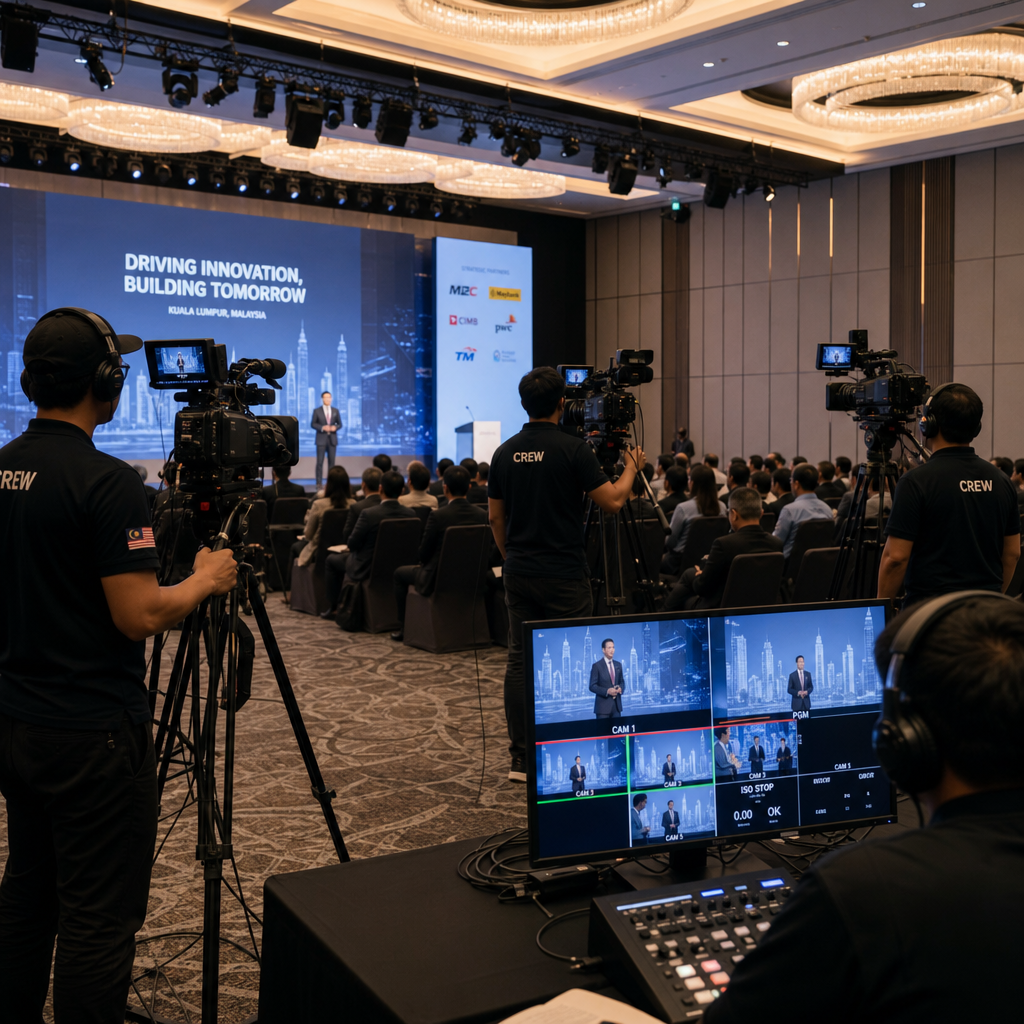
Pre-production for multi-camera event production Malaysia is where most projects either succeed or create problems that no amount of skill on the day can fix. This phase must produce four specific documents before any crew is confirmed: a production brief, a run-of-show grid, a camera position plan, and a technical rider.
The Production Brief
The production brief captures the business objective behind the footage, not just the event logistics. It must answer: who is the primary audience for the final video, where will it be distributed, what is the single message it must communicate, and what does success look like in measurable terms. A brief that says “film our annual dinner” is not a brief. A brief that says “produce a 3-minute highlight reel for LinkedIn targeting prospective enterprise clients, emphasising product launch and executive keynote” gives every crew member a decision filter for the entire day.
The Run-of-Show Grid
The run-of-show grid maps every event segment against camera assignments, lighting cues, and audio inputs. For a typical Malaysian corporate gala or conference, this document becomes the director’s roadmap. It should include segment name, start and end time, primary camera instruction, secondary camera instruction, audio source, and any special technical requirements per segment. Build this in collaboration with the event planner, not in isolation, because program order changes happen frequently in Malaysian event planning and your crew needs to adapt without losing coverage.
Pro tip: Request the event MC’s full script at least 48 hours before shoot day. Segment transitions and speaker changeovers are where multi-camera productions miss shots, and knowing exactly when they happen lets your director pre-position cameras in advance.
The Venue Recce
Walk every Malaysian venue before the shoot day. Note ceiling height, ambient light sources, pillar positions that will block sightlines, and power outlet locations for each camera position. Ballrooms at properties like Sunway Pyramid Convention Centre or Hilton Kuala Lumpur have specific lighting rigs that interact with camera sensors in predictable ways. Knowing this in advance means you arrive on shoot day with solutions, not surprises.
Camera Placement Strategy for Malaysian Event Venues
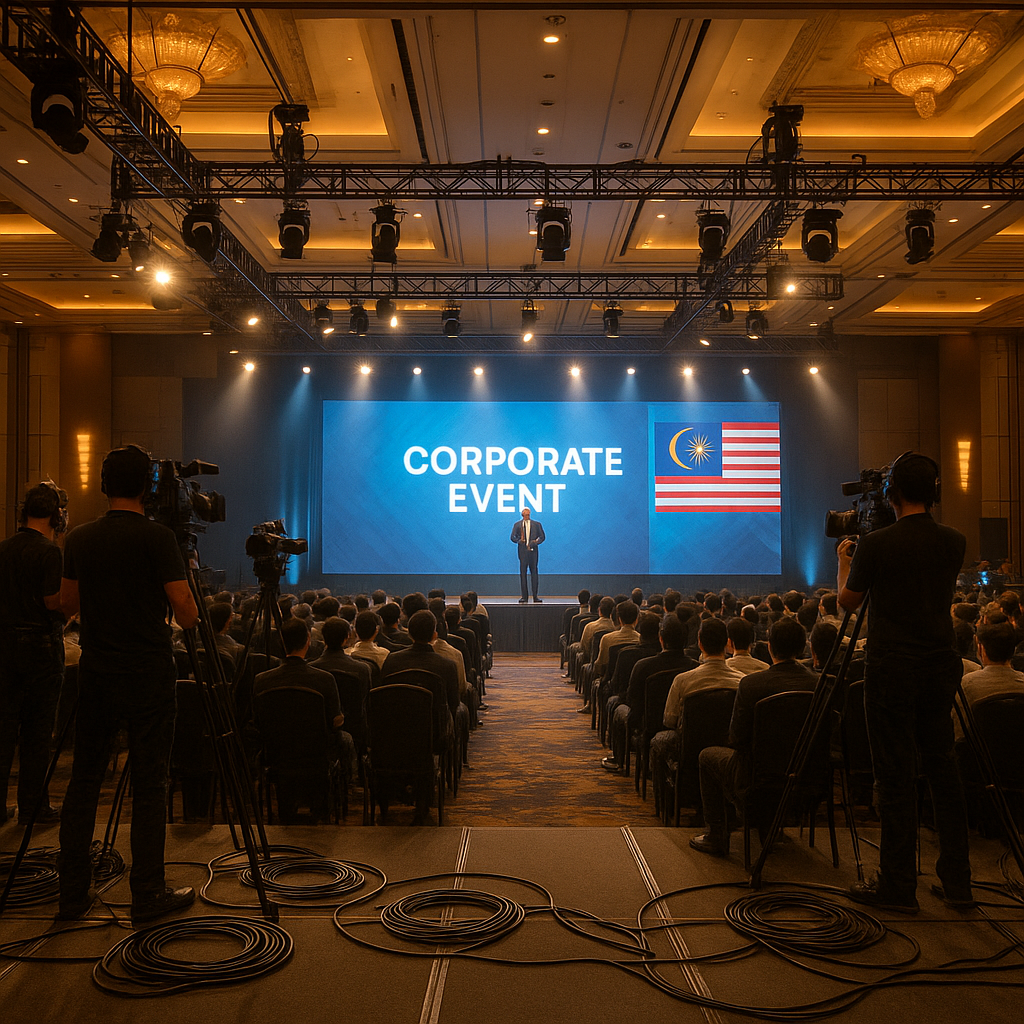
Camera placement in multi-camera production is not about preference. It is about guaranteed coverage, angle variety, and ensuring that every key moment in the run-of-show has at least two camera options in the final edit. In practice, a three-camera minimum configuration works for most Malaysian corporate events.
Camera A: The Master Wide
Camera A sits at the back of the room or on an elevated platform at mid-room. It holds a consistent wide shot of the full stage at all times. This camera never moves during a live segment. It is the safety net that editors reach for when a cut does not work. Its angle should be centered on stage, free of obstructing heads, and locked on a fluid head tripod. For large ballrooms, a camera crane or jib adds production value to this position without displacing the locked wide.
Camera B: The Medium Presenter Shot
Camera B is positioned on the right or left side of the room at mid-distance from the stage, giving a 45-degree angle to the presenter. This angle is the workhorse of the edit. It provides natural head room, reads facial expressions, and cuts cleanly against the wide. If budget allows only two cameras, Camera A and Camera B together produce a functional two-angle edit. Camera B operators need to track presenter movement precisely and maintain consistent framing as speakers walk or use a stage.
Camera C: The Roving Camera
Camera C is handheld or on a shoulder rig, operating in the audience area and around the stage periphery. This camera captures audience reactions, close-up detail shots of awards, product reveals, and spontaneous moments that add emotional texture to the edit. The operator for Camera C needs clear briefing on which moments are priority and which are supplementary, because this role involves constant judgment calls under time pressure.
Pro tip: For events with a formal awards or recognition segment, position Camera C specifically to capture recipient reactions as they are announced. This footage is almost always the most emotionally resonant content in the final highlight reel and is impossible to recreate after the fact.
Crew Roles and Responsibilities in a Multi-Camera Setup
Multi-camera production is a crew sport. The roles below are not interchangeable, and under-staffing any of them creates a gap that the footage will reflect permanently.
The Director
The director monitors all camera feeds simultaneously, calls shots in real time to operators via intercom, and makes every editorial decision during the shoot. This person must understand the run-of-show at a granular level. A director who is reading the schedule is already late. A strong director has memorised the next three program transitions and is already positioning the crew for them.
The Technical Director
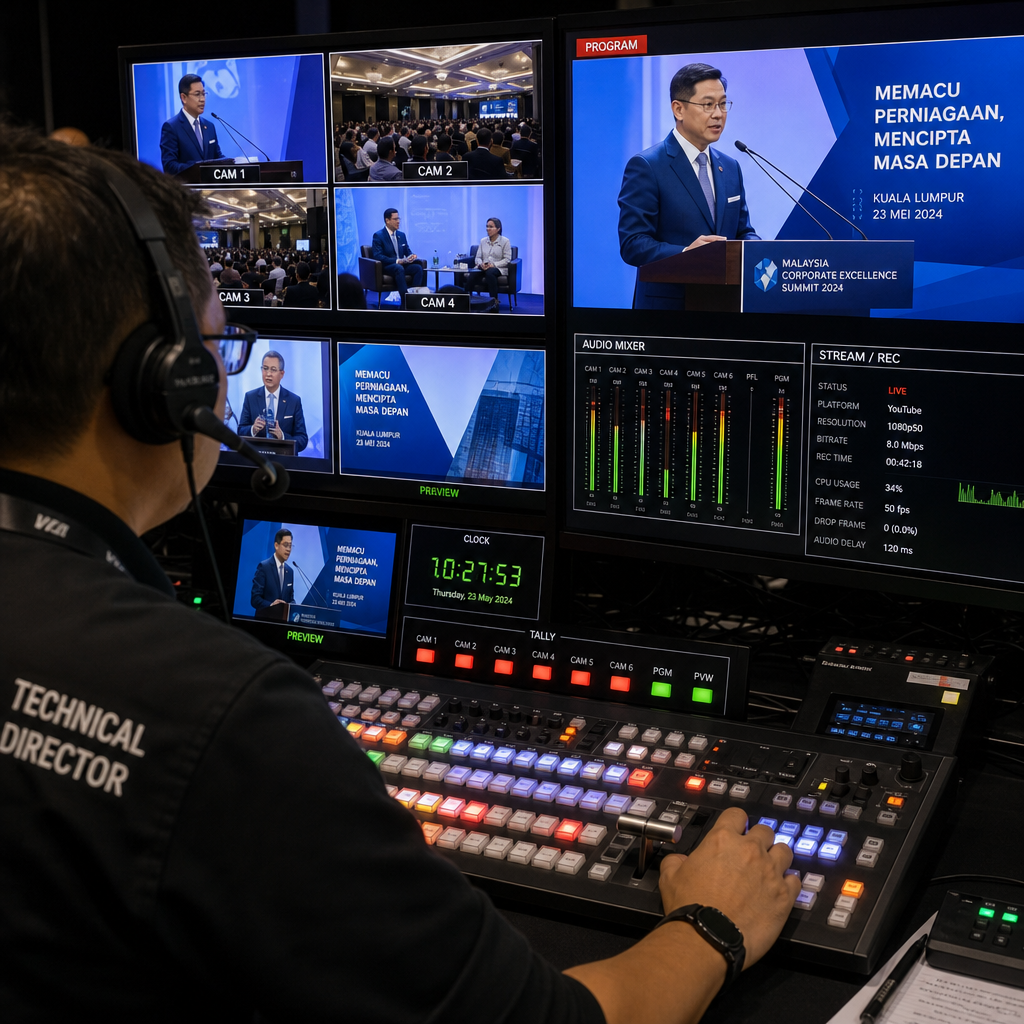
If the event involves live switching, the technical director operates the vision mixer or switcher hardware, cutting between camera feeds on the director’s calls. This role requires fast, accurate execution. A cut made half a second late in a live broadcast is visible to every viewer. For recorded-only productions without live switching, this role can be absorbed by a senior operator or the director, but it adds cognitive load.
Camera Operators and the Audio Engineer
Each camera requires a dedicated operator. Unattended or remotely operated cameras used to cut costs almost always miss critical moments. The audio engineer manages the feed from the event’s PA system, lavalier microphones, and any supplementary recording devices. Audio quality is the single most common reason event footage becomes unusable, and it is consistently under-resourced in Malaysian event video production budgets. One dedicated audio engineer for a multi-camera shoot is not overhead. It is insurance.
Live Switching vs. Post-Production Editing: Which Approach Fits Your Event
This is the decision that most directly affects your budget, your crew size, and what you can deliver on the day versus days later. Both approaches are legitimate. Neither is universally superior. The right choice depends on your specific event objectives.
Live switching means a technical director cuts between camera feeds in real time, producing an edited program as the event happens. This output can be sent directly to a live stream, displayed on screens in the venue, or recorded as a clean program cut. The advantage is speed. The finished edit is available immediately after the event. The limitation is that live switching decisions are permanent. A missed cut or a slow reaction cannot be corrected in post.
Post-production editing means all cameras record independently to local media throughout the event. An editor then assembles the multi-camera timeline after the fact, with full control over every cut. This approach produces a higher quality final product for most corporate video applications, but it requires a delivery timeline of several days to weeks depending on event duration and complexity.
“The best live event footage in the world starts with a director who has read the script more times than the MC has.” – Production Director, Musemedia Malaysia
Production Approach Comparison
| Approach | Best Suited For | Key Limitations |
|---|---|---|
| Live Switching with Simultaneous Record | Events with live streaming requirements, same-day screen output, or tight post-production timelines. Common for AGMs, product launches, and conferences. | Live editorial decisions are final. Requires a technical director and vision mixer hardware. Higher day-of crew cost. |
| Multi-Camera Iso Record with Post Editing | Events where final video quality is the priority and delivery can be scheduled. Ideal for annual dinners, award ceremonies, and corporate brand films. | No same-day output. Longer post timeline. Requires structured timecode or sync system to keep cameras aligned in editing. |
| Hybrid: Live Switch for Stream, Iso for Edit | Events that need both a live broadcast and a polished post-produced master. Common for large-scale conferences and events with both physical and virtual audiences. | Highest crew and equipment cost. Requires clear signal routing to avoid stream compression contaminating the archive record. |
Integrating Live Streaming with Multi-Camera Production
Live streaming has become a standard expectation for Malaysian corporate events, particularly post-2020, as organisations discovered that their events could reach audiences beyond the physical room. Integrating live streaming into a multi-camera production requires deliberate technical planning, not just plugging a cable from the switcher to a streaming encoder.
The streaming encoder compresses the program output significantly for transmission. If this compressed signal is also being used as the recorded archive, the final edited video will show compression artifacts, especially in fast-motion sequences and scenes with rich colour backgrounds. The correct setup records each camera locally at full resolution while sending a separate encoded stream to the streaming platform. This doubles the storage requirement but produces a post-production master that is genuinely broadcast-quality.
Platform selection matters for Malaysian corporate events. YouTube Live supports high-concurrent-viewer events with minimal configuration. Facebook Live works for audience-facing brand events where social sharing is the goal. Private streaming via platforms like Vimeo Livestream or StreamYard gives organisations control over who can access the broadcast, which is appropriate for internal town halls, investor briefings, or confidential product previews.
Bandwidth at Malaysian venues is the most unpredictable variable in live streaming production. Always conduct a speed test at the specific venue location, not at the main hotel lobby, on the day before the event. Reserve a dedicated upload connection for streaming, separate from the general guest Wi-Fi, and have a 4G or 5G mobile data backup encoder ready as a failover. In practice, venue network failures are the most common cause of live stream interruptions in Malaysian event production.
Common Mistakes That Ruin Multi-Camera Event Footage in Malaysia
These are not theoretical risks. They are patterns that appear repeatedly in post-production review of event footage from Malaysian corporate productions.
Relying on the Event Venue’s House Lighting
Hotel ballrooms in Malaysia are designed for aesthetics, not for camera sensors. Warm amber uplighting, coloured LED washes, and deep shadow zones create footage that looks dramatic to the human eye and terrible on a monitor. Camera sensors need consistent, directional light with a predictable colour temperature. For any event where the footage quality matters commercially, budget for supplementary lighting, even if it is a minimal setup of two LED panels at the front of the stage.
Skipping Timecode Synchronisation
Timecode sync is the invisible infrastructure of multi-camera editing. Without it, editors manually align clips by audio waveforms, which works for short events but becomes exponentially slower for four-hour productions. Use a timecode generator that feeds all cameras, or at minimum use a clapper board at the start of every new recording session. This is a five-minute setup task that can save eight hours in post-production.
Not Confirming Deliverables Before the Shoot
A common mistake is completing a multi-camera event shoot and then discovering that the client needs a vertical 9:16 version for Instagram Stories, a subtitled version for LinkedIn, and a Bahasa Malaysia version for internal distribution, none of which were discussed in the original brief. Each of these deliverables changes how the shoot is conducted. Talking head interviews need to be framed differently for vertical reframing. Subtitle requirements affect whether a transcript is recorded on the day. Confirm every deliverable format in writing before a single camera ships to the venue.
Budget Planning for Multi-Camera Event Production in Malaysia
Budget conversations for multi-camera production Malaysia tend to break down because clients compare the day rate for equipment hire with the total cost of a production company package and assume they are comparing equivalent services. They are not.
A realistic multi-camera event production budget for a Malaysian corporate event covers crew (director, camera operators, audio engineer, production assistant), equipment (cameras, lenses, tripods, audio hardware, monitors, cables, storage), pre-production (recce, brief development, run-of-show creation), and post-production (editing, colour grading, audio mix, graphics, delivery formatting). Each of these line items represents real working hours and specialised skills.
For a three-camera conference or launch event in Kuala Lumpur, production budgets from professional Malaysian video companies typically start at RM8,000 to RM15,000 for a single day of coverage with a standard highlight reel delivery. Events requiring live switching hardware, live streaming setup, or multiple final deliverables will sit higher. Comparing this to a freelance rate for a single camera operator is not a meaningful comparison.
According to Statista, corporate video production budgets globally have increased year-over-year as organisations recognise that video content produced at events extends the commercial lifespan of those events far beyond the day itself. For Malaysian organisations, an event that generates a 3-minute highlight reel, a 60-second social cut, and a full-length archive record is effectively three separate content assets produced from a single production investment.
Pro tip: When reviewing production proposals, look for whether post-production is included or quoted separately. Some providers quote low day rates and charge separately for editing, colour, audio mix, and revisions. A fully-loaded quote from a reliable partner is almost always more cost-effective than a low entry price that generates revision invoices throughout post-production.
Frequently Asked Questions
How many cameras do I actually need for a Malaysian corporate event?
Three cameras is the practical minimum for an event where the footage will be used commercially. Two cameras can produce a functional edit but give editors very limited options when one shot does not work. Four or more cameras are appropriate for large-stage events, award ceremonies with multiple presenter and recipient positions, or events with a live streaming requirement where the program quality is publicly visible.
What is the difference between multi-camera production and just hiring multiple camera operators?
Multiple camera operators without a coordinated production structure produces multiple independent clips, not a multi-camera production. A genuine multi-camera setup includes a director coordinating all cameras via intercom, a consistent timecode or sync system, a unified technical approach to exposure and colour, and an edit workflow designed to handle multiple simultaneous angles. The infrastructure and coordination are what distinguish production from coverage.
Can multi-camera production work for smaller events with under 100 attendees?
Yes, and it often should. The value of multi-camera production is not about the audience size in the room. It is about the quality of the footage produced. A 50-person product launch that generates a polished three-camera edit for digital distribution is more commercially valuable than a 500-person event filmed with a single operator. Scale the crew to the budget, not to the headcount.
How far in advance should I book a multi-camera production company in Malaysia?
For major corporate events, book at minimum four to six weeks in advance. This allows time for a proper pre-production process including brief development, venue recce, run-of-show preparation, and equipment confirmation. Booking two weeks before a significant event almost always results in a compressed pre-production phase that shows up in the final footage. Production companies with strong reputations in Malaysia fill their schedules quickly around peak conference seasons, typically Q1 and Q4.
What should I check when reviewing a multi-camera production company’s portfolio?
Look for footage from events that match your venue type and scale. Check whether the editing reflects genuine multi-angle coverage or just a single-camera shoot with cutaway footage inserted. Listen to the audio quality, as poor audio is a reliable indicator of an under-resourced production. Ask specifically whether the work shown was produced with live switching or post-production editing, because this tells you about the company’s technical capabilities, not just their aesthetic output.
How does event video production in Malaysia handle Bahasa Malaysia versus English content in the final edit?
This is a deliverable decision that must be made in pre-production. If an event features presentations in both languages, the edit can be cut as a bilingual master, or separate language versions can be produced for different distribution channels. Subtitling requires a transcript, which should be captured on the day or transcribed in post. For events with a significant Bahasa Malaysia component being distributed to English-language international stakeholders, a translated subtitle track is often the most practical solution.
If you have managed a multi-camera event production in Malaysia and encountered a challenge or approach not covered here, share your experience in the comments below.
We would love your feedback and any insights you would share with others. What perspective would you add?
References
- HubSpot marketing statistics resource covering video content engagement and B2B marketing performance benchmarks
- Statista global data platform covering corporate video production spending trends and digital media investment statistics
- Forbes coverage of corporate communications, brand video strategy, and event marketing investment decisions
- Ahrefs blog covering content marketing performance metrics relevant to video content distribution and brand reach
- McKinsey and Company research on digital transformation, corporate event strategy, and marketing content effectiveness