
Most corporate events in Malaysia are filmed with a single camera and edited into a forgettable highlight reel that nobody watches twice. The problem is not the event itself. The problem is the production approach. Multi-camera production Malaysia solves what single-camera setups cannot: the ability to capture simultaneous angles, live reactions, speaker close-ups, and audience energy all at once, giving your brand footage that actually holds attention and serves a real marketing purpose.
Table of Contents
- Quick Takeaways
- Why Single-Camera Setups Fail Corporate Events
- What Multi-Camera Production Actually Involves
- Direct Impact on Event Video Quality
- Comparing Production Approaches
- How Brands Use Multi-Camera Footage After the Event
- Live Streaming and Multi-Camera Production
- What to Look for in a Multi-Camera Production Partner
- Frequently Asked Questions
- References
Quick Takeaways
| Key Insight | Explanation |
|---|---|
| Multiple angles prevent dead footage | When one camera misses a reaction or moment, other cameras capture it. You never lose a critical shot. |
| Live switching enables real-time broadcast quality | A vision mixer operator cuts between cameras live, producing broadcast-grade output for streaming and recordings simultaneously. |
| Post-production time drops significantly | With a live-switched master recording, editors have a clean base cut to refine rather than rebuilding the entire video from scratch. |
| Audience reaction shots increase viewer engagement | Cutaway shots of attendees responding authentically make event videos more credible and emotionally resonant for viewers who were not there. |
| Multi-camera footage is modular content | Different angle cuts can be repurposed into social clips, testimonial segments, highlight reels, and internal training materials from one shoot. |
| Speaker close-ups are non-negotiable for credibility | A dedicated camera on the speaker captures expression and delivery detail that a wide shot cannot show, which matters for executive positioning. |
| Production planning determines output quality | Camera placement, shot lists, and director briefings done before the event control the quality of footage more than any post-production fix. |
Why Single-Camera Setups Fail Corporate Events
A single camera positioned at the back of a ballroom captures the stage but misses everything else. It misses the CEO’s expression during applause. It misses the panel member who reacts to a provocative question. It misses the audience nodding in agreement during a product launch. These are the moments that make event footage compelling, and a single-camera operator cannot physically be in two places at once.
In practice, single-camera corporate event recordings often result in a static wide shot for the duration of the event, with occasional zooms that look amateur when cut together. The editor is left with limited options and the final output reflects those limitations. For brands investing in event video production Malaysia audiences will actually share or use, this approach consistently underdelivers.
A common mistake is assuming that good camera equipment compensates for a single-camera setup. A 4K single-camera recording is still a single perspective. Resolution and angle diversity are entirely separate problems. You can have the sharpest image in the room and still produce flat, disengaging footage if there is no coverage depth.
What Multi-Camera Production Actually Involves
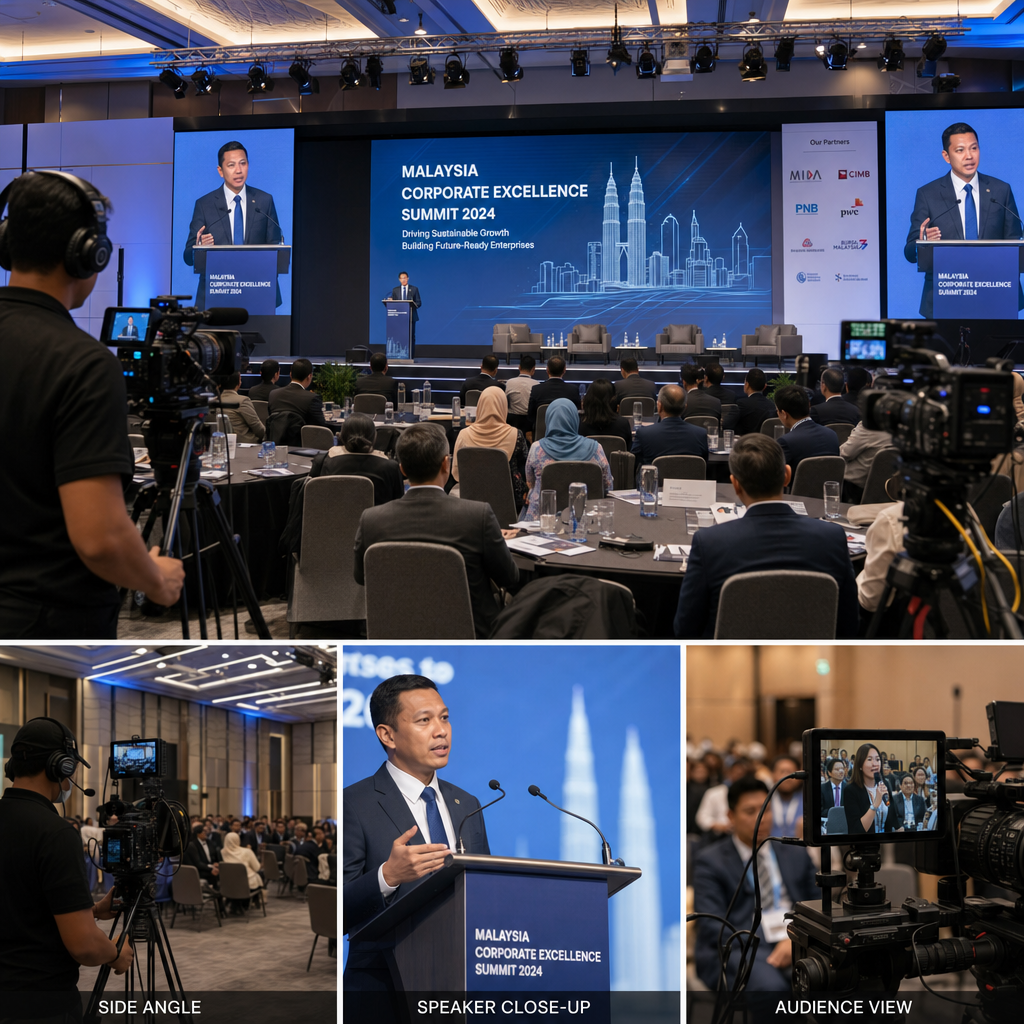
Multi-camera production is a coordinated system, not simply placing extra cameras around the room. Each camera has a designated role: a wide establishing shot, a dedicated speaker close-up, a roving camera for audience and atmosphere, and sometimes a jib or crane shot for dramatic overhead coverage. Each operator is briefed on their shot responsibilities before the event starts.
The Role of the Vision Mixer
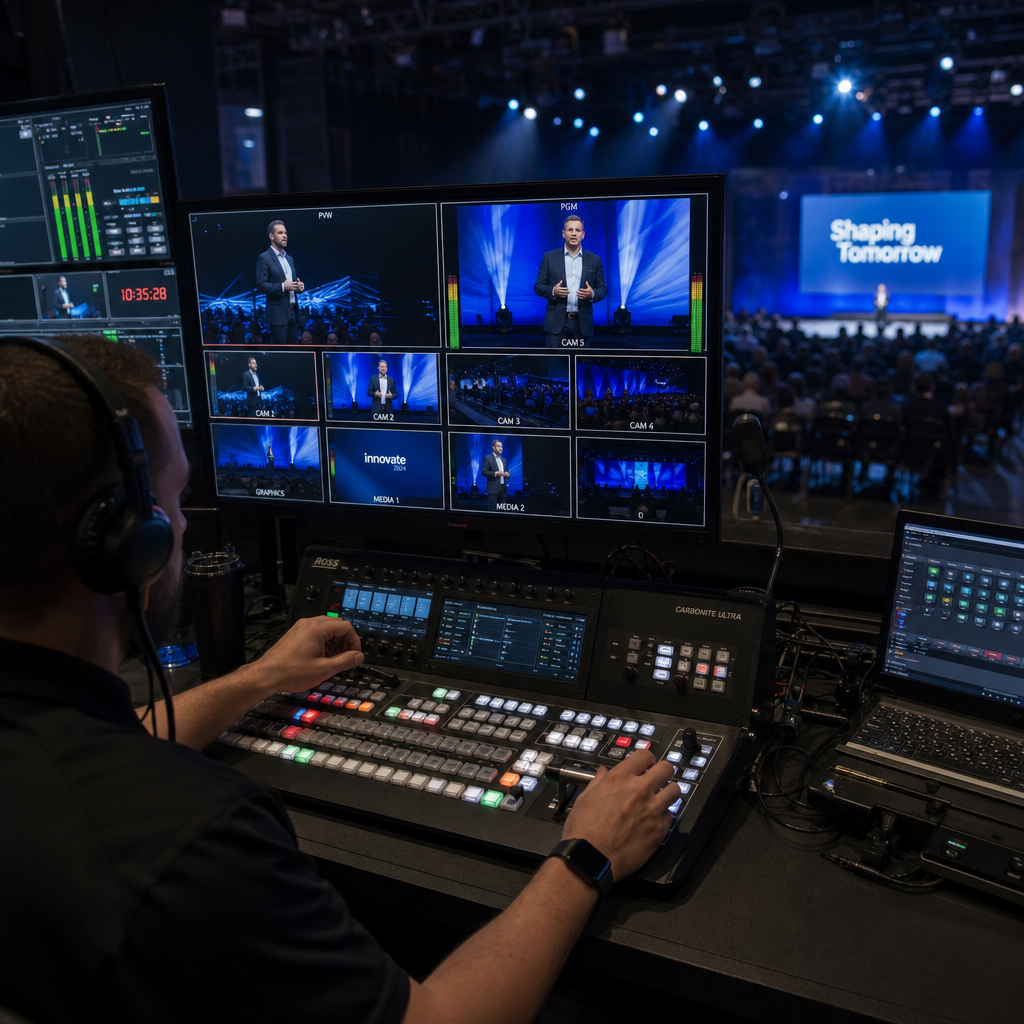
The vision mixer, also called a video switcher operator, sits at a production desk and monitors all camera feeds simultaneously. During the event, this person makes real-time editorial decisions, cutting between cameras to follow the natural flow of the programme. This live switching is what separates a professional multi-camera production from a collection of simultaneous recordings.
Recording Formats: ISO vs. Mixed Output
Professional multi-camera productions record two types of output: the switched programme mix, which is the live-edited master recording, and ISO recordings from each individual camera. ISO recordings give editors the raw material to refine or correct the live cut in post-production. Without ISOs, you are permanently locked into the live switcher’s decisions. With ISOs, you have full editorial flexibility after the event.
Pro tip: Always confirm with your production partner whether ISO recording is included. Some operators only deliver the programme mix, which removes your ability to fix switcher errors or repurpose individual camera angles for social media clips later.
Direct Impact on Event Video Quality
The measurable difference between single-camera and multi-camera event footage comes down to viewer retention. According to HubSpot’s marketing research, video content that maintains visual variety through editing holds viewer attention significantly longer than static or minimally edited footage. Multi-camera production is the structural mechanism that creates that visual variety from a live event context.
“Video is the most consumed content format for brand storytelling, but only when the production quality matches the brand’s credibility expectations.” HubSpot, Content Marketing Research
For corporate events specifically, quality signals matter to stakeholders who were not present. When a board presentation, product launch, or annual conference is recorded and distributed internally or externally, the production quality communicates something about the organisation’s professionalism. A shaky, single-angle recording of a RM500,000 event sends an unintended message about how seriously the organisation treats its own work.
Coverage Redundancy Protects Your Investment
Multi-camera setups provide a form of insurance. If a speaker moves out of frame on one camera, another angle covers the gap. If a technical glitch affects one feed, the programme continues on other cameras. In practice, live events generate unexpected moments constantly. A single-camera operator reacting to those moments mid-event will introduce camera shake, lost focus, or missed content. Multi-camera systems absorb those variables without the audience or final recording noticing.
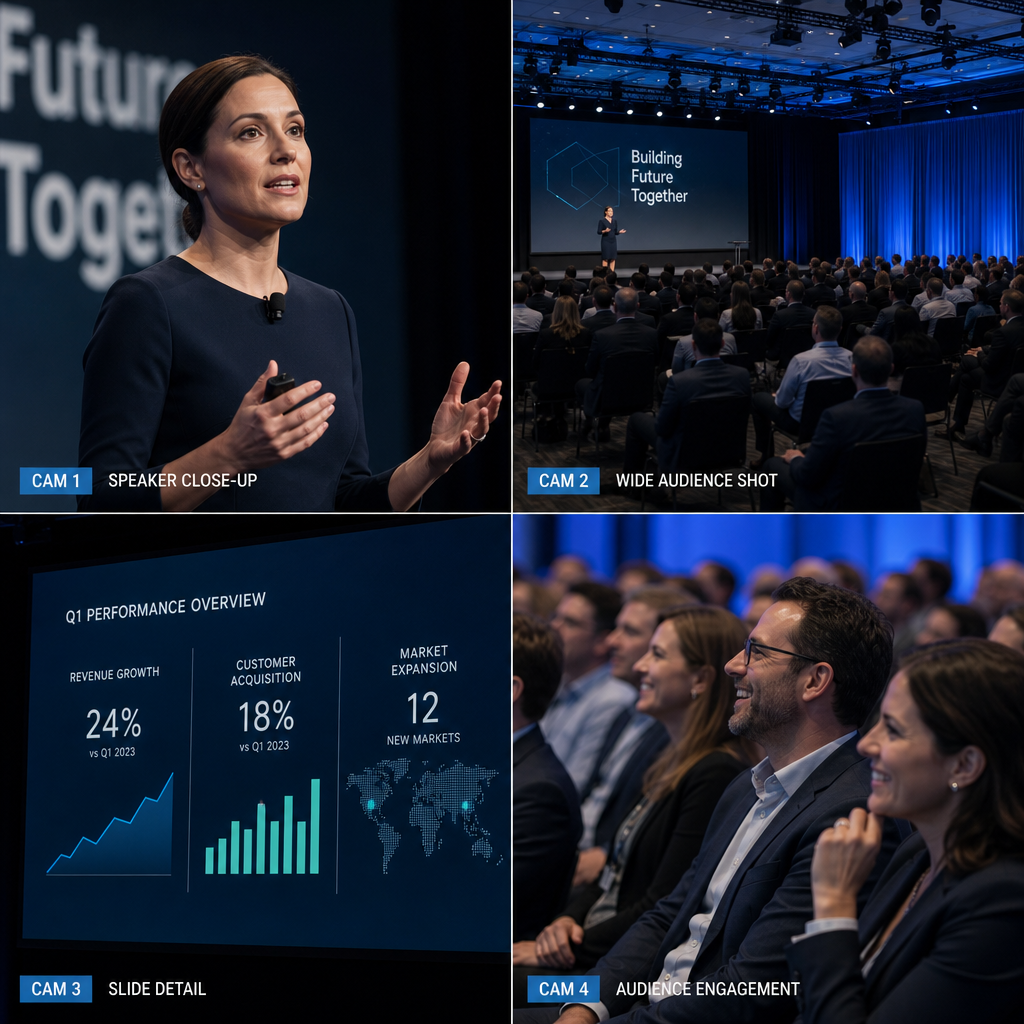
Pro tip: For events with keynote speakers or panel discussions, always deploy a dedicated locked-off camera on the speaker or panel at medium close-up range. This camera should never be moved during the presentation. It becomes your safety net and your primary speaker coverage simultaneously.
Comparing Production Approaches
Understanding the real differences between production approaches helps marketing managers and event planners make informed decisions, not just budget decisions. Below is a direct comparison of the three most common approaches to corporate event video production in Malaysia.
| Production Approach | Best Suited For | Primary Limitations |
|---|---|---|
| Single-Camera Recording | Small internal meetings, simple documentation, budget-constrained shoots with no distribution ambition | No angle coverage depth, no reaction shots, limited post-production options, static viewer experience |
| Multi-Camera Production with Live Switching | Corporate conferences, product launches, award ceremonies, live-streamed events, brand flagship events | Requires pre-event planning, trained crew, production desk setup. Higher upfront cost but significantly higher output value |
| Multi-Camera Production with ISO and Post-Edit | High-visibility events requiring broadcast-quality output, executive leadership forums, events with extensive content repurposing planned | Highest production cost and post-production time, but delivers the most versatile and highest-quality final content library |
How Brands Use Multi-Camera Footage After the Event
One of the most underutilised advantages of multi-camera production is what happens after the event ends. The footage library generated from a well-executed multi-camera shoot is a content asset, not just a recording. Brands that understand this extract significantly more value from a single event investment.
Content Repurposing from a Single Event Shoot
From one multi-camera corporate event shoot, a brand can produce: a two-to-three minute highlight reel for LinkedIn and the company website, individual speaker clips for thought leadership content, audience testimonial cuts filmed during networking segments, b-roll packages for future promotional videos, and internal training or onboarding content using recorded presentations. This modular content approach means the production cost is distributed across multiple deliverables rather than assigned to a single output.
According to Statista, video content accounts for over 82% of global internet traffic as of recent reporting periods. Brands that generate event footage but do not repurpose it are leaving a significant portion of their content marketing potential unused. Multi-camera production creates the raw material needed to execute a serious post-event content strategy.
Testimonial and Social Proof Capture
Multi-camera setups allow a dedicated roving camera to capture spontaneous attendee reactions, interview-style testimonials, and ambient event energy during breaks. This footage serves a different purpose from the main stage coverage. It is the social proof content that makes future event promotions credible and that prospective clients or partners respond to when evaluating whether your events are worth attending.
Live Streaming and Multi-Camera Production
Live streaming a corporate event with a single camera is a missed opportunity. Viewers watching remotely experience exactly what a single-camera recording delivers: one angle, no visual variety, and a passive viewing experience that competes poorly with anything else on their screen. Multi-camera live streaming solves this by delivering a directed, broadcast-style experience to remote viewers in real time.
The same vision mixer operator cutting between cameras for the recording is simultaneously feeding the switched output to the streaming encoder. Remote attendees see the same dynamic coverage as the in-room audience experiences. For hybrid events, which have become a standard expectation for corporate organisations in Malaysia, this is not optional if you want remote participants to feel genuinely included rather than like afterthoughts watching a webcam feed.
For organisations running annual general meetings, investor briefings, or regional conferences with distributed teams, multi-camera live streaming also creates a verifiable record of the event that holds more authority than a summary email or slide deck. The production quality signals that the event mattered and was executed with institutional seriousness.
What to Look for in a Multi-Camera Production Partner
Not every video production company in Malaysia operates genuine multi-camera systems. Some offer multiple cameras without a live switching desk, which means each camera records independently and the edit is assembled entirely in post-production. This is a legitimate approach for certain deliverables, but it is not the same as a live-switched multi-camera production and should not be priced or positioned as such.
Questions That Reveal Production Capability
Ask any prospective partner: Do you use a live vision mixer during production? Do you provide ISO recordings from each camera? How many cameras are typically deployed for events of this scale? Who serves as the on-site director and how do they brief camera operators? What is your contingency for a camera or switcher failure mid-event?
A production partner with genuine multi-camera experience will answer these questions specifically and confidently. Vague answers about flexibility or creativity without operational detail are a warning sign. Event video production Malaysia clients are often making significant event investments. The production partner should be able to demonstrate a clear operational system, not just a portfolio of attractive final cuts.
Pre-Event Planning Is Where Quality Is Determined
The best multi-camera productions are decided in the planning phase, not the edit suite. A competent production team will conduct a venue site visit, develop a camera placement plan based on the event layout, coordinate with the event AV team on lighting and stage design, and produce a shot list or run-of-show that camera operators and the director follow during the event. This groundwork is what separates consistently excellent outputs from lucky results.
The data consistently shows that productions without detailed pre-event coordination are the ones that arrive in post-production with unusable footage, mismatched audio, or coverage gaps at the most critical moments of the event. Planning is not overhead. It is the primary determinant of output quality.
Frequently Asked Questions
How many cameras are needed for a typical corporate event in Malaysia?
For a standard corporate conference or product launch, three to four cameras is the functional minimum for genuine multi-camera coverage. This typically includes one wide shot, one dedicated speaker close-up, one audience or reaction camera, and optionally one roving camera for atmosphere and interviews. Larger events with multiple stages or simultaneous sessions require additional cameras and operators assigned per zone.
Is multi-camera production significantly more expensive than single-camera?
Yes, the upfront cost is higher because you are paying for additional equipment, additional operators, a vision mixer operator, and a production desk setup. However, the content output from a multi-camera shoot typically generates three to five times more usable footage for repurposing compared to a single-camera shoot of the same event. When you calculate cost per deliverable rather than cost per shoot, multi-camera production is consistently more efficient for organisations with a real content strategy.
Can multi-camera production work for smaller corporate events?
Yes, and it is often more valuable at smaller events because the stakes per moment are higher. A 50-person product briefing where an executive makes a key announcement is exactly the scenario where having three cameras ensures you capture every angle of that announcement. Smaller events do not require smaller production ambitions if the content is going to be distributed beyond the room.
What is the turnaround time for multi-camera event video post-production?
For events with a live-switched programme mix recording, a basic edit can be delivered within two to three business days for internal use. A fully graded and colour-corrected highlight reel with graphics typically requires five to ten business days depending on length and complexity. Productions using ISO recordings for a full editorial rebuild will take longer. Always confirm turnaround expectations with your production partner before the event, not after.
How does multi-camera production integrate with live streaming for hybrid events?
The switched output from the vision mixer is fed directly to a streaming encoder in real time. This means the same live-edited programme that creates the event recording also generates the live stream. Your remote viewers receive a directed, multi-angle viewing experience rather than a static webcam feed. The production team needs to account for streaming latency and encoder settings during setup, which is part of the pre-event technical check that a competent production partner builds into their workflow.
What deliverables should I request from a multi-camera event production?
At minimum, request the programme mix recording as a master file, ISO recordings from each camera, and a raw audio recording from the event sound desk. From these assets, your production partner can deliver a highlight reel, individual speaker clips, social media cutdowns, and any other format your content strategy requires. Do not accept a delivery that only includes the final edited video. You want the source materials under your brand’s control.
If you have experience commissioning multi-camera event coverage or if you are currently evaluating production partners for an upcoming corporate event, share what factors have been most important in your decision-making process.
References
- HubSpot marketing and video content engagement statistics used by marketing professionals and brand managers
- Statista global internet traffic and video consumption data for content strategy research
- Forbes business and brand communications insights for corporate marketing strategy
- McKinsey research on corporate communications, digital investment, and brand content effectiveness
- Ahrefs content marketing blog covering video content strategy and organic brand growth